


-
 홈
홈
-
Publications
- JPI Policy Forum
JPI Policy Forum
Total 175
-
- By
- LEE Jae-jun (Jeju Peace Institute)
- Vol
- 05/13/2023
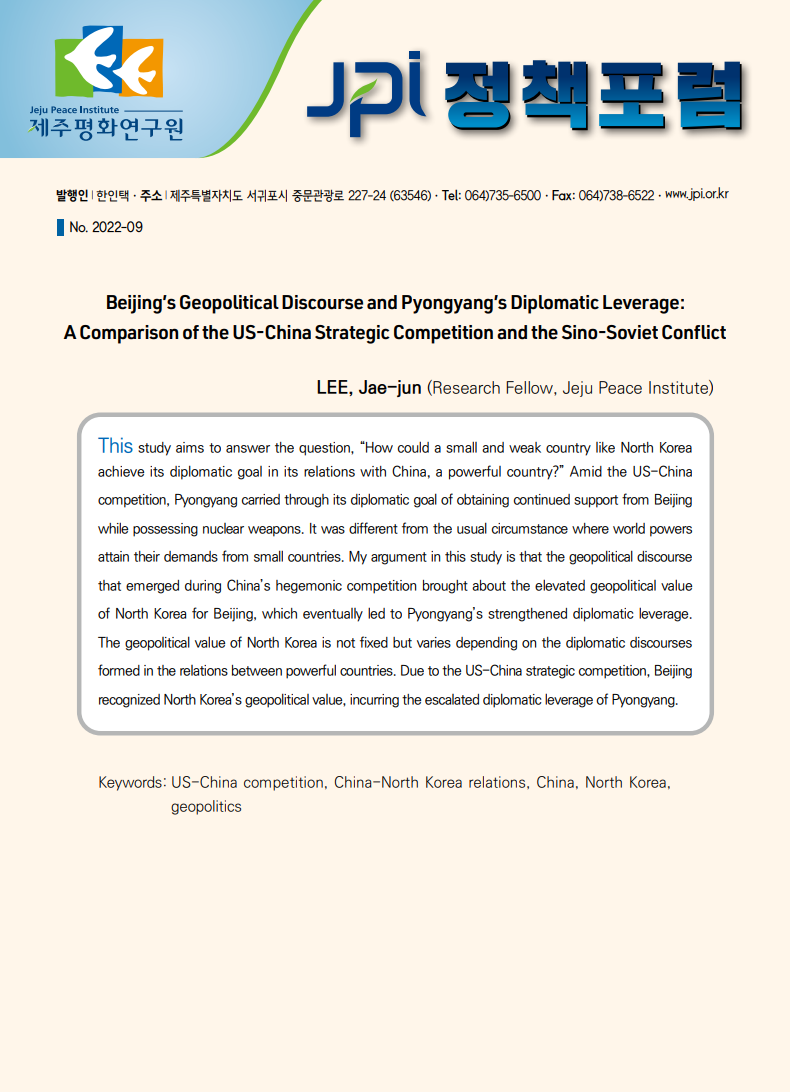
LEE Jae-jun (Jeju Peace Institute)This study aims to answer the question, “How could a small and weak country like North Korea achieve its diplomatic goal in its relations with China, a powerful country?” Amid the US-China competition, Pyongyang carried through its diplomatic goal of obtaining continued support from Beijing while possessing nuclear weapons. It was different from the usual circumstance where world powers attain their demands from small countries. My argument in this study is that the geopolitical discourse that emerged during China’s hegemonic competition brought about the elevated geopolitical value of North Korea for Beijing, which eventually led to Pyongyang’s strengthened diplomatic leverage. The geopolitical value of North Korea is not fixed but varies depending on the diplomatic discourses formed in the relations between powerful countries. Due to the US-China strategic competition, Beijing recognized North Korea’s geopolitical value, incurring the escalated diplomatic leverage of Pyongyang. -

- By
- HAN Intaek, KOBAYASHI Somei, KIM Sang Kyou
- Vol
- 2018-7/8/9
HAN Intaek (Director of Research, Jeju Peace Institute), KOBAYASHI Somei (Associate Professor, Nihon University), KIM Sang Kyou (Professor, Institute of Chinese Studies, Hanyang University)Public Opinions in the US and Public Diplomacy toward the USAs North Korea has developed nuclear missiles to the extent that they could threaten the United States, the American public has come to recognize the North Korean threat clearly and map out how to respond to it. Therefore, they can no longer be approached merely in terms of “knowledge public diplomacy” or “cultural public diplomacy.” It is time to carry out “policy public diplomacy” to communicate with them and coordinate the policies of the two countries.According to an opinion poll, the American public seem to have a shared supra-partisan consensus about the North Korean nuclear threat, the importance of the ROK-US alliance, and countermeasures needed to counter North Korea’s nuclear weapons. Even if the Democrats call the tune by seizing control of the House of Representatives after the midterm elections, they are unlikely to bring any unexpected change to U.S. policy toward North Korea.According to a survey, Americans support the establishment of diplomatic ties with North Korea, or a partial withdrawal of U.S. troop from the South as a compensation measure for North Korea’s nuclear disarmament but remain lukewarm toward economic support for the North and disapprove of a total withdrawal of U.S. forces from the Korean peninsula. South Korea should bear this in mind when engaging in negotiations to denuclearize the North and pursuing public diplomacy.Changes in Chinese Perceptions of Korea and Korea’s Policy in ResponseKorea and China are closer to each other than any other in terms of cultural similarity, geographical proximity and shared historical experiences. However, after the Korean War, they cut off bilateral relations. The reduction of military threats following the end of the Cold War accelerated the normalization of relations between neighboring countries amid the post-Cold War changes in the international community. South Korea and China were in need of bilateral cooperation since Korea had to improve inter-Korean ties through its northern policy to stabilize and unify the Korean peninsula, while China had to carry out its reform and door-opening policies. Such strategic motives led to the normalization of diplomatic relations in 1992, and to a deeper economic interdependence through continued expansion of trade with and investment in each otherWhile economic exchanges between them produced exponential growth, they started to experience friction and conflict. At the same time, historical issues worsened negative perceptions about each other. Furthermore, the security issue of a THAAD deployment almost dismantled the ties between Korea and China.The seriously negative perceptions about each other are feared to worsen these ties further. China is a significant political and economic stakeholder, exerting a powerful influence on Korean peninsula issues. Hence, it is essential to assess the potential impact of the Chinese perception of Korea, and carefully analyze any surface changes. South Korea should examine the fundamental factors behind changes in the perception of the Chinese public about Korea, and map out how to respond, accordingly.Japanese Social Sentiment about Korea: Public Opinions Mirrored in Mainstream Media on the Forced Labor of KoreansSince the second half of 2018, especially after the ruling by the South Korean Supreme Court on compensation for the forced labor of Koreans by the Japanese, social sentiment in Japan about Korea has sharply taken a turn for the worse. This research paper analyzed the news coverage of the ruling by mainstream daily newspapers in Japan to find out the opinions of Japanese society about Korea. Major nationwide newspapers have criticized President Moon Jae-in and his government, but there were differences in their critical tone and rationale. It is necessary to understand the diversity of public opinion in Japan before starting to communicate with the Japanese people and engaging in public diplomacy.As reported by the newspapers, there exists a gap between Korea and Japan in historical perception, with Japanese society remaining divided over the history issue as well. Hence, the two countries should acknowledge the differences and draw a roadmap that will allow them to get over indulgences in national sentiment about the past to the end of pioneering forward looking cooperation and development. Whether the roadmap can be shared by Korean and Japanese societies remains a future task for both of them.AuthorHAN Intaek (Director of Research, Jeju Peace Institute)KOBAYASHI Somei (Associate Professor, Nihon University)KIM Sang Kyou (Professor, Institute of Chinese Studies, Hanyang University) -
- By
- JUN Hae-Won, Kim Deuk-Kab, DOH Jong Yoon
- Vol
- 2018-2/3/6
JUN Hae-Won (Associate Professor, Korea National Diplomatic Academy), Kim Deuk-Kab (Visiting Professor, Institute of East and West Studies, Yonsei Univ.), DOH Jong Yoon (Chair of Regional Integration Program, Jeju Peace Institute)ROK and EU Crisis Management Operations as Global Security Partners (Politics / Security)At the end of 2016, an agreement on a crisis management framework between the Republic of Korea (“Korea”) and the European (“EU”) was put into effect. This agreement established a legal foundation for Korea’s participation in the EU’s crisis management operations. This agreement expanded upon existing forms of cooperation that mainly permitted dialogue by allowing Korea and the EU to operationally cooperate in political and security matters. The EU’s crisis management operations are conducted to prevent conflicts, maintain peace, and respond to terrorism, growth in the number of weapons of mass destruction, regional conflicts with international effects, failed states, and organized crime. The EU’s crisis management operations are joint response activities conducted at the level of the entire EU to promote multilateralism by complying with the UN Charter and to prevent conflicts by responding with both military and non-military methods. Such operations are categorized as either military or civilian missions.Beginning in March 2009, Korea assigned the Cheonghae Unit to serve as a member of combined naval forces to eliminate Somalian piracy. However, in February 2017 Korea and the EU began to directly cooperate militarily in crisis management when Korea sent the Cheonghae Unit to participate in the EU’s NAVFOR ATALANTA Somalia operation. Korea is a global shipping nation and about 25–30% of its goods transported via shipping passed through the seas near Somalia. As such, the security of the seas near Somalia was directly connected to Korea’s national interests and so became a primary motive for Korea to cooperate with the EU in eradicating piracy in the region.Furthermore, Korea already had a deep understanding of the EU ATALANTA operation, which facilitated military cooperation between the two countries. In contrast, Korea and the EU are still working out how to cooperate over civilian crisis management.However, civilian crisis management operations occur on smaller scales than military crisis management operations, so pioneering of new methods of cooperation is easier in civilian operations than military operations.Korea’s participation in the EU’s crisis management operations is significant in terms of its ability to pursue crisis management goals that would be difficult for it to achieve alone, diversification of its international contributions, and the realization of its immediate interests. Crisis management cooperation with the EU helps Korea’s national interests by strengthening its crisis management capabilities through exchanges of experience and knowledge and by forming networks with EU experts.’ Establishing a Smart Partnership Between Korea and the EU in the Digital Age (Science Technology/ICT)The Fourth Industrial Revolution has seen many destructive innovations occur as the result of new technologies. Korea and the EU must strengthen their cooperation over ICT standardization, cyber security, and scientific and technological research and development. Korea spends 4.2% of its GDP on research and development, but only 20% of this amount is for the development of basic technologies. Korea’s global research and development network is also weak.The EU is currently conducting the Horizon 2020 program in order to develop critical technologies in six fields, including ICT, nanotechnology, and advanced materials. Korea has participated in the Galileo project and a 5G joint research project, but its participation in the Horizon 2020 project is relatively compared to that of similar countries due to a reliance on American and Japanese technologies, a lack of understanding of the EU’s research and development programs, language barriers, and the Horizon 2020 program’s structural limitations. The Korean government should use ICT technology as leverage for participating in research projects conducted in the EU in areas in which Korea is relatively uncompetitive, such as quantum computing, energy, and the environment. In order to make this possible, the Korean government also needs to the circumstances in which Korea can participate more in the Horizon 2020 program by signing a bilateral agreement with the EU, increasing its CFM budget, and improving its NCP system.Furthermore, in today’s ultra-connected society, internet of things (“IoT”) security specifically and cyber security generally along with interoperability and standardization are becoming increasingly important. The EU is currently standardizing big data, cloud computing, cyber security, IoT, and 5G technologies. In order to further strengthen cyber security, the EU is developing a cyber security certification system and the strengthening of the role of the EU Agency for Network and Information Security.Consequently, Korea and the EU must forge a smart partnership to better pursue their mutual interests in the IoT age.Korea and the EU must put in joint efforts to research and develop new technologies and to establish standards to improve the interoperability necessary to expand the IoT. Korea and the EU must work together to establish international regulations to block the expansion of digital protectionism in the name of personal information protection and cyber security. Challenges and tasks after the 2018 diplomatic visits to EuropeThe diplomatic visits to Europe must be approached from a different angle than the visits to the Korean peninsula’s four neighbors. Europe is a significant part of the multilateral global order and a major player in addressing emerging global security issues so it has its own characteristics and interests. This essay examines the appropriateness of President Moon’s discussion topics during his 2018 tour of Europe, whether he considered the systemic characteristics of the countries he visited, whether those countries’ sensitivities and vulnerabilities were accounted for, and whether his requests for them to play various diplomatic roles were made appropriately. In this context, President Moon’s 2018 European tour resulted in both successes and exposed future challenges. First, the Korean government’s calls to establish a peaceful order on the Korean peninsula and denuclearization discussions did not achieve the expected results because the relaxation of sanctions against North Korea and CVID were related to UN resolutions. Similar to its consistency in justifying its calls for sanctions against North Korea for the crises it has caused, the Korean government must also be consistent in its justifications for relaxing and lifting sanctions in multilateral diplomatic contexts. Second, in order to gain global support for peace on the Korean peninsula, the Korean government needs a strategy for assigning appropriate roles to the other parties involved in the peace dialogue by first deciding which theoretical framework it will request and in which European language it will make the request. Europe is still participating in the dialogue by criticism, pressure, and CVID. This participation-by-criticism role was established in response to the situation on the Korean peninsula before the 4/27 summit between North Korea and South Korea, so a new strategic framework is needed to replace this outdated role. The Korean government must actively articulate this new strategy in its requests to Europe. In multilateral diplomacy, rules, regulations, and systems are established through dialogue, so Korea’s diplomatic capability will be reflected in whether it can offer a new framework for discussing the road ahead in multilateral meetings such as ASEM. Third, the Korean government must consider action plans for addressing global interests, such as climate change, sustainable economic development, and renewable energy development. These issues will be the focus of the global order in the near future, so Korea must persistently contribute to the discussion of these issues on the global stage.AuthorJUN Hae-Won (Associate Professor, Korea National Diplomatic Academy)Kim Deuk-Kab (Visiting Professor, Institute of East and West Studies, Yonsei Univ.)DOH Jong Yoon (Chair of Regional Integration Program, Jeju Peace Institute) -
- By
- JUN Hae-Won, Kim Deuk-Kab, DOH Jong Yoon
- Vol
- 2018-2/3/6
JUN Hae-Won (Associate Professor, Korea National Diplomatic Academy), Kim Deuk-Kab (Visiting Professor, Institute of East and West Studies, Yonsei Univ.), DOH Jong Yoon (Chair of Regional Integration Program, Jeju Peace Institute)The Role of Neighboring Countries in the Denuclearization of the Korean Peninsula after the Summit Meetings and Future Prospects: U.S. Military tensions rose significantly on the Korean peninsula as a result of the 20 North Korean missile launches conducted in 2017. Eleven of these missile launches and North Korea’s sixth nuclear weapons test took place after President Moon took office and President Trump mentioned the possibility of a military strike against North Korea. However, the process of denuclearizing the Korean peninsula has begun with the Moon administration inviting North Korea to the Pyeongchang Winter Olympics, inter-Korean summit meetin gs on April 27 and May 26, and a North Korea-U.S. summit meeting in Singapore on June 12. The main objective of this paper is to analyze the U.S.’s foreign policy framework and the perspectives of the Trump administration as the U.S. is a major player in the process of denuclearizing the Korean peninsula.Despite the negative public sentiment and critique in the U.S. media, the Trump administration is showing fundamental trust in North Korea’s gestures toward denuclearization and is actively making diplomatic efforts to achieve a complete and irreversible dismantlement of North Korea’s nuclear program. While the U.S. is offering to ease sanctions in return for North Korea making more visible and tangible denuclearization efforts, President Trump has stated that denuclearization process will proceed without undue haste and not according to any particular time table. The Role of Neighboring Countries in the Denuclearization of the Korean Peninsula after the Summit Meetings and Future Prospects: China The security paradigm on the Korean peninsula is rapidly changing because of a new approach that is different from the existing international order as established by powerful nations. The two Koreas, which are the main parties involved in issues on the Korean peninsula, have been proactively working towards denuclearizing the Korean peninsula and the U.S. has actively responded to such efforts, resulting in the inter-Korean summit meeting in April 2018 and the U.S.-North Korea summit meeting in June 2018. Throughout the course of these two summit meetings, China expressed its desire to restore its relations with North Korea through three rounds of summit meetings and to become actively involved in issues on the Korean peninsula as an “interested party.”By holding the three rounds of summit meetings, North Korea and China were able to recover their relations to a large extent, and China-which used to be excluded in the process of inter-Korean summit meeting and North-Korea-U.S. summit meeting-was able to dismiss the notion of the so-called “China Passing (isolation of China)” while emphasizing that it will play an active role in the denuclearization and peace building efforts on the Korean peninsula. As China, which used to emphasize its role as a “mediator” in the denuclearization issue, is now stressing its role as an “interested party,” it is expected that it will more actively intervene in future efforts on the end-of-war declaration and building a peace regime. The Role of Russia in the Denuclearization of the Korean Peninsula after the Summit Meetings Based on the discussions currently being had between the two Koreas and between North Korea and the U.S. about denuclearizing the Korean peninsula, it may seem as if every problem can be easily solved through negotiations between North Korea and the U.S. However, if we refrain from this type of wishful thinking and view the situation from multiple perspectives, it is clear that China, Russia, and Japan are important stakeholders as neighbors to the Korean peninsula. Russia directly borders the Korean peninsula and was one of the states directly involved in the decision to divide the two Koreas following the Korean War. It also serves as an ultimate guardian of North Korea’s independence and supports the security of the North Korean regime. Of North Korea’s four neighbors, Russia is the most active supporter of denuclearizing the Korean peninsula and of normalizing the North Korean state. This paper discusses Russia’s stances and strategies with regard to the denuclearization of the Korean peninsula. Russia intends to be a main actor in the denuclearization process and to reorganize the political and military order of Northeast Asia to maintain peace through multilateralism. Russia already has successfully mediated between countries involved in major regional conflicts, such as during the nuclear negotiations with Iran or the Syrian civil war.In May, Vladimir Putin was inaugurated as the Russian president for the fourth time with a term of six years. When starting his third term as president in 2012, Putin pushed an ambitious plan of building a Eurasian modeled on the European that would encompass all of the regions that constituted the former Soviet and of achieving economic development through the New East Policy. However, after the Ukraine crisis broke out in November 2013, Russia has been facing stringent economic sanctions which have increased in the wake of Putin’s annexation of Crimea. These sanctions are the reason why Russia currently has such a strong interest in realigning the political order in northeast Asia.The Moon administration that took office in 2017 aims to maintain peace and opportunities for prosperity for both North and South Korea and throughout northeast Asia through its New Northern Policy. President Putin may be able to seize new opportunities in northeast Asia and on the Korean peninsula that can serve as substitutes for the exchanges that Russia used to have with Europe, which have decreased significantly since the Ukraine crisis. These opportunities are why Russia is paying keen attention to and trying to play a leading role in the denuclearization of the Korean peninsula. This paper analyzes the foundations of Russia’s diplomatic policy, its close relations with North Korea, how it intends to promote denuclearization, and its potential for cooperating with South Korea.AuthorJUN Hae-Won (Associate Professor, Korea National Diplomatic Academy)Kim Deuk-Kab (Visiting Professor, Institute of East and West Studies, Yonsei Univ.)DOH Jong Yoon (Chair of Regional Integration Program, Jeju Peace Institute) -
Emerging Nuclear Order in Northeast Asia and the Possibility of Nuclear Weapon Free Zone View Count 6
- By
- CHEON Seong Whun (Visiting Researcher, The Asan Institute for Policy Studies)
- Vol
- 2017-12
CHEON Seong Whun (Visiting Researcher, The Asan Institute for Policy Studies)Despite the NPT’s contribution to preventing global nuclear proliferation, North Korea’s nuclear armament has emerged as a threat to the international nuclear nonproliferation regime and the existing nuclear order in Northeast Asia that has complied with it.South Korea will be able to exercise its initiative as a nuclear disarmament leader in Northeast Asia or on the global level by resolving the North Korean nuclear issue through mutual disarmament. Considering that China does not possess tactical nuclear weapons and Japan is a non-nuclear nation, the denuclearization of the Korean Peninsula could develop into a ‘Northeast Asia Tactical Nuclear Restrictive Zone,’ as well as expanding into ‘Tactical Nuclear Weapon Dismantlement Treaty’ discarding tactical nuclear weaponsaround the world, including Russia and the EU to the west of the Ural Mountains.The situation in Northeast Asia, where South Korea must respond to North Korea’s nuclear challenges with tactical nuclear weapon redeployment or its own nuclear armament card, is not suitable for discussing the denuclearization zone. Nevertheless, it is still desirable to promote the Northeast Asia Nuclear Weapon FreeZone from a long-term perspective in connection with the resolution of the North Korean nuclear issue.Tactical nuclear weapon redeployment is a one-step back for two-step forward, i.e. the Northeast Asian Nuclear Weapon Free Zone, and the ultimate goal of tactical nuclear weapon redeployment is to simultaneously discard both countries’nuclear arsenals by proposing nuclear disarmament negotiations between the two Koreas after redeployment.South Korea will be able to exercise its initiative as a nuclear disarmament leader in Northeast Asia or on the global level by resolving the North Korean nuclear issue through mutual disarmament. Considering that China does not possess tactical nuclear weapons and Japan is a non-nuclear nation, the denuclearization of the Korean Peninsula could develop into a ‘Northeast Asia Tactical Nuclear Restrictive Zone,’ as well as expanding into ‘Tactical Nuclear Weapon Dismantlement Treaty’ discarding tactical nuclear weaponsaround the world, including Russia and the EU to the west of the Ural Mountains.AuthorCHEON Seong Whun (Visiting Researcher, The Asan Institute for Policy Studies) -
- By
- HAN Intaek (Director of Research, Jeju Peace Institute)
- Vol
- 2017-11
HAN Intaek (Director of Research, Jeju Peace Institute)Denuclearization through security assurance is an important policy alternative because economic sanctions have not yet led to denuclearization and military measures are too risky. As can be seen in the Ukrainian crisis, security assurance can be an empty promise, however. Therefore, in order to induce denuclearization through security assurance, it is desirable to promote a denuclearization zone treaty that the US, Russia and China participate in and ratify. If North Korea’s motive for nuclear armament is to disperse their domestic unrest and maintain the regime by generating the rally round the flag effect (diversionary nuclear proliferation), there is a limit in inducing denuclearization even through a perfect security assurance.Therefore, if the ‘diversion effect’ reaches the exhaustion point, North Korea will be more likely to engage in denuclearization negotiations.Therefore, if the ‘diversion effect’ reaches the exhaustion point, North Korea will be more likely to engage in denuclearization negotiations.AuthorHAN Intaek (Director of Research, Jeju Peace Institute) -
- By
- LEE Sam Sung (Professor, Hallym University)
- Vol
- 2017-10
LEE Sam Sung (Professor, Hallym University)As North Korea’s nuclear armament is being completed, discussions on military options such as pre-emptive strike, preventive war, and North Korean leaders’ elimination are intensifying inside and outside the US government. Discussions on South Korea’s independent nuclear armamentor the redeployment of US tactical nuclear weapons on the Korean Peninsula are being intensified. In addition, some discussions have been raised to accelerate the collapse of North Korea by intensifying military pressure. This article sheds light on the practical limitations of this military optionsdebate, and first of all, aims to reveal that a peaceful approach is the only option left for us.This article will summarize the content of the Korean Peninsula Peace Treaty as well as the key elements of the Northeast Asian Nuclear Weapon Free Zone Treaty. Starting from the discussions on the Denuclearization Zone that were raised in the existing East Asian civil society, this article harmonized the treaty with the Korean Peninsula Peace Agreement and critically revised the main content in order to increase the feasibility. Finally, this article examines the meaning of balanced diplomacy as the orientation of Korean diplomacy that can ensure peace on the Korean Peninsula by pursuing the peaceful resolution of the North Korean nuclear issue.This article will summarize the content of the Korean Peninsula Peace Treaty as well as the key elements of the Northeast Asian Nuclear Weapon Free Zone Treaty. Starting from the discussions on the Denuclearization Zone that were raised in the existing East Asian civil society, this article harmonized the treaty with the Korean Peninsula Peace Agreement and critically revised the main content in order to increase the feasibility. Finally, this article examines the meaning of balanced diplomacy as the orientation of Korean diplomacy that can ensure peace on the Korean Peninsula by pursuing the peaceful resolution of the North Korean nuclear issue.AuthorLEE Sam Sung (Professor, Hallym University) -
- By
- CHO Seong Ryoul (Senior Researcher, The Institute for National Security Strategy)
- Vol
- 2017-09
CHO Seong Ryoul (Senior Researcher, The Institute for National Security Strategy)If the current trends in Northeast Asia are maintained, it is expected that North Korea will acquire nuclear weapons, China will challenge the existing US-Russia-centered nuclear order, and Japan will gradually overcome domestic resistanceto nuclear weapon development.Considering the current situation of each country, it is truly difficult to promote the Northeast Asian Nuclear Weapons Free Zone at the government level. In this respect, there is a necessity to deepen the debate at the track 1.5 level as well as at the track 2 level.In order to realize the idea of the Northeast Asian Nuclear Weapons Free Zone, it is necessary to draw elements from the “Joint Declaration on the Denuclearization of the Korean Peninsula” that the Korean government has maintained and the “Four Pillars Nuclear Policy” that the Japanese government has maintained based on the basic framework and ideology of the Northeast Asian Nuclear Weapons Free Zone, and creatively combine them with the content of “9.19 Joint Statement” on the Denuclearization of the Korean Peninsula.Considering the current situation of each country, it is truly difficult to promote the Northeast Asian Nuclear Weapons Free Zone at the government level. In this respect, there is a necessity to deepen the debate at the track 1.5 level as well as at the track 2 level.AuthorCHO Seong Ryoul (Senior Researcher, The Institute for National Security Strategy) -
Regionalism after Liberalism: Challenges for Regionalism Following the Emergence of Brexit and Trump View Count 7
- By
- DOH Jong Yoon (Chair of Regional Integration Program, Jeju Peace Institute)
- Vol
- 2017-08
DOH Jong Yoon (Chair of Regional Integration Program, Jeju Peace Institute)The emergence of terrorism in various countries of the West in the 21st century and the global financial crisis that began on Wall Street in the United States in 2008 have created doubt toward the US-led neoliberal economic order across the world. Amidst these circumstances, the Brexit referendum of May 2016 and the victory of Donald Trump in the US presidential election of the same year have led numerous experts to voice the sense of threat that the liberal international order is facing a crisis. Indeed, the two most noteworthy phenomena within the international economy in early 2017 were Brexit and the changes in the US trade policy, which both represent a significant reflection of national interest.Regionalism is a political, economic and social process to induce regional cooperation through multilateralism and democratic governance based on globalism as the product of liberalism. Under this premise, this paper aims to discuss the direction of change in regionalism since the crisis of liberalism and our response, following the functional development of regionalism under the US-led international liberal reality and liberal foundation that had continued since the mid-20th century. This paper asserts that, whereas international relations prior to liberalism could be explained from a Hobbesian perspective and the mechanisms of liberalism were based on Millian and Lockian relations, international relations and regionalism after liberalism must be established through more reciprocal and horizontal relationships based on social, cultural and moral norms. In other words, this paper recognizes the need to surpass Hobbesian animosity and Lockian competition, perceiving the definition of relationships from a Kantian perspective as “friendship,” which may become a core challenge in the future. Recent discussions of “progressive liberalism” or “post-liberalism” advocate the need to restore economic justice and reciprocity, emphasize social solidarity and philanthropic relationships, break away from politics as a means to protect the vested interests of a powerful minority, share a sense of identity, allow civil society to become the mediator of harmony between the market and the state in order to transition toward a politics of many based on balanced interests. In conclusion, the concept of liberalism must present a new logical basis in response to the historical challenge that it faces, and strive to surpass material constraints in presenting the logic of altruism without contradictions, as opposed to the definition of ethical concepts for the logic and legitimization of self-interest. However, it cannot be overlooked that the issue of survival remains a fundamental part of international relations in reality. Nonetheless, this paper emphasizes that this factor does not necessarily connote a selective survival between life and death, but rather the realization of self-interest through autonomy. In the future, regionalism must contemplate its response to the dual challenges of enhancing autonomy and resolving the formation of competing blocs.AuthorDOH Jong Yoon (Chair of Regional Integration Program, Jeju Peace Institute) -
- By
- SUH Dong Joo (Senior Research Fellow, Institute for National Security Strategy)
- Vol
- 2017-07
SUH Dong Joo (Senior Research Fellow, Institute for National Security Strategy)The Putin government of Russia is enlarging its presence in international affairs by intervening in the Syrian civil war and the negotiation process to end the war, and by performing a leading role in the negotiations on Iran’s nuclear arms, after its annexation of Crimean peninsula in March, 2014. Russia has as its top priority the lifting of sanctions by the U.S. and the West on itself, while dealing with the North Korean nuclear and missile issues using its ties with the U.S. and China. After the inauguration of the Trump administration in January, 2017, attention was being paid to the future course of the U.S.-Russia relations which had been acutely worsened during the Obama administration. Along with the U.S.-China relations, the U.S.-Russia ties are the pivot of the world political and economic order and also serve as a barometer of the regional security in East Asia. The key agendas of the U.S.-Russia relations in the early days of the Trump administration were the Trump administration’s posture toward Russia; the personal ties of Trump and Putin; the hacking scandal involving the alleged Russian interference in the U.S. presidential election and its consequences on their ties; growing mistrust in each other; coexistence of the factors for cooperation and conflict; the hardline policy of the U.S. Congress toward Russia; tit-for-tat expulsion of diplomats; and Syrian civil war and the North Korean nuclear crisis. As regards the North Korean nuclear issue, the Putin government is seen as maintaining the position ① not to allow North Korea to possess nuclear arms ② to support the denuclearization of Korean peninsula ③ to oppose military action against North Korea and call for diplomatic solutions to the issue ④ demand unconditional reopening of the six-party talks and ⑤ agree with the measure to improve ties with the North to persuade its abandonment of nuclear arms.Noteworthy is the more active move of the Putin government, deviating from the standoffish stance, to get itself involved in the North Korean nuclear and missile issues. It is important for Seoul to substantiate its strategic partnership with Russia to tide over the complicated security crisis on the peninsula. First, the two countries need to secure common grounds and cooperate with each other, with a mind to not tolerate the nuclear threats of North Korea, denuclearize the peninsula and seek peaceful and diplomatic solutions. At the same time, Seoul is required to make efforts to utilize the intermediary role of Russia over the nuclear issue; take measures to follow up on the ROK-Russia summit meeting in Vladivostok; decouple the ROK-Russia relations from the U.S.-Russia ones; take note of the reorganization of the U.S.-China-Russia ties and activate the 1.5 track dialog channel; initiate the minilateral cooperation in the Northeast Asian region; expand the strategic communication channel with Russia; and activate public diplomacy toward Russia.AuthorSUH Dong Joo (Senior Research Fellow, Institute for National Security Strategy)


