


-
 홈
홈
-
Research
- Research Reports
Research Reports
Total 37
-

- By
- HAN Inteak(JPI)
- Vol
- 2015-02
Existing security strategies and institutions in Northeast Asia are becoming increasingly ineffective. Multilateral security cooperation is a promising alternative to existing security arrangements, as it has the potential to complement and even replace them. It is, however, difficult to launch multilateral security cooperation in Northeast Asia right away. If the experience of Europe and Southeast Asia is any guide, active multilateral security dialogues precede multilateral security cooperation. In this study, Track 1 security dialogues and Track 2 dialogues in the Asia-Pacific have been compared using the Dialogue and Research Monitor dataset. Analysis showed that the role and contributions of Track 2 dialogues may be lesser than some of their proponents have argued. Nevertheless, Track 2 dialogues are more than just ‘talk shops’ unlike their critics have argued. Track 2 dialogues addressed sensitive issues before Track 2 dialogues did, functioned as an alternative diplomatic route when official diplomacy was deadlocked, and helped participants to socialize in global norms, for instance. Also important, Track 2 dialogues guided Track 1 dialogues in the area of human security. If we can synergy between Track 1 dialogues and Track 2 dialogues, we can improve the quality of policies as well as promote international cooperation. It is therefore important to promote Track 2 dialogues as well as Track 1 dialogues. Contents Ⅰ. Introduction Ⅱ. Overview of Asia-Pacific Track 2 Multilateral Security Dialogue Ⅲ. Evaluation of Asia-Pacific Track 2 Dialogue Ⅳ. Track 2 Multilateral Security Dialogue for Northeast Asia -
- By
- YI Seong-Woo(JPI)
- Vol
- 2015-01
There has been a major transformation in the form of diplomatic relations. The summit diplomacy among and between the heads of states has extended its role in resolving major issues in international relations. Since South Korea is geographically situated between the major powers, the peace and prosperity of South Korea is to some extent dependent on external changes. Therefore, this research introduces a theory on summit diplomacy and applies the model to the Korean situation. There are seven factors that facilitate summit diplomacy: (1) the appearance of an unprecedented threat and crisis diplomacy (2) diplomatic policy as a new political tool (3) the importance of business diplomacy (4) extension of the international community and regionalism (5) conflict between career diplomats and politicians (6) concentration of power in the head of government and (7) technology development. Except for general factors, such as the last four variables, this research will apply the variables to Korean governments’ summit diplomacy concerning the major powers, notably the U.S., China, Russia, and Japan. Based on the analysis, this research presents the following findings: (1) An economic crisis, such as the IMF crisis, can override a security issue. However, as soon as an economic crisis is resolved, a security issue such as a nuclear threat will quickly appear and take over the policy initiative. (2) Regardless of any achievement, inter-Korean summit meetings are likely to be regarded as a policy tool for diverting public criticism from failures of domestic policy. (3) Although the summit diplomacy of South Korea can utilize both the multilateral and bilateral formats, the summit meeting appears to be a ceremonial protocol rather than a proper negotiation aimed at resolving a critical issue. (4) The extension of summit diplomacy is a reflection of the improved national power and prestige of South Korea. (5) Despite the increased role of South Korean summit meetings, there remain difficulties in coping with the relative power gap between South Korea and the major powers in order to achieve national reunification. Contents Ⅰ. Introduction Ⅱ. Theories on Summit Diplomacy Ⅲ. Application of Summit Diplomacy Theory in Korea Ⅳ. Conclusion: Policy Recommendations for Peace and Security through Summit Diplomacy -
Track II Diplomacy for Conflict Settlement & Cooperation Enhancement: Cases & Implications (Korean) View Count 7
- By
- HAN Intaek (JPI)
- Vol
- 2014-03
Contents I. From Asia Paradox to Peace & Cooperation II. Southeast Asia’s Multilateral Security Cooperation & Track II Diplomacy III. ASEAN ISIS IV. Other Regions’ Track II Diplomacy: CSCAP & NECAD V. Implications for the Northeast Asia Peace and Cooperation Initiative VI. Foreign Policy & Security Consultative Meeting for Research & Policymaking VII. Multilateral Security Cooperation: Why Europe and Southeast Asia are so different? VIII. Policy Considerations? -
Arms Race in East Asia & Peace on the Korean Peninsula: U.S.-China-Japan Relations & the Korean Peninsula(Korean) View Count 7
- By
- YI Seong-Woo (JPI)
- Vol
- 2014-02
Contents I. Introduction II. Arms Race in East Asia & Theoretic Background on East Asia’s Regional Order: Long Cycle Theory & Hegemonic Stability Theory III.East Asia’s Strategic Structure: Two Types of Danger IV. Conclusion: Policy Implications towards the Korean Peninsula? -
Korea-China-Japan: Characteristics of Nationalism & Conflict Resolution Measures(Korean) View Count 7
- By
- CHIN Haeng-Nam (JPI)
- Vol
- 2014-01
Contents I. Introduction II. Nationalism & Theoretic Considerations on Conflict III.Korea-China-Japan: Current State of Conflicts IV. Korea-China-Japan: Rise of Nationalism, background & characteristics V. Korea-China-Japan: Nationalism & Examining the Conflict’s Interaction VI. Korea-China-Japan: Responding the Rise of Nationalism & Conflict Resolution Measures VII. Conclusion? -
- By
- YI Seong-Woo (JPI)
- Vol
- 2013-03
East Asia is faced with diverse types of conflicts due to a complex mixture of cultural similarities, historical grievances, and geographical proximity combined with the interaction of the regional powers’ current domestic and international political and economic situations. East Asian countries have engaged in territorial disputes particularly what should be considered their sovereign islands. Conflicts over the interpretation of history, coupled with cultural disputes, have aggravated the territorial disputes, resulting in a vicious cycle disrupting regional cooperation in East Asia. Nowadays, territorial disputes are increasingly becoming the most significant issue in the international relations of East Asia. This study is intended to introduce the exact state of territorial disputes in East Asia, analyze their causes, pursue solutions to them, and present policy solutions to the conflicts. Specifically, this study will address the current state and causes of territorial disputes in East Asia along with potential solutions to the conflicts: the core of the Dokdo Island issue and strategic alternatives for Korea and Japan the core of the Northern Islands dispute and strategic alternatives for Russia and Japan, and the core of the Senkaku Islands dispute and strategic alternatives for China and Japan. Contents I. Multilateral Approaches to Sovereignty Issues of Disputed Islands in East Asia II. Scientific Understanding of Territorial Disputes: Development of Territorial Disputes on a Global Level III. Territorial Conflicts between Russia and Japan over the Kuril Islands IV. Strategies of China and Japan on the sovereignty dispute over Senkaku Islands and implications for international politics V. The Dispute on Dokdo Island and the Issue of Sovereignty between Korea and Japan VI. Pursuit of Multilateral Approaches to Territorial Disputes -
 On Peaceful Use of Cyber-Space (Korean) View Count 7
- By
- HAN Intaek (JPI)
- Vol
- 2013-02
Various types of online hazards from hacking to cyber warfare are emerging as current or potential challenges for the peaceful unification of cyber space. Cyber attacks have now become a new variable that could threaten stability and peace, just like conventional military attacks or terror attacks. Traditional studies on peace and security have limited implications in terms of the prevention or settlement of disputes that arise from a new source called cyber space. To identify new security threats and respond to them proactively, Korea needs to move forward from traditional security concepts to new ones with a positive attitude. What is important is that, because cyber space is “created” by participants, their perspectives and ideas can be self-fulfilled and realized in it. In other words, “An artificial environment, cyber space, is a boulevard built by our choice.”Depending on how we view and analyze cyber space, security threats or opportunities on cyber space can be looked at differently, with varying results. Therefore, underestimating and overestimating cyber space threats must be avoided. Contents I. Peace and Security in the Cyber Era II. Two Perspectives on Cyber Threats III. Alliance and Cooperation in Cyber Space IV. Conclusions V. Policy Consideration -
- By
- CHIN Haeng-Nam (JPI)
- Vol
- 2013-01
To boost its mass media public diplomacy, Korea needs to take the following strategic approaches: First, domestic media-related agencies and organizations need to establish governance that can maximize the synergy effects through balanced cooperation. Second, Korea needs to provide full support to foreign journalists so that they can cover the reality of Korea accurately and extensively as part of efforts to promote communication between Koreans and foreigners and deepen understanding between them. Third, Korea needs to discuss actively the idea of building a Korea-China-Japan joint TV station in Korea the gateway to Northeast Asia with China and Japan and promote the idea effectively. Fourth, as one of the world’s strongest middle powers, Korea needs to promote the establishment of a world-class 24-hour English news TV channel in the country given the world’s mega trends. Fifth, Korea needs to boost its efforts to present truths through the continued verification of facts, lest citizens’ voices become distorted or biased on social media. Contents I. Identification of Issues II. Theoretical Reviews of Media Public Diplomacy III. Current State and Tasks of Korea’s Media Public Diplomacy IV. The Current State of Overseas Media Public Diplomacy and its Implications for Korea V. Ways to Enhance Korea’s Media Public Diplomacy VI. Conclusions -
- By
- HAN Intaek (JPI)
- Vol
- 2012-03
National image is an aggregate conception that other governments and peoples have toward a given nation. It affects not only the competitiveness of a nation but also its efforts toward international cooperation in a significant way. Despite such importance, national image has hardly been addressed theoretically in the field of international relations. Thus, little is known about how national image is formed and altered, what practical impacts it has, and how best they can be utilized. Moreover, there is a dearth of empirical studies on the contents and features of the national image of Korea as perceived by the outside world. The same is true for empirical studies on the contents and features of the national images of foreign countries as perceived by Koreans. Therefore, this study aims at making contributions to easing the shortage of theoretical and empirical studies in Korea regarding national image by presenting data that the government can refer to for the establishment of national strategies in the area. Contents I. Introduction II. Middle Power Diplomacy III. Strategies to Boost National Integrity IV. Conclusions and Implications -
- By
- CHIN Haeng-Nam (JPI)
- Vol
- 2012-02
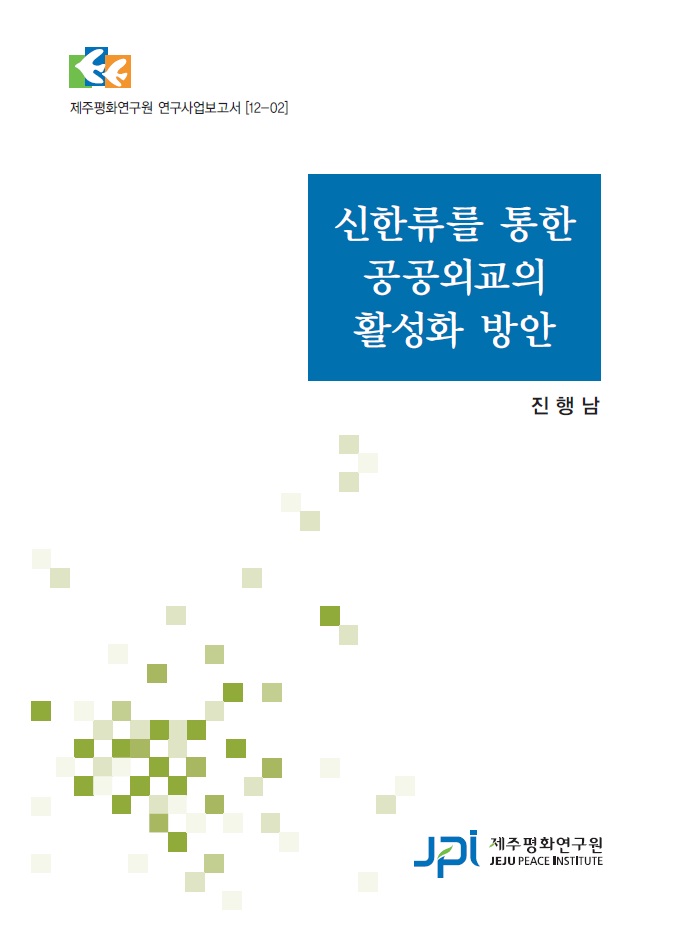
The “New Hallyu” centered on K-Pop is spreading around the world quickly beyond East Asia in line with the increased use of social media throughout the globe. Meanwhile, public diplomacy which targets the foreign public, unlike traditional diplomacy, and includes diplomatic activities carried out either by governments or non-government individuals or organizations ? is gaining increasing importance around the world nowadays. Against such backdrop, this study intends to present the policy alternatives required to connect public diplomacy to the New Hallyu, which is emerging as a supranational cultural phenomenon, and contribute to reinforcing Korea’s diplomatic capabilities. Contents I. Introduction II. Theoretical Reviews of Public Diplomacy III. Current State and Tasks of Korea’s Public Diplomacy IV. Overseas Public Diplomacy Promotion Cases and their Implications for Korea V. Evolution Processes of Hallyu and New Hallyu Phenomenon VI. Ways to Reinvigorate Public Diplomacy through the New Hallyu VII. Conclusions


