


-
 홈
홈
-
Publications
- JPI Archives
- Jeju Forum Journal
Jeju Forum Journal
전체 19건
-
- 저자
- Brendan M. Howe (Ewha Womans University)
- 발간호
- 2
Security is an increasingly contested concept in terms of referent object and the scope of issues covered in its conceptualization and provision. Traditional approaches have addressed the survival of states in a hostile operating environment focusing on questions of war and peace from the perspectives of national or systemic interstate security. Even if traditional approaches can be seen to have functioned reasonably well within the limited parameters of the old state-centric operating environment, they have fallen short in addressing new challenges to state and international security that do not originate from state actors. They have also proven to be very limited in their ability to embrace nontraditional security (NTS) perspectives relevant to the provision of human security for vulnerable individuals and groups, or biospheric security. Furthermore, there is a lack of understanding and consideration of the intersections and interdependencies between different levels of security analysis and policy provision. This paper, therefore, advocates a holistic model of understanding of the mechanisms of the contemporary security operating environment, and comprehensive policy prescription to address old and new security challenges, traditional and NTS issues, and the spillover between them.Brendan M. Howe is Professor of International Relations at Ewha Womans University GSIS. He researches on traditional and nontraditional security and has authored, co-authored, or edited 90+ publications including: UN Governance in Cambodia and East Timor (2020), Regional Cooperation for Peace and Development (2018), National Security, Statecentricity, and Governance in East Asia (2017), Peacekeeping and the Asia-Pacific (2016), Post-Conflict Development in East Asia (2014), and The Protection and Promotion of Human Security in East Asia (2013). -
 Jeju Forum Journal 2호 조회수 4
- 저자
- Min, Jeonghun (Korea National Diplomatic Academy), Robert Sutter (George Washington University, USA), Brendan M. Howe (Ewha Womans University)
- 발간호
- 2
Article ■ 2020 U.S. Presidential Election and Prospects for U.S. Policy toward East Asia ■ US Turn against China, 2020 Elections, Implications for South Korea ■ The Interdependencies of Security Conceptualization and Provision: National, Environmental, and Human(e) SecurityArticle 02 2020 U.S. Presidential Election and Prospects for U.S. Policy toward East Asia Min, Jeonghun (Korea National Diplomatic Academy) 12 US Turn against China, 2020 Elections, Implications for South Korea Robert Sutter (George Washington University, USA) 23 The Interdependencies of Security Conceptualization and Provision: National, Environmental, and Human(e) Security Brendan M. Howe (Ewha Womans University) -
- 저자
- Håvard Mokleiv Nygård (Peace Research Institute Oslo; PRIO)
- 발간호
- 1
The world is in turmoil. The corona-pandemic continues to take lives and disrupt daily lives across the globe. This happens against a backdrop of a declining US and western-based world order and a resurgence of authoritarian rulers. In this essay, I discuss the inability of the international community to respond to the pandemic, especially as it relates to helping countries in armed conflict. At the end of March, the UN Secretary-General issued an urgent plea for a worldwide ceasefire to help communities cope with the pandemic. The plea was not met with adequate international support. I moreover show that regimes across the globe have used the pandemic to restrict political and civil liberties. In sum, we risk emerging from the pandemic as a less democratic world. Dr Håvard Mokleiv Nygård (PhD, University of Oslo, 2014) is Research Director at the Peace Research Institute Oslo (PRIO). Nygård’s main research interests are related to understanding the causes, consequences and dynamics of armed conflict, contentious action, peacebuilding, and social order. His research has been published in inter alia the American Journal of Political Science, Journal of Politics, World Politics, Journal of Peace Research, Journal of Conflict Resolution, and World Development. Nygård regularly consults for various international organizations such as the World Bank, the United Nations Development Program, the Community of Democracies, the EU External Action Services, and the Human Security Report. -
- 저자
- Zhu Feng and Wang Xiaotian (Nanjing University)
- 발간호
- 1
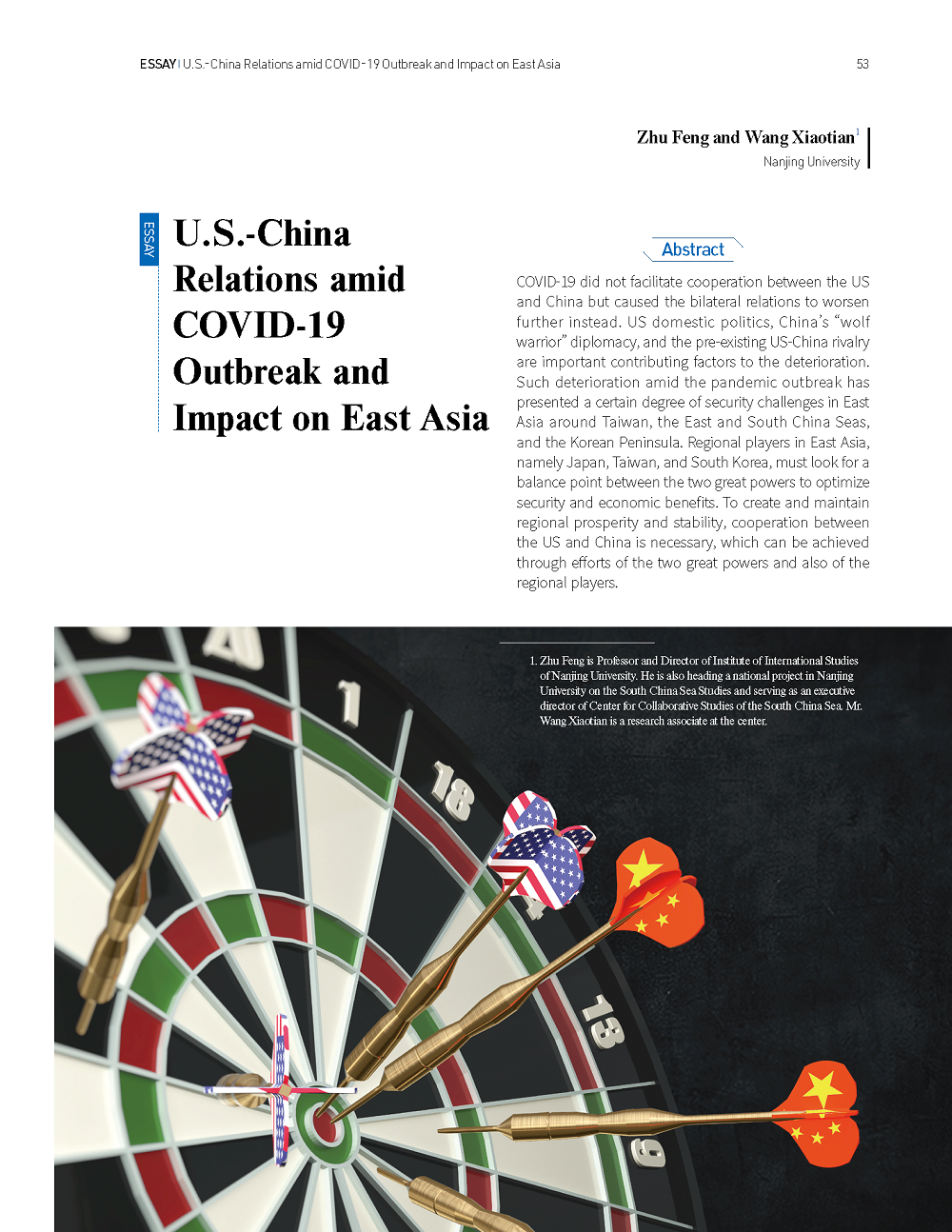
COVID-19 did not facilitate cooperation between the US and China but caused the bilateral relations to worsen further instead. US domestic politics, China’s “wolf warrior” diplomacy, and the pre-existing US-China rivalry are important contributing factors to the deterioration. Such deterioration amid the pandemic outbreak has presented a certain degree of security challenges in East Asia around Taiwan, the East and South China Seas, and the Korean Peninsula. Regional players in East Asia, namely Japan, Taiwan, and South Korea, must look for a balance point between the two great powers to optimize security and economic benefits. To create and maintain regional prosperity and stability, cooperation between the US and China is necessary, which can be achieved through efforts of the two great powers and also of the regional players. Zhu Feng is Professor and Director of Institute of International Studies of Nanjing University. He is also heading a national project in Nanjing University on the South China Sea Studies and serving as an executive director of Center for Collaborative Studies of the South China Sea. Mr. Wang Xiaotian is a research associate at the center. -
- 저자
- Yves Tiberghien (University of British Columbia)
- 발간호
- 1
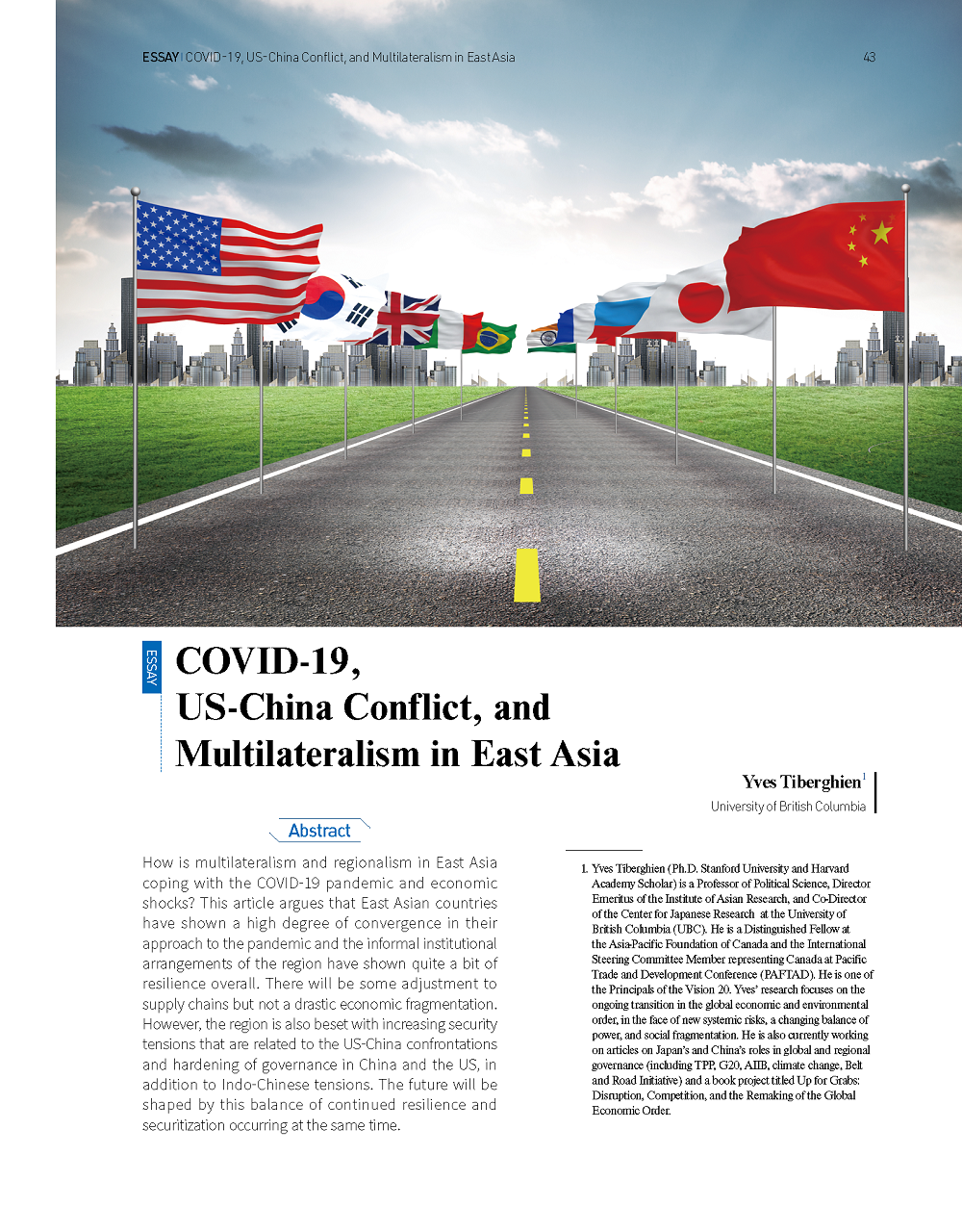
How is multilateralism and regionalism in East Asia coping with the COVID-19 pandemic and economic shocks? This article argues that East Asian countries have shown a high degree of convergence in their approach to the pandemic and the informal institutional arrangements of the region have shown quite a bit of resilience overall. There will be some adjustment to supply chains but not a drastic economic fragmentation. However, the region is also beset with increasing security tensions that are related to the US-China confrontations and hardening of governance in China and the US, in addition to Indo-Chinese tensions. The future will be shaped by this balance of continued resilience and securitization occurring at the same time. Yves Tiberghien (Ph.D. Stanford University and Harvar Academy Scholar) is a Professor of Political Science, Director Emeritus of the Institute of Asian Research, and Co-Director of the Center for Japanese Research at the University of British Columbia (UBC). He is a Distinguished Fellow at the Asia-Pacific Foundation of Canada and the International Steering Committee Member representing Canada at Pacific Trade and Development Conference (PAFTAD). He is one of the Principals of the Vision 20. Yves’ research focuses on the ongoing transition in the global economic and environmental order, in the face of new systemic risks, a changing balance of power, and social fragmentation. He is also currently working on articles on Japan’s and China’s roles in global and regional governance (including TPP, G20, AIIB, climate change, Belt and Road Initiative) and a book project titled Up for Grabs: Disruption, Competition, and the Remaking of the Global Economic Order. -
- 저자
- Stephan Haggard (University of California San Diego)
- 발간호
- 1
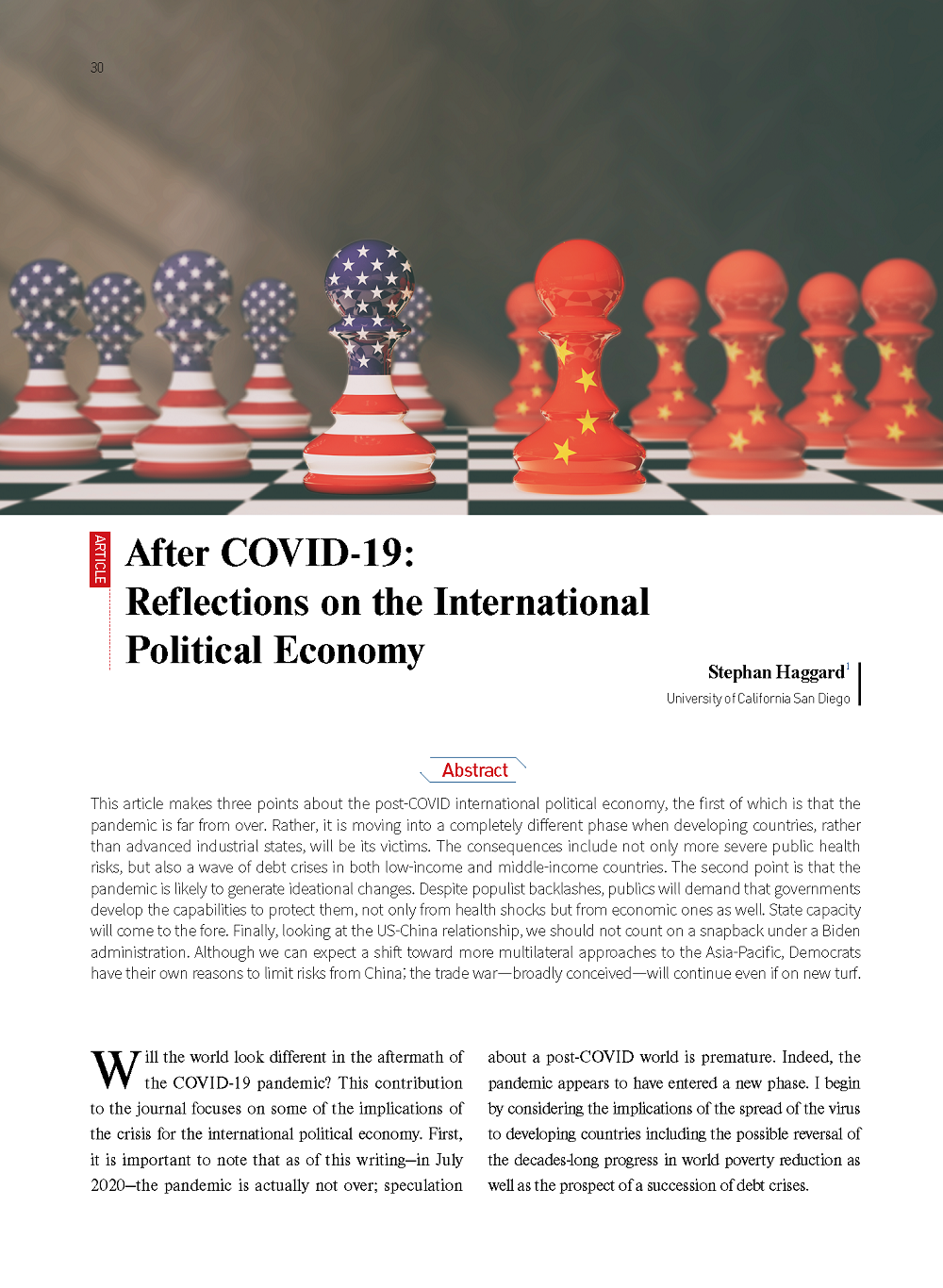
This article makes three points about the post-COVID international political economy, the first of which is that the pandemic is far from over. Rather, it is moving into a completely different phase when developing countries, rather than advanced industrial states, will be its victims. The consequences include not only more severe public health risks, but also a wave of debt crises in both low-income and middle-income countries. The second point is that the pandemic is likely to generate ideational changes. Despite populist backlashes, publics will demand that governments develop the capabilities to protect them, not only from health shocks but from economic ones as well. State capacity will come to the fore. Finally, looking at the US-China relationship, we should not count on a snapback under a Biden administration. Although we can expect a shift toward more multilateral approaches to the Asia-Pacific, Democrats have their own reasons to limit risks from China; the trade war—broadly conceived—will continue even if on new turf. Stephan Haggard is the Krause Distinguished Professor at the School of Global Policy and Strategy, University of California San Diego. His most recent work includes Hard Target: Sanctions, Inducements and the Case of North Korea (with Marcus Noland, 2017); Developmental States (2018); and Backsliding: Democratic Regress in the Contemporary World (with Robert Kaufman, forthcoming 2020). -
- 저자
- Moon Chung-in (Yonsei University)
- 발간호
- 1
The novel coronavirus (COVID-19) has spread rapidly around the world since it was first reported in the Chinese city of Wuhan in December 2019. As of late July 2020, the global number of confirmed cases has surpassed eighteen million, with fatalities reaching 700,000. None of the five oceans or six continents remain free of COVID-19 diagnoses. The pandemic has brought about unprecedented sudden impacts on people’s economic, social, and political life. International relations have been equally devastated by the pandemic, precipitating new discourse on world order in the post-COVID-19 era. After having examined five contending scenarios of future world order (walled cities and the new medieval age, Pax American II, Pax Sinica, Pax Universalis, and status quo of asymmetric US-China bipolarity), the article predicts that the status quo order is likely to continue in the post-coronavirus era. Fierce hegemonic rivalry between China and the US will pose a serious existential dilemma to South Korea. In order to cope with the challenge of the worsening status quo order, South Korea is required to seek a sagacious and resolute diplomacy backed up by a broad national consensus. Distinguished University Professor, Yonsei University and Vice Chairman and Executive Director, Asia-Pacific Leadership Network for Nuclear Nonproliferation and Disarmament (APLN). -
 Jeju Forum Journal 1호 조회수 4
- 저자
- Moon Chung-in (Yonsei University), Stephan Haggard (University of California San Diego), Yves Tiberghien (University of British Columbia), Zhu Feng and Wang Xiaotian (Nanjing University), Håvard Mokleiv Nygård (PRIO)
- 발간호
- 1
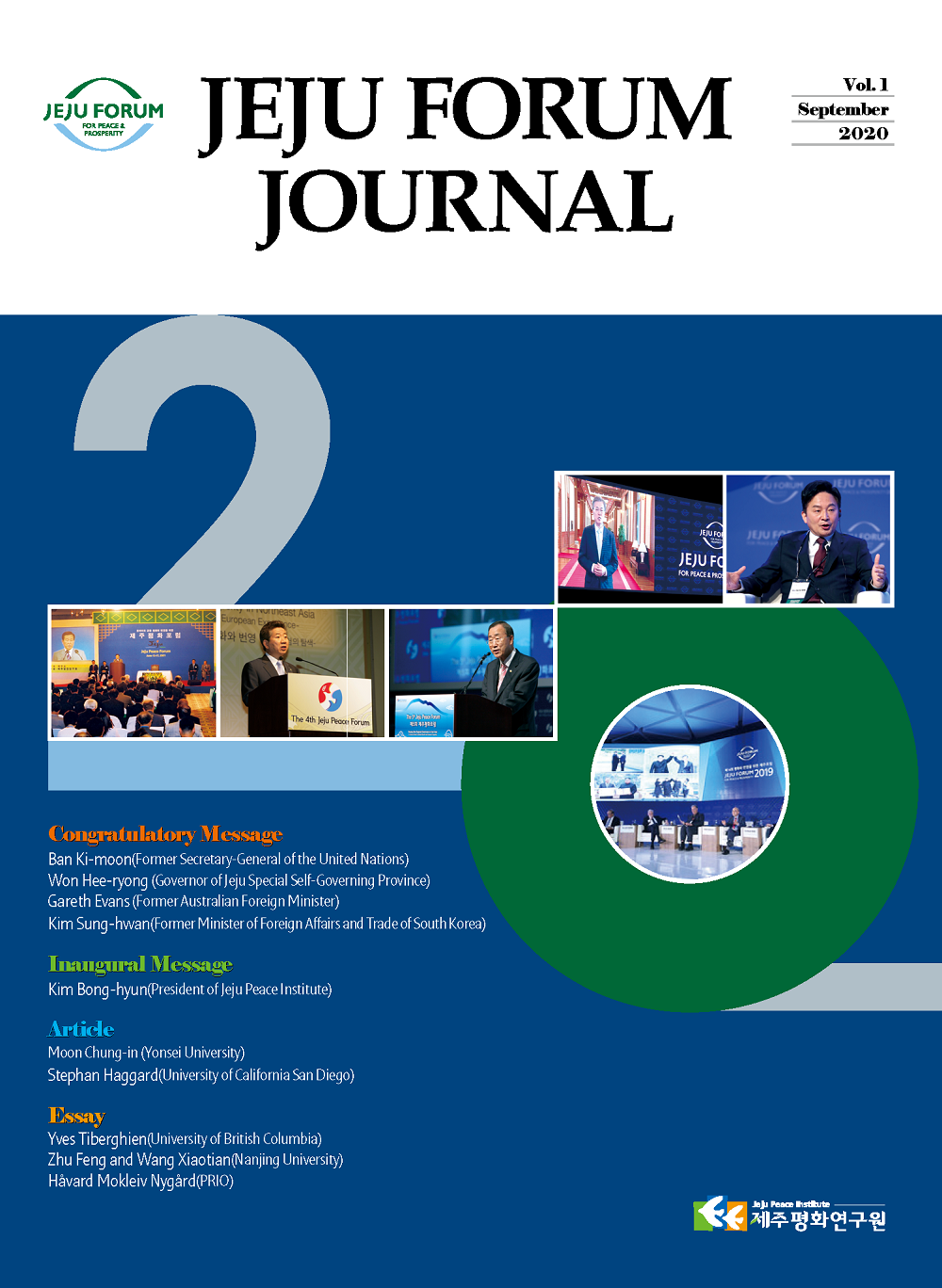
Editor's Note Since 2001, the Jeju Peace Institute (JPI) has played a major role in hosting and organizing the Jeju Forum. We have invited prominent scholars, politicians, diplomats, and activists to discuss various issues like peace and prosperity, multilateralism, and establishing regional peace community in East Asia. By launching the Jeju Forum Journal, which will supersede the Jeju Forum Alumni News, the JPI intends to extend the opportunity to discuss these significant issues throughout the year. Specifically, the Jeju Forum Journal intends to publish manuscripts discussing today's most pressing global issues and events (i.e., events that are expected to have severe repercussions on relations between states; foreign policies of certain states that can affect other states’ actions; and other issues that are widely discussed among public, scholars, and global leaders today), so our readers can better understand the environment and circumstances surrounding East Asia and the world. The main theme of our first issue is "After COVID-19," a timely subject as the spread of COVID-19 continues to affect the daily lives of people around the world. Moon Chung-in of Yonsei University, Stephan Haggard of University of California San Diego, Yves Tiberghien of University of British Columbia, Zhu Feng and Wang Xiaotian of Nanjing University, and Håvard Mokleiv Nygård of Peace Research Institute Oslo (PRIO) made contributions to this first issue. They have shared their knowledge and insights regarding the impact COVID-19 had on the world so far and how it is going to shape the future of multilateralism, democracies, US-China relations, and East Asia. (We want to notify that the Jeju Forum Journal is committed to political neutrality and that the manuscripts in our publication do not represent our official views. By providing a platform to discuss such matters, the Jeju Forum Journal aims to lead the global discourse in promoting multilateral cooperation, peace, and prosperity across the world. Chung Seung-chul Research Fellow, Jeju Peace Institute Congratulatory Message 03 Ban Ki-moon(Former Secretary-General of the United Nations) 04 Won Hee-ryong(Governor of Jeju Special Self-Governing Province) 05 Gareth Evans(Former Australian Foreign Minister) 06 Kim Sung-hwan(Former Minister of Foreign Affairs and Trade of South Korea) Inaugural Message 07 Kim Bong-hyun(President of Jeju Peace Institute) Editor's Note 08 Chung Seung-chul(Research Fellow, Jeju Peace Institute) Article 10 Moon Chung-in(Yonsei University) 28 Stephan Haggard(University of California San Diego) Essay 41 Yves Tiberghien(University of British Columbia) 51 Zhu Feng and Wang Xiaotian(Nanjing University) 64 Håvard Mokleiv Nygård(PRIO) -
 萨德(THAAD)是否会成为中国的威胁? 조회수 5
- 저자
- 禹政烨(峨山政策?究院)
- 발간호
- 2015-10
[编者语]习近平主席与朴槿惠总统执政后,韩中关系得到了前所未有的紧密发展。但是近来,韩国部署萨德(THAAD)的可能性出现,这成为两国关系之间新的变因。为使围绕萨德的讨论能够建立于准确的事实与相互理解之上,JPI PeaceNet计划介绍各国对萨德的视角。期待中国读者的关注,也欢迎中国专家撰文投稿。 文章被采用后,将登载于JPI PeaceNet,同时还将支付一定的稿费。编辑:韩仁泽研究委员(ihan@jpi.or.kr) 据媒体报道,在2月4日的韩中国防部长会谈中,中国国防部长常万全对美国在韩国部署末段高空区域防御系统萨德(THAAD)表示了担忧。在2月5日的中国外交部例行记者会中,有人问到有关中国对韩半岛部署萨德的立场,中国外交部发言人洪磊回答:“希望有关国家从维护地区和平稳定和双边关系大局出发,慎重妥善处理有关问题”,“关于反导问题,中方的立场是一贯的、明确的。我们认为,任何国家在谋求自身安全时,要顾及别国安全利益和和平稳定。”2014年7月,习近平主席同朴槿惠总统在首尔举行韩中首脑会谈时,习近平主席也直接谈及导弹防御系统问题,举出“主权国家的逻辑”,表明了对韩半岛部署萨德的消极立场。习近平主席的逻辑是,美国以美军的保护为名义在韩国部署萨德时,韩国作为主权国家应表明反对意见。 韩国政府对中国反对在韩国部署萨德的理由做出了解释性的反驳;此外,一些媒体发表文章解释称,萨德的部署实际上有可能影响中国的安全,到头来也会给韩国带来不好的影响。所以,我们有必要纠正对萨德,更进一步说则是对导弹防御系统的整体认识。 2008年,驻韩美军司令官沃尔特•夏普在出席美国参议院军事委员会听证会时提出了建立包括萨德在内的防御系统的必要性;2011年,驻韩美军司令官詹姆斯•瑟曼在议会听证会中谈及部署萨德的必要性,萨德从此成为了争论的焦点。 2014年6月,柯蒂斯•斯卡帕罗蒂司令官在演讲中表示,“已(向美政府)要求部署‘萨德’”,使此话题再一次成为热点问题。尤其,有一部分言论认为,韩国部署萨德意味着加入美国导弹防御系统,所以这一问题脱离了它的本质,变成了一个政治问题。 为了明确“编入美国导弹防御系统”或“加入美国导弹防御系统”这些模糊的定义,首先应考察美国在导弹防御上的战略性、政策性概念。在考察过后才能得知,美国的导弹防御系统究竟会不会成为威胁中国安全的因素,以及萨德作为导弹防御系统的末端组成部分,中国是否有必要担忧。 如何理解萨德(THAAD)? 理解美国导弹防御系统的关键词之一就是“防御针对本土的有限弹道导弹攻击(defending the territory of the United States against limited ballistic missile attack)”。这一说法被提出后经历了数次的发展与变化,现在美国的导弹防御系统的目的有以下几点。(1)保护美国国土免遭来自包括核武器在内的大量杀伤武器、传统弹道导弹攻击;(2)保护在外美军(包括基地、兵站、指挥部、军人)免遭以上攻击;(3) 保护美国的同盟国、伙伴免遭以上攻击;(4) 防御因事故或未经允许发射的弹道导弹的攻击。 这里需要注意的是,来自俄罗斯与中国的大规模攻击并非导弹防御的对象。关于导弹防御通常会出现的典型错误是就是导弹防御的目的,也就是将美国的导弹防御误认为针对俄罗斯与中国。美国导弹防御的目的是对现在已估算的美国、NATO、俄罗斯、中国控制之外的约6300个弹道导弹的防御。 从“意图”与“能力”两个层面来分析,可以认为美国导弹防御系统的对象是将俄罗斯与中国排除在外的。 美国是否具有以俄罗斯和中国为对象组建导弹防御的意图?美国的导弹防御从引入这一概念开始,围绕这一问题的争论就从未间断。从战略考虑来看,目前美国的导弹防御还未考虑到建立对俄罗斯与中国的弹道导弹的防御系统。美国强调,俄罗斯和中国与美国之间的战略平衡不会因为在欧洲和亚洲部署导弹防御系统而改变,其理由如下:战略上,建立以大国为对象的导弹防御系统会引发非常消耗性的军备竞赛。当一方越是试图建立导弹防御系统,另一方则会为使其防御系统丧失能力,增加用于攻击的武器系统。所以,建立以大国为对象的导弹防御系统,从战略上反而会给美国带来不利的结果。其次,导弹防御系统的建立会导致对方改变战略计算,增加战争的可能性。如果建立了导弹防御系统,在受到攻击后进行反击时,会担心自己的反击因对方的防御系统而失去意义,这就造成了要先发制人进行攻击的诱因。这最终会导致战略上的互不信任,产生从这一逻辑出发先发制人的攻击更为有利的想法,这其实不符合美国的战略利益。 从“能力”的层面来看,以俄罗斯和中国为对象建立导弹防御系统目前还毫不现实。考虑到俄罗斯与中国拥有的核弹头与弹道导弹能力,当出现军事冲突的时候,完全无法防御来自俄罗斯或中国的大规模攻击。假如有100个导弹发射过来,考虑到现在的技术能力,乐观估算即使能够击落70%,那么仍然有30个导弹能够攻击目标,所以导弹防御是完全没有意义的。这与未成功击落几个导弹而重新尝试拦截的状况完全不同。此外,如果考虑到部署导弹防御系统所需的天文数字般的费用,大国之间建立弹道导弹防御系统只会是填不满的无底洞。所以,目前对待俄罗斯与中国只能依赖相互遏制。中国也将相互脆弱性(mutual vulnerability)视为中美战略关系的基本。 下面讨论的是为什么萨德本身不会成为中国的威胁。首先来看国内认为萨德会成为中国的威胁的主张,这一观点认为由于萨德系统所需的X波段雷达,具体来说是AN/TPY-2 X-Band radar的探测距离较长(实际数据约达1000km),可以观察到中国的举动,美国便是出于这种目的才打算在韩国部署萨德。但是,日本已经部署了两台相似类型的AN/TPY-2雷达,而台湾则部署了被称为全球最强的雷达UHF long range EWR based on the AN/FPS-115 Pave Paws系统。台湾的这一雷达可以同时拦截3000公里以内的1000个目标物,台湾约花费12亿美元,从2004年开始部署,直到2009年才完工。在台湾和日本都已经部署了这种雷达的情况之下,说韩国引进的雷达将是美国用于监视中国的,这种主张的说服力是不充分的。 萨德的目标是为拦截中国的导弹这一主张已经失去根据,所以这里不再赘述。萨德的拦截是在弹道导弹再次进入大气层向目标物攻击的阶段,而不是在导弹发射后的上升阶段,或是在外大气层飞行的阶段进行拦截。 由于在上升阶段进行拦截的不现实性,美国已经停止了这一计划;对在外大气层飞行的导弹的拦截系统,目前正在美国国内部署中。萨德是进入我国领土内仅能对导弹使用的防御系统。 中国为什么反对萨德? 美国的弹道导弹防御系统既不是针对中国,也没有那样的能力,而且萨德本身也与中国无关,那么中国为何在这一问题上给韩国施加压力? 大体上可以解释为两点。 第一,考虑到现在的东北亚局势与韩国国内政治,中国很可能认为韩国是美国在东北亚同盟国中最弱的一环,将韩国视为美国同盟体系瓦解的起点。虽然韩美同盟并不会因为这一问题本身而瓦解,但是中国很有可能在今后通过一系列类似举动来削弱韩美同盟。国内已经出现一些支持中国反对在韩国部署萨德的声音。与美国不同,由于中国没有同盟国,所以美国同盟体系的削弱符合中国的战略目标,因此今后中国还会继续对韩国施加压力。通过向韩国施加压力,中国也在试探在韩美同盟问题上中国可以多大程度地对韩国施加压力。 第二,构建导弹防御系统是为了防止韩半岛现在的战略局势出现变化。北韩持续进行着弹道导弹开发与核开发,导致韩国在战略上处于十分不利的环境中。虽然通过美国的遏制扩张应对着北韩,但是如果比较韩半岛内的战斗力,由于北韩拥有导弹与核能力,所以呈现出一种有利于北韩的不对称。正因为这种不对称结构,才使北韩的各种强硬外交与挑衅行为成为可能。由于金正恩政权具有很难通过开放实现经济发展的特点,所以强硬外交与挑衅是政权存在的理由。在这种情况下,中国可能并不希望我们具备防御北韩导弹的能力而导致战略局势出现变化,换句话说,这种情况下北韩将难以继续强硬外交与挑衅。因为中国担心这种情况会引发北韩内部的不确定性和潜在不稳定性。 我们的应对方向 首先,萨德的部署还没有进行正式协议,或是作出决定。所以,应该表明萨德并不会给中国带来损失,与中国的战略利害无关;并强烈主张反倒是中国现在的态度只会被认为是偏护北韩。 第二,应该从萨德的部署意味着加入美国导弹防御系统这种没有根据的争论中摆脱出来,根据我们的安全情况、预算情况,以及最为重要的北韩导弹威胁能力来讨论究竟是否需要萨德。现有的韩国型导弹防御系统中并没有部署萨德的计划,所以我们应该跳出萨德的部署是美国的导弹防御这样一种奇怪的的逻辑,在北韩威胁日益变化的情况下,我们应该构建起一个应对性的导弹防御战略和政策,以应对超出我们目前导弹防御系统的北韩可能的攻击。 现担任峨山政策研究院华盛顿事务所所长。毕业于首尔大学经营学系,在美国乔治敦大学获得政策学硕士学位,在美国威斯康星大学密尔沃基分校取得政治学博士学位。现就职于美国南加州大学韩国学研究所,担任博士后研究员。主要研究领域为决策过程中的舆论问题、有关武力介入第三国内战的国际争端等。


