


-
 홈
홈
-
Publications
- JPI PeaceNet
JPI PeaceNet
전체 41건
-
 미얀마(버마) 선거와 한국의 전략 조회수 117
- 저자
- 장준영(한국외국어대학교)
- 발간호
- 2012-07
예상대로 미얀마 보궐선거는 아웅산수찌(Aung San Suu Kyi)가 이끄는 국민민주주의연합(NLD: National League for Democracy)의 승리였다. 내각 입각이나 의원직 상실 등으로 공석이 된 총 45개 상하원 및 지방의회 대표자를 선출한 본 보궐선거에는 17개 정당과 무소속 7명을 포함하여 총 157명이 출마했다. NLD는 1명을 제외한 43명의 출마자가 당선되는 그야말로 초유의 압승을 거두었다. 이런 분위기라면 2015년 총선에서 NLD가 당연히 원내 1당이 될 것 같지만 차기 총선까지 4년의 시간동안 민주화가 얼마나 진전될지는 미지수이기 때문에 현실은 녹록치 않다. 이를테면 스스로 병영으로 복귀하는 군부가 얼마나 될지, 민주세력 간의 수평적 연대는 가능할지, 집권 여당이 정치의 주도권을 장악하며 경제발전을 성공리에 추진하게 될 것이라는 예상외의 가능성도 있다. 본 보궐선거를 두고 아웅산수찌를 중심으로 한 민주인사들의 제도권 입성에 따른 민주주의의 첫 걸음이라는 한결같은 의의가 부여되었다. 그런데 필자는 2010년 총선과 같은 다양한 선거부정을 저지르고도 왜 여당이 맥없이 패배했는지 의문이 생기며, 그중 한 가지 답을 찾았다. 대통령과 선거위원회 위원장 등 주요인사는 금번 선거를 2010년 총선과 동일하게 ‘자유롭고 공정하게’ 치를 것이라고 약속했지만, 그 속성과 환경은 명백히 다르다. 즉 2010년 총선이 군복을 벗은 민간정부를 수립하기 위해 군부의 기준에 따른 ‘자유롭고 공정한’ 선거였다면, 금번 보궐선거는 미국과 유럽연합이 죄여 온 제재의 고삐를 느슨하게 풀기 위한, 다시 말해 자유로운 환경에서 NLD를 선택할 권리를 보장한 ‘자유롭고 공정한’ 선거였다. 그러니 2010년 군부의 기준에 따라 아웅산수찌와 NLD 후보가 낙선하고 여당 후보가 당선될 경우 정부가 야심차게 추진해 온 지난 1년간의 개혁은 일순간 물거품이 될 것이 뻔하다. 개혁을 통해 미얀마의 대외 이미지가 개선되었다고 하더라도 여전히 미국과 유럽연합의 대(對) 미얀마정책 결정은 아웅산수찌의 입장을 따르고 있으므로 정부와 여당은 독자적으로 제재 해제를 추진할 수 없는 태생적 한계에 봉착해 있다. 정부, 여당, 군부는 강압적 통제방식을 버리고 경제발전을 통한 이른바 ‘실적에 의한 정통성(performance legitimacy)’ 으로 정권을 유지하는 방식을 채택했다. 따라서 그들은 의회 주도권에 영향을 미치지 않는 44석과 제재 해제의 가능성을 맞교환한 합리적 게임을 했다고 보인다. 그러므로 2015년 총선까지 그들에게 주어진 4년은 아웅산수찌의 절대적인 영향력과 국민적 인기를 극복하기 위한 기간이자, 근대화를 통해 물질적 혜택과 복지를 국민에게 분배할 가능성을 전시함으로써 과거의 과오를 희석시키기 위한 기회의 시간이기도 하다. 본 보궐선거에서 경제제재와 관련된 어떠한 공략도 제시하지 않은 NLD는 제재 해제를 요구하는 정부의 입장에 적극적으로 동조하지 않을 것 같지만, 정책 결정의 열쇠는 아웅산수찌가 쥐고 있다. 그녀는 과거의 제재 고수 입장에서 다소 유연하고 탄력적으로 선회하기 시작했지만 여전히 경제제재와 국민의 경제적 고충 간의 개연성을 부정하는 NLD의 당론을 따른다. 아웅산수찌에 대한 맹목적인 신뢰도 한 몫을 했겠지만 국민들은 군부가 망친 경제문제의 해결을 위해 NLD를 지지했다고 본다. 그렇기 때문에 NLD가 국민의 목소리에 귀 기울이지 않는다면 민심 이반에 대한 책임을 고스란히 질 수밖에 없게 된다. NLD의 애매한 입장과 상반되게 미국과 유럽연합은 애초의 약속대로 경제제재를 포함한 제제의 수위를 완화하는 양상이다. 이미 미국은 클린턴 장관의 방문 이후 대리공사급에서 대사급으로 격상키로 한데 이어 세계은행(WB), 아시아개발은행(ADB), 국제통화기금(IMF) 등 국제금융기구들이 기술적으로 미얀마를 지원하는 방안도 허용했다. 유럽연합은 미국보다 한걸음 빨리 미얀마 당국자의 여행금지를 철폐하고, 향후 2년에 걸쳐 1억 5000만 유로(2,265억 원)를 지원하기로 약속했다. 금번 보궐선거에 대한 대가로 미국은 미얀마 당국자의 여행금지를 해제하고, 미국기업의 금융서비스 제공이나 투자를 촉진하기 위한 방안을 마련 중이다. 미얀마에 미국국제개발처(USAID) 사무소의 개설은 미국정부의 지속적인 원조를 시사한다. 매년 4월 미얀마에 대한 제재를 갱신하는 유럽연합은 제재 근거인 공동입장(Common Position)의 유효성을 신중히 재고하고 있으며, 유럽연합의 결정은 다음 달 의결되는 미국의 입장에 큰 영향을 미칠 것이다. 이제 한국은 군부의 고립과 봉쇄를 통해 정권 퇴진을 추구했던 서방국가들의 노선 변화에 주목해야 한다. 한국과 미얀마는 1975년 국교를 수립한 이래 곧 40년을 맞이하지만 공통적 관심사가 없었거나 우리의 수동적 시각으로 인해 지금까지 양자관계의 진전은 목도되지 않았다. 그러나 한국은 중국, 인도, 일본처럼 미얀마와 불편한 관계를 가진 국가들에 비해 후발성의 이점이 있고, 한류(韓流)는 한국의 긍정적 이미지를 축적해 가고 있다. 이에 따라 한국은 미얀마의 국내외적 구도를 정확히 파악하면서 아시아에서 한국의 위상과 외교 전략에 부합되는 대(對) 미얀마정책을 수립하고 앞으로 원칙으로서 지속성을 유지할 필요가 있다. 우선 미얀마를 둘러싼 주변국 관계를 고려할 필요가 있는데, 한국은 아시아 중견국으로서 미얀마를 두고 중국과 미국의 패권경쟁을 위한 구도에 휘말릴 필요가 없다. 오히려 미얀마가 회원국으로 있는 동남아국가연합(ASEAN)이 블록화를 추구하며 중국위협론에 공동 대응하고 있는 사실을 착안하여 아세안과 협력하는 차원에서 미얀마에 접근해야 하고, 그럴 경우 비동맹중립노선을 외교정책의 기조로 채택하는 미얀마는 한국에 대한 외교적 부담을 가지지 않을 가능성이 높다. 떼잉쎄인 미얀마 대통령이 공공연히 한국의 새마을운동과 경제발전 경험에 지대한 관심을 표명하고 있다는 사실에 주목해야 한다. 새마을운동의 경우 올해부터 공적개발원조(ODA)방식으로 지원 사업을 시작했는데, 한국의 개발경험을 그대로 이식시키는 것이 아니라 주민들에게 동기를 부여할 수 있는 맞춤형 형태로 변형할 필요가 있다. 미얀마는 반세기에 걸친 군부권위주의, 사회주의로 인한 타성에 젖은 업무처리 관행으로 인해 상명하달과 명령 등 수직적 관계가 지배적인 사회로 동기부여와 자발적 참여가 쉽지 않다. 따라서 한국의 새마을운동 전문가를 포함하여 미얀마전문가들이 현지를 직접 찾아 민관을 동시에 소통시킬 수 있는 분위기를 조성하는 기술이 필요하다. 나아가 주민들의 의욕을 고취시킬 수 있도록 인센티브제도 도입, 한국으로의 산업시찰, 취업자리 알선 등 다양한 사업과 연계하는 방안을 고려해야 한다. 국제사회가 미얀마의 경제발전만큼이나 민주화와 인권개선에 거는 기대도 크다는 점을 유념해야 한다. 세계에는 여전히 비민주국가들이 존재하지만 그 대부분의 국가들에는 노벨평화상 수상자 아웅산수찌와 같은 민주화를 위해 투신하는 재야인사가 거의 없다. 그렇기 때문에 미얀마는 야당과 국제사회의 지속적인 견제와 감시로 인해 군사정권시절 우리나라나 이웃 동남아 비민주국가들처럼 경제적 개발독재만을 추진할 수 없게 될 것이다. 따라서 한국은 정경분리원칙을 고수할 필요가 있으며, 두 영역 간에는 공통의 변수를 마련할 필요가 있다. 상업주의의 표상으로서 한류는 미얀마 국민들의 눈과 귀를 즐겁게 해 주는 일차적 외래문화일수도 있지만 한국의 역동적 근대사에 대한 관심을 유도하는 한류 콘텐츠를 적극 보급함으로써 미얀마 정치발전의 촉매가 될 수 있다. 언젠가 필자는 1980년 광주사태를 소재로 한 영화를 현지 지하운동가에게 보여준 적이 있는데, 첨단화된 도시 속 화려한 배우들만이 즐비한 한국의 현실만을 알았던 이들은 한국도 그들과 같은 아픔을 받았다는 사실과 함께 세계의 민주주의에 무지했다는 사실에서 큰 충격을 받았다. 2010년까지 한국은 미얀마에 550만 달러의 공적개발원조를 지원했다. 이제 미얀마의 가치가 더욱 부상함에 따라 한국의 대(對) 미얀마 원조액은 늘어나겠지만 증액만이 양자관계를 격상하는 결정요소는 아니다. 역사의 주인이자 찬란한 불교문화의 옹호자, 맹목적 민족주의로 무장한 군부들은 그들의 조국 미얀마가 국제사회에서 거지처럼 보이는 것을 무척이나 경계한다. 국민들은 당장의 생활고를 타파할 수 있는 외국의 도움을 필요로 하지 인터넷을 통해 외국에서 어떤 일이 벌어지고 있는지에 대해 별 관심을 두지 않고 있다는 사실을 알아야 한다. 이 글에 포함된 의견은 저자 개인의 견해로 제주평화연구원의 공식입장과는 무관합니다. * 장준영은 한국외국어대학교 동남아연구소 책임연구원. 한국외국어대학교에서 미얀마 군부의 정권유지 전략에 대한 연구로 국제관계학 박사학위를 취득함(2009). 미얀마 정치변동과 국가-사회관계, 동남아 국제관계 등에 관한 다수의 논문과 저서를 출판하였음. -
- 저자
- LEE Sun-Jin(Former Korean Ambassador to Indonesia)
- 발간호
- 2012-06
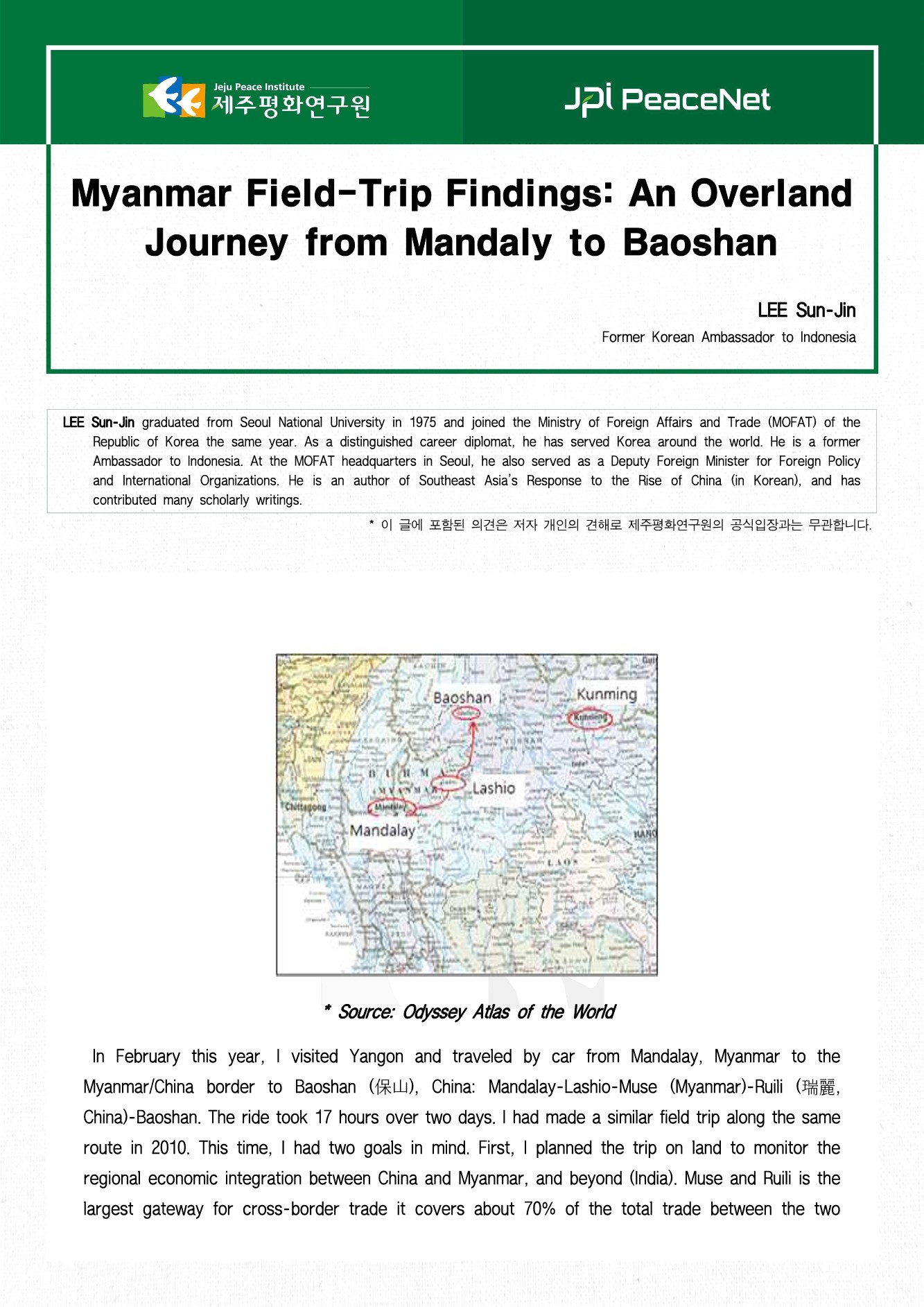
* Source: Odyssey Atlas of the World In February this year, I visited Yangon and traveled by car from Mandalay, Myanmar to the Myanmar/China border to Baoshan (保山), China: Mandalay-Lashio-Muse (Myanmar)-Ruili (瑞麗, China)-Baoshan. The ride took 17 hours over two days. I had made a similar field trip along the same route in 2010. This time, I had two goals in mind. First, I planned the trip on land to monitor the regional economic integration between China and Myanmar, and beyond (India). Muse and Ruili is the largest gateway for cross-border trade it covers about 70% of the total trade between the two countries. In addition, I wished to investigate hearsay reports on the large-scale projects that are currently being pursued by China in Myanmar. Findings (1) Myanmar-Kunming (昆明) Pipeline Construction in Progress. I witnessed many constructions sites, which were very close to the road: some within 100 meters or 1-2 kilometers away from the road I passed. Most of the sites were indeed visible from the road between “Pyin Oo Lin” (located about an hour-drive from Mandalay) to “Lashio” (located about an hour-drive before the border). I encountered repeated processions of trucks carrying construction materials such as large-sized pipes during my journey. In some sections, a pair of pipelines were completed with about 5-10 meters of space lying between them and about a half meter above the ground by my eye measurement. The pipelines have two usages: one for the crude oil imported by China from the Middle East or Africa and one for the gas explored by Korean Daewoo International in the Myanmar waters. According to informed sources, the project will be completed sometime next year, though not within the target date of May, 2013. A Chinese scholar told me that construction on the China side has already been completed. (2) Mandalay Kunming Railway Construction on Hold. Early last year, there was a news report that the government of Myanmar and China signed an agreement to build a railway connecting Myanmar and China along the pipeline route. They also agreed to improve and upgrade the existing road networks between Mandalay and Kunming. However, the new Myanmar government has not yet given a go-ahead signal. According to a rumor circulating in Yangon, China is planning to construct a railway in a space between the two pipelines, but the new Myanmar government is objecting to the idea. (3) Surge in Cross-border Trade. On the way to the border, I was amazed to witness the sharp increase in the cargo-carrying traffic on the road. In my previous trip, I had counted the number of lorry trucks (load capacity of 25 tons) coming from the opposite direction, from the border to Mandalay. The trucks carried heavy loads of international cargo (international cargo is easily recognized since it is fully covered and carried by lorry trucks). The number had been 40 lorry trucks per hour in 2010, but this time it had increased to 92. Surprised to see the surge in cargo traffic, I counted again in the afternoon. The number reached 110, which implies a two to threefold increase in 18 months since July, 2010. Trucks carrying construction materials for the pipeline project are not included in my estimates. I was told that 20-30% of shipments from China are diverted to India through Mandalay (of course, officially non-registered). Once the road connection between Mandalay-India is completed in the near future, the China-India trade via Myanmar (trilateral trade) will further expand. If the bilateral/trilateral border trade with China and India continuously grows, the Myanmar government will feel compelled to positively reexamine the aforementioned Mandalay-Kunming railway connection. (4) “Myitsone Dam” Project in Suspension In 2006, China and Myanmar signed an MOU on the hydroelectric power development project constructing seven dams along the Irawaddy River in Kachin State. The project is one of the largest dam construction projects in the world with the estimated total construction cost over USD 16 billion. However, the new Myanmar government announced the suspension of the dam construction in September, 2011 with an excuse that the local residents in the area were opposing the project. The announcement was in stark contrast with the position of the previous military junta, which had been resolute in implementing the project as scheduled. The junta had even sent a military unit to protect the construction sites where militia of the Kachin state used to enjoy self-governing power. The Kachin militia had tried to sabotage the construction and attacked military posts in defiance of the military presence in their area. Some Myanmar watchers interpret the government’s decision to suspend the project in two ways: first, the new government wishes to address the public concerns about growing economic dependency on China, and secondly, the position of the new government has become secure enough to be able to rebuff any possible counter-blow by the retired junta. (5) Democratization Process in Myanmar, “so far so good” The democratization process has been successful until now under the leadership of the highly popular President Thein Sein. A wide range of reform and open-door policies have been introduced and received favorably by the public, the opposition parties including Aung San Suu Kyi, and even the military. However, the new government is aware that such a democratization process will not be sustainable without matching economic performance. Moreover, peace accords with local militias are still volatile and many more challenges lie ahead. Myanmar Overview Myanmar is a strategic location for China China needs to cross Myanmar to reach Southwest Asia, the Middle East, and beyond. As such, the US and India will enhance their efforts to check China’s advancement in Myanmar. Under the circumstances, Myanmar will try to make use of these rivalries to promote democracy and economic development. In addition, ASEAN will also utilize the attention and assistance from the powers to promote ASEAN integration programs. Such play-making in this region could be the opening of a Pandora’s box. 이 글에 포함된 의견은 저자 개인의 견해로 제주평화연구원의 공식입장과는 무관합니다. * LEE Sun-Jin graduated from Seoul National University in 1975 and joined the Ministry of Foreign Affairs and Trade (MOFAT) of the Republic of Korea the same year. As a distinguished career diplomat, he has served Korea around the world. He is a former Ambassador to Indonesia. At the MOFAT headquarters in Seoul, he also served as a Deputy Foreign Minister for Foreign Policy and International Organizations. He is an author of Southeast Asia’s Response to the Rise of China (in Korean), and has contributed many scholarly writings. -
 2012 서울 핵안보정상회의: 인도의 시각 조회수 128
- 저자
- Rajaram PANDA
- 발간호
- 2012-04
2012년 3월 26~27일 이틀간 한국에서 핵안보정상회의가 개최되고 있다. 이번 정상회의에서는 테러리스트들이 핵무기를 획득하고 사용함으로써 발생하는 위험에 대해 중점적으로 논의할 것이다. 49개국의 교섭대표들이 지난 1월 16~17일 양일간 뉴델리에서 차기 정상회의 의제를 논의하기 위해 모였었다. 이 자리에서 인도 외무부 란잔 마타이(Ranjan Mathai) 장관은 “핵안보정상회의는 핵테러 위협에 대한 전 세계적인 경각심을 높이는데 그 목적이 있다”고 밝혔고 “핵안보라는 것은 근본적으로 개별 국가의 책임이지만, 핵안보의 목표 및 기준강화를 위한 국제협력이 필요하다”고 덧붙였다. 핵안보는 근본적으로 개별 국가의 책임이지만, 핵안보 강화나 불법거래 근절을 위해서는 국제협력이 필요하다. 한미 공동 주재로 핵안보정상회의 준비를 위해 뉴델리에서 개최된 사전 회의에선 서울 정상회의 참가국이 승인 할 사항에 대해 초점을 두고 논의를 이어갔다. 2010년 4월 워싱턴에서 열린 제1차 핵안보정상회의에서 47개국 정상 및 3개 국제기구(국제연합UN, 국제원자력기구IAEA, 유럽연합EU)의 대표가 국제안보의 가장 도전적인 과제인 ‘핵테러 위협’에 대해 논의했으며, 인류, 사회, 환경을 보호하기 위한 강력한 핵안보 조치를 취하기로 약속했다. 오바마 미국 대통령은 2009년 4월 프라하 연설에서 핵테러 방지를 위한 세계 정상의 단합을 촉구하고 “향후 4년 내에 전세계 모든 핵물질 사용에 대한 위험 가능성을 제거하고 핵물질을 안전하게 방호하기 위해서는 새로운 국제 공조가 필요하다”고 선언하였다. 핵안보정상회의는 국가의 수반이 참가하는 최고위급 안보회의로서, 21세기 국제안보에 가장 큰 위협인 핵테러를 방지하는데 공동의 목표를 두고 있다. 서울 핵안보정상회의 의제를 확정 짓기 위해 1월 뉴델리에서 소위 “교섭대표회의”라고 불리는 국제회의가 열렸다. 46개국 및 4개 국제기구(국제원자력기구IAEA, 국제연합UN, 유럽연합EU, 국제경찰INTERPOL)의 교섭대표가 당시 회의에 참석했다. 이 회의는 세간의 이목을 끄는 2012년 3월 ‘서울 핵안보정상회의’를 준비하는 일련의 회의 중 4번째 회의였으며, 부에노스아이레스, 서울, 헬싱키에서 열린 바 있다. 인도는 개발도상국 중 최초로 교섭대표 회의의 개최국이 되었다. 뉴델리 회의의 목표는, 테러단체의 핵무기 획득 가능성을 차단하고 세계 모든 핵물질 사용에 대한 위험 가능성을 제거하기 위해 이번 서울 핵안보정상회의에서 채택될 사안을 마무리 짓는 것이었다. 인도는 파키스탄에 있는 테러단체가 핵무기를 획득하는 것에 대해 우려하고 있으며, 특히 국가 무기고를 지키는 경비대원의 역할에 대해 염려하고 있다. 회의에 참석한 많은 참가국 대표들은 고농축 우라늄HEU은 핵무기 연료로 사용될 수 있기 때문에, 군사적 목적 이외로 전용될 가능성을 “원칙적으로” 최소화하는데 동의했다. 고농축 우라늄HEU에 대한 이번 합의는 서울 핵안보정상회의 정상합의문인 “서울 코뮈니케(Seoul Communique)”에 포함될 것이다. 서울 핵안보정상회의에서 논의될 중요 안건은 개량 핵무기를 생산하려는 과격분자로부터 방사성 물질을 안전하게 보호하는 방안이 될 것이다. 그 밖의 의제로 핵 테러 공격의 위험을 최소화하고 일본 후쿠시마 다이이치 원자력 발전소 사태와 같은 위기를 방지할 “타당하고 구체적인” 방안도 포함될 것이다. 한편 2012년 1월 발표된 텍사스 오스틴 대학의 ‘핵확산 방지 프로젝트’에 따르면, 핵확산 방지·의료·보건 관련 미국 전문가 단체에서 미의회로 보낸 서한을 통해, 무기로 전용 가능한 러시아산 우라늄으로 만든 의료용 방사성동위원소 사용 제한을 촉구했다. 또한, 늦어도 2017년까지 전면 사용 금지를 요구했다. 이 단체가 보낸 서한에서는, 러시아가 폭발물로 전용할 수 있는 우라늄을 지속적으로 활용하고 있으며 이를 통해 의료용 방사성동위원소(몰리브덴99)를 생산해 미국 의료계 동위원소 판매시장을 장악하려 한다고 폭로했다. 이 단체는 러시아의 이러한 조치가 미국의 정책 고농축우라늄을 사용하지 않는 원자로를 통해 의료용 방사성동위원소를 생산과 상반된다고 주장한다. 따라서 러시아의 의도가 핵 테러 위협을 증가시킬 수 있다는 것을 분명히 보여주고 있다. 이 단체의 전문가들은 2011년 11월 상원에서 승인한 법안(미국 의료용 방사성동위원소 보호법) 수정을 요구했다. 핵무기로 전용 가능한 우라늄으로 생산되지 않는 방사성동위원소를 정부가 우선적으로 구매할 수 있도록 법제화하려는 취지였다. 이명박 대통령은 정치적 결단력과 국제협력을 통해 핵 테러 및 기타 위협과 같은 어려운 도전 과제에 중대한 진전을 이끌어 낼 수 있다고 언급했다. 의장국으로서 한국은 더 나은 국제 핵안보를 위한 비전을 설정하고 그 비전을 실천할 수 있는 구체적인 수행계획을 만드는 데 총력을 기울일 것으로 보인다. 서울 핵안보정상회의는 보다 안전하고 평화로운 세상을 구축하기 위한 구체적인 성과를 거두어 낼 수 있을 것이다. 또 녹색성장과 인류 번영을 촉진할 수 있는 핵에너지의 평화적 이용에도 중점을 둘 것으로 보인다. 테러리스트의 핵물질 획득 및 사용을 저지하는 것이 이번 정상회의의 주된 목표지만, 한국이 이란과 북한 문제를 공식적으로 논의할 계획은 없는 것으로 보인다. 하지만 사실 서울 핵안보정상회의 개최만으로도 북한에 분명한 메세지를 전달할 수 있을 것이다. 북한은 미사일 및 기타 무기 관련, 가장 유력한 핵확산국가로 여겨지고 있고 시리아 같은 국가들과 핵 관련 협력을 구축하고 있다고 의심받고 있다. 한국은 북한의 새 지도자 김정은이 기존 김정일의 핵무기 정책을 변경 없이 그대로 고수할 것이라고 보고 있다. 2011년 12월 사망한 김정일은 핵무기를 한국과 미국의 침략 가능성에 대응하기 위한 북한 정부의 보험정책이자 국제사회에 경제적 원조와 안보적 양보를 얻어낼 수 있는 중요한 수단으로 여겼다. 이러한 정책은 새 정권이 들어서도 변동이 없을 것으로 보인다. 3월 정상회의 의장국으로서 한국은 차기 핵안보정상회의 의장국을 선정해야 할 것이다. 네덜란드가 2014년 3번째 핵안보정상회의 개최에 동의했다. 유럽의 중심부에 자리한 네덜란드의 위치를 고려했을 때, 적절한 선택이 될 것이다. 2014년 네덜란드에서 열릴 핵안보정상회의의 공식 명칭은 이번 서울 핵안보정상회의에서 결정될 것이다. 보다 안전하고 살기 좋은 세상을 위한 범세계적인 노력에 찬사를 보낸다. 이 글에 포함된 의견은 저자 개인의 견해로 제주평화연구원의 공식입장과는 무관합니다. * 前 Institute for Defence Studies and Analyses 연구위원. 현재 뉴델리에 기반을 두고 독자적으로 연구 활동 중. 동아시아 지역의 안보 및 전략적 사안에 연구 초점을 두고 있음. Jawaharlal Nehru University에서 박사학위를 받았으며, 총 7권의 단행본과 100여 개의 연구기사를 출간했음. -
 러시아의 아시아-태평양 전략 조회수 134
- 저자
- Artyom LUKIN(Far Eastern Federal University)
- 발간호
- 2012-05
오랜 역사를 통틀어 러시아의 대외적인 야망은 거의 전적으로 서양을 향한 것이었다. 서방과의 관계가 러시아의 외교 정책을 계속 지배하겠지만, 최근의 변화는 러시아의 정책 결정자들이 이제 아시아-태평양 지역의 중요성을 재평가하고 있음을 시사한다. 지난 십 년간 러시아는 경제통합에 대한 다자간 협력과 노력을 통해 이웃 국가들과 적극적으로 관계를 맺어 왔다. 올해 러시아가 태평양의 주요 도시 블라디보스토크에서 2012 APEC 정상회담을 개최하는 동안에 모스크바의 새로운 태평양 전략이 돋보이게 될 것이다. 러시아는 19세기말 이래로 아시아 태평양 지역에서 주요 역할을 담당해왔지만, 이 지역과의 관계는 경제 문제보다는 주로 정치 군사적인 문제에 치중해 왔다. 2만5천 킬로미터가 넘는 태평양 연안을 보유하고 있음에도 불구하고, 러시아는 아시아-태평양 지역주의에 비교적 늦게 참여했다. 최근 푸틴과 메드베데프 대통령 재임 중에 러시아의 국내 상황이 개선되어, 모스크바가 보다 주도적인 외교정책을 시작할 수 있게 되었다. 정치외교 전선에서, 러시아는 남한과 좋은 관계를 유지하면서도 북한과의 관계를 회복시켰으며, 가장 중요하게는 중국과 “전략적 동반자관계”를 확립하였다. 게다가 러시아 정부는 러시아 극동지역의 사회 경제적 개발을 촉진시키기 위해 국가가 지원하는 대규모 투자 프로그램을 시작하였다. 그 목표는 오래 방치된 이 지역의 경제 및 사회기반시설을 개선시키는 것 외에도 태평양 지역에서 러시아의 지정학적 위치를 강화하려는 것이다. 러시아는 이제 모든 아시아 태평양 다자간 안보위주 및 정치적 기구들의 일원이다. 2003년에 러시아는 6자 회담의 공동 후원자가 되었으며 2010년에는 마침내 동아시아 정상회담(EAS)에의 가입 초대를 받아내고, ASEAN 국방장관의 Meeting Plus(ADMM-Plus) 과정에 들어갔다. 러시아가 선호하는 아시아 태평양 정치 질서 모델은 중국, 미국, 일본, 인도 그리고 아마도 한국과 인도네시아와 함께, 러시아도 선두 주자의 하나인 다극적 협력 시스템이라고 하겠다. 이러한 정치적 관여에도 불구하고, 아시아 태평양 지역에서 러시아의 경제적 위상은 기껏해야 보통에 불과한데, 대략 지역 총 무역량의 1퍼센트를 차지하고 있다. 하지만, 러시아는 APEC 활동을 강화해오고 있다. 물론, 올해 정상회담을 개최하므로 러시아가 포럼의 지도자의 역할을 수행해야만 하는 것이 한 가지 이유겠지만, 또한 러시아의 경제그룹에의 참여 강화가 블라디보스토크 행사를 넘어서 2012년 이후에도 계속될 것이라고 믿을 만한 이유가 있다. 예컨대, 러시아는 지역 내 FTA를 하나도 체결하지 않은 아시아 태평양 지역의 극소수 국가 중의 하나라는 사실을 바꾸려고 결심한 것 같다. 2010년에, 러시아는 뉴질랜드와 공식 협상을 시작했으며, 현재 베트남과 싱가포르와의 FTA를 검토하고 있다. 또한, 작년 12월 러시아의 WTO가입은 모스크바가 아시아 태평양 지역에서 러시아의 무역 문제를 개선하는데 도움이 될 것으로 예상된다. 아시아 태평양 지역과의 통합은 러시아의 삼대 주요 지역통합 프로젝트 중의 하나이다. 모스크바의 지상 목표는 아마도 필시 러시아 주도의 유라시안연합을 통해, 구소련 영역의 경제적 재통합을 확보하는 것이다. 두 번째는 러시아 대외 무역의 대부분을 차지하는 유럽연합과의 통합이다. 이와 동시에 모스크바는 유라시안연합을 유럽과 아시아 태평양 지역 간의 연결고리로 바꾸려는 목표를 갖고 있다. 아시아 태평양 지역에의 참여 확대는 유럽연합과의 통합이 모스크바의 기대에 미치지 못한다면 하나의 대비책으로 작동할 수도 있다. 하지만 지역통합에 대한 러시아 노력의 성공은 아시아 태평양 지역의 기존 강대국들의 지원 여부에 달려있다. 중국은 물론 러시아의 지역 내 주요 “전략적 동반자”이다. 예컨대 2010년에 중국은 독일을 추월하여 러시아의 최대 무역 상대국이 되었지만, 아직은 중국이 러시아가 아시아 태평양 경제협력 시스템의 온전한 일원이 되도록 도와주는 것을 우선시할지는 의심스럽다. 중국은 러시아를 믿을만한 원자재 공급원으로 두는 것에 매우 만족하고 있으며, 러시아와 다른 아시아 태평양 시장들과의 연결을 촉진시키기 보다는 이러한 자원 기지를 자신에게 묶어두는 것에 관심을 갖고 있다. 일본은 러시아의 중국 의존이 커지지 않도록 러시아를 떼어내는 것에 관심이 있을 테지만 러시아의 지역적 열망을 돕기 위해 많은 것을 할 것 같지는 않다. 이의 대부분은 아직도 러·일 관계를 해치고 있는 불길한 남쿠릴열도/북방영토 분쟁에 기인한다. 또 다른 아시아-태평양 강대국은 미국이다. 미국이 러시아와 협력하여 러시아가 지역과의 유대 관계를 확대하도록 도와주는 것이 가능할까? 러시아와 미국의 관심은 두 나라 모두 중국의 발흥으로 야기된 지정학적 불확실성에 대비하기를 원한다는 점에서 공통점이 있다. 따라서 두 나라가 협력하기에 충분한 동기가 있을 수도 있다. 비아시아 강대국으로서 문화적으로나 역사적으로, 러시아와 미국은 아시아 태평양 기구를 만드는데 있어서 당연하게도 환태평양적 관점을 지키는데 관심이 있다. 특히 러시아 경제가 점진적으로 더욱 개방될 것이기 때문에 미국 주도의 환태평양 동반자 관계(TPP)에 대한 러시아의 가입은 배제되지 말아야 한다. 만약 모스크바가 TPP 가입 요청을 결정하고 워싱턴의 응답이 긍정적이라면, 그것은 러시아와 미국과의 관계뿐만이 아니라, 러시아와 아시아 태평양 지역과의 관계에 있어서 새로운 시대를 초래할 것이다. 러시아와 아시아 태평양 지역 강대국들과의 전략적 동반자 관계의 형태 및 어떻게 지역 내 경제적 통합이 발전할 것인가에 관하여는 아직 정해진 것이 없다. 하지만 러시아가 점점 더 동쪽을 바라보며, 아시아 태평양 지역과의 관계에 있어서 새로운 페이지를 넘길 것이라는 것은 분명한 것 같다. * 이 글의 원본 (“Russia looks to the Pacific in 2012”)은 East Asia Forum에 게재되었던 것으로, East Asia Forum과 제주평화연구원의 협약 하에 국문으로 번역하여 배포한다. 이 글에 포함된 의견은 저자 개인의 견해로 제주평화연구원의 공식입장과는 무관합니다.* Artyom LUKIN은 블라디보스토크 소재 극동연방대학교 국제관계학 부교수이자 지역국제학원의 연구 부소장임 -
- 저자
- YI Ok-Yeon(Seoul National University)
- 발간호
- 2011-23
At the European Summit held for the third time last year, participants agreed on a plan to resolve Europe’s fiscal crisis. The public debt-to-GDP ratio is 166 percent for Greece, the epicenter of the fiscal crisis. One of the achievements made at the summit is that banks that provided loans to the Greek government agreed to cut Greece’s debts by half in order to lower its public debt-to-GDP ratio to 120 percent by 2020. The participants also agreed to expand the European Financial Stability Facility, a European financial rescue fund, in order to prevent fiscal crisis of Italy and Spain, which are seen as next candidates for financial trouble. The agreements reached at the summit demonstrate Europe’s resolve to prevent the current fiscal crisis, which, according to German Chancellor Angela Merkel, is the most serious crisis in the post-war period, from turning into a collapse of Europe, repeating pre-war history. However, the proposed comprehensive solution failed to show exactly how they would increase fiscal revenues. Nor did it result in real actions that would unify financial policies of the 17 countries, which have already unified their monetary policies. Although the agreements came out of overnight negotiations between the heads of European countries, more meetings are necessary if verbal agreements are to turn into real solutions that are costly to implement. What are the implications of the ongoing European fiscal crisis for Asia? The circulation of a single currency in multiple countries requires each member’s fiscal soundness. However, the levels of fiscal soundness in EU countries are very different. Compared with the fiscally sound Germany, countries such as Portugal, Italy, Ireland, Spain, and Greece fall behind in fiscal soundness and lack the ability to repay debts. The problem is that debts owed by the EU member countries are deeply interrelated. “Bad” countries borrowed money at the same interest rates as fiscally sound member countries and paid for government expenditures. A government needs to raise tax revenue in order to pay for its own expenditure. However, raising tax revenue amounts to an act of political suicide in a low growth country. Greeks could find a way out of its fiscal fiasco only through an international bailout offered on the condition of Greece’s fiscal austerity. At the same time, the notion that a European supranational institution should regulate loose fiscal policies of member countries gained traction. Creditor countries, such as Germany and France, hastened to find measures to deal with fiscal crises out of fear that their own financial institutions might suffer fatally if Greece’s financial woes were left unattended. However, the solutions that they found were only stopgap measures rather than a bailout measure that could prevent the chaos following the fiscal collapse of Greece. Moreover, the EU countries have yet to institutionalize financial supervisory powers over financial institutions also, they have yet to unify fiscal policies of individual countries. After World War II, Europe worked toward European integration, which was thought to promote common peace and prosperity through collaboration between member countries, in the hope that European integration would put an end to the history of bloody conflicts and a new regional order. Finally, they succeeded in reorganizing Europe into a supranational body the EU and launching the borderless Schengen Area and the eurozone, where a single currency is circulated, although it took a long time. Furthermore, they accomplished a feat of turning an imaginary community into a real one, in which a total of 27 countries take part as members. Needless to say, this was an encouraging historical event for Asian countries envisaging a pan-Asian community. However, the tension between sovereignty based on nation states and national territories and integration that required transfer of part of government power to a supranational body was not resolved. In other words, they could not put an end to the doubt concerning whether the supranational body, which was neither a modern state nor an international organization, could a new type of authority that is not national nor hierarchical. Some scholars opined that the tension between the sovereignty of European countries and regional integration was a natural phenomenon and also that there was a need for a new thinking about the relations between them. Europe’s experience came as a lesson to be learned for Asian countries, which are faced with more stumbling blocks to the goal of regional integration than their counterparts in Europe. Efforts to define or redefine contentious relations between national sovereignty and regional integration ultimately lead to institutionalization of integration. That is because, in the process of transferring part of power previously held by sovereign national states to newly established supranational organizations, there is a need for a basis in the constitution that guarantees that the partial transfer of authority will provide an opportunity to exercise national sovereignty in a new form and manner rather than the impairment or shrinkage of national sovereignty. That is, relations between national sovereignty and regional integration should adopt a consensus about positive-sum relations (inter-complementary or inter-substituting as required) between them as an internal element, like an institution, rather than (inter-offsetting) being zero-sum relations. European countries’ steps taken toward a true community are often met with stumbling blocks in the institutionalization stage of establishing or reestablishing relations like this. Such was also partly experienced by Asian countries. Even if there is no logical shortcoming in the argument that tension between the sovereignty of European countries and regional integration was a natural phenomenon, it is very difficult to mitigate the emotional resistance, because tense relations may become friendly, but they presuppose competition, and thus they are very likely to be hostile and cliquish. Friendly, tense relations are no more than an artificial outcome reorganized by the intention to foster joint peace and prosperity. Accordingly, when faced with a challenge about their justification, they are likely to be returned to the relations of exclusivity. In Europe, they appear in the shape of measure taken by individual countries to reduce adverse impacts from the financial crisis. In Asia, they appear in the shape of modern territorial disputes and a campaign to rewrite the history involving neighboring countries. At present, amid the mounting tension between national sovereignty and regional integration, the EU countries are repeatedly seen to take off the disguise of friendly relations and turn to the cliquish relations that they are used to. The Netherlands, which has taken pride in providing the cornerstone of the EU, publicly talks about withdrawing from the eurozone. The Slovak Republic, which attained economic growth as a beneficiary of the European regional integration, vetoed the European bailout plan. After being driven to the brink of financial collapse, Italy took an aloof response, as if it was nothing to be surprised at to its sovereign rating being downgraded. As a country that did not join the eurozone as an EU member, the U.K. pointed to its opt-out from the eurozone as a wise decision. Its ruling Conservative Party even proposed holding a referendum to decide whether to withdraw from the EU, although the proposal was not accepted. According to the Lisbon Treaty, which was signed after many difficulties as an alternative to the Constitutional Treaty whose own ratification was faced with difficulties, the establishment of the monetary policy for the member countries of the eurozone is the EU’s own right. That is, only the EU, which is not a European country, but a supranational organization, is granted the right to establish its monetary policy. However, it is a pie in the sky, as the EU does not have the right to financially supervise the maintenance of the circulation of a single currency. Moreover, one bill for all the EU member countries entails the burden of having to be translated into 22 languages beside English, which is the lingua franca. It is not just the difficulty of proper translation between many languages, but a restriction that leads to a gap in the legal binding force associated with the selection of specific terminologies. Besides, when the difference in the laws and systems concerning the financial supervision adopted by the EU member countries is considered, the direction of the European integration is decided, on the occasion of the current financial crisis, depending on whether the establishment of the monetary policies of the EU member countries is adopted as the EU’s exclusive right. In addition, monetary policy and fiscal policy are supposed to be in close interrelations, but they are not under the reality of the eurozone. The financial crisis that has risen above the surface makes one cast the question about the identity of Europe. We regard Europe’s regional integration as an irrevocable, courageous political action that puts a long history of disputes behind and pushes ahead with joint peace and prosperity among Europeans. In such a context, the financial crisis experienced by the eurozone, which adopted a single currency, is a matter of utmost concern for both elites and the general public, as it can lead to an implosion of the EU. However, the problem of social integration, which remains under the surface, is also deeply linked to the financial crisis. To answer a basic question, “What is Europe?,” one can answer in a narrow sense that it refers to an area where the Euro is used as an official currency. Then, in a wider sense, the question requires deliberation on what capacity the people with the right to reside within such an area and the relevant obligations are fixed. Even now, the discussion about the identity of Europe is confined to functional aspects due to various reasons. They adopted a single currency when they were excited about an ideal, dreaming about one integrated Europe, but as the disease symptoms are found and the fantasy is gone, they appear to be busy trying to manage the situation rather than curing the disease. It is not difficult to predict that, if heterogeneous groups of people among Europeans belong to the walks of people most vulnerable to a financial crisis, there will be a self-contradictory situation in which exceptions and concealments go together under the name of integration. Looking at the ongoing process of the European community, Asians will find that the process of the European community is only at the beginning stages. Europeans showed that the establishment of a community itself is a process full of difficulties as it is a process for the birth of a new political body Asians also experienced it. However, unless painstaking efforts are made to give strength for self-breathing to the just-launched community, it will go through a rapid process of aging and losing life. The work of breathing life requires the establishment of a system of the basic law or the Constitution that stipulates regional governance, operation of multi-level political authority equipped with a substantially working channel, adoption of a subsequent measure that will reduce loss caused by accidents, and institutionalization of crisis management that will prevent occurrence of accidents in advance. Sixty years ago, Jean Monnet said, “Nothing can be achieved without people, nothing endures without institutions,” while setting up a plan for Europe’s regional integration. Europeans laments that they need a Monnet who will help them overcome difficulties, when the ideal of a European community does not appear to work amid the mounting tension between national sovereignty and regional integration in Europe. Asians grumble that the community could be launched in Europe thanks to Jean Monnet. However, Asians should keep in mind that grumbling like that remains at a very superficial level, when they look at what is happening in Europe. An attempt to turn an imaginary community into a real one requires political integration, but if the community can operate as an authoritative body binding the people really, it requires social integration. If I am allowed to add something to what Jean Monnet said, I would say, “Nothing can be achieved without people, nothing endures without institutions, but this cannot be achieved with or without people.” The current financial crisis in Europe was caused by “holding a skating event on thin ice, with all the spectators and athletes hypnotized, despite preparations having been made for a long time.” Moreover, there were not sufficient systematic preparations for a crisis situation only first-aid kits were prepared. Nevertheless, Europe has the potential to re-overhaul the crisis management system, as it has made quantitative growth over an extended period of time. If they are willing, Europeans can turn the thin ice into a perfect skating link. Asians displayed the potential to rise above the tide over the economic crisis in 2008. Unfortunately, Asians find themselves unable to discard the old habit of passively adapting themselves to the world order led by Europe or the U.S. rather than actively establishing a new world order themselves, despite the fact that their rapid economic growth is faster than that of Europe or the U.S. If they lack the will for an establishment of a community rather than the ability itself, the community will exist only on paper or be like a house built in the air. If a group of people lacks ability, it is meaningless to evaluate their achievement. But if a group of people has achieved a less-than-expected results due to a lack of will, even though they have the ability, they cannot avoid being blamed. Expectations of Asians grow larger and they should not be satisfied with playing only an ancillary role in the world order. Some people define the behavior of Asians taking such an ancillary role upon themselves as a strategic choice. However, if Asians truly wish to establish a community for themselves, the past and present of Europe show Asians how they should cross the bridge of regional integration over the river of national sovereignty. In Asia, the river of national sovereignty flows very rapidly and Asians should cross the bridge very carefully, but it is the most important that they should have the sense of mission about crossing the bridge. It is more realistic to adopt a change by way of thinking that they can cross the river rather than expecting a Monnet to appear and lead them with encouraging remarks. Asians should not neglect cognitive mobilization concerning what Asia is. The current situation in Europe in which Europeans are in a state of confusion amid the financial crisis shows Asians that the best timing for being equipped with a crisis management system within a community is right before the launch of the community. Rapid rivers sometimes attack people on the bridge. 이 글에 포함된 의견은 저자 개인의 견해로 제주평화연구원의 공식입장과는 무관합니다. * YI Okyeon is Professor of Political Science & Diplomacy at Seoul National University. She graduated from the University of California, Davis, and received a Ph.D. in political science from the University of Michigan, Ann Arbor. She was a professor at Korea National Defense University and a visiting professor at Leiden University in the Netherlands. She is the author of numerous books and articles, including “Befuddling Executive Power with Executive Unilateralism in the Unitary Executive.” -
- 저자
- Rajaram PANDA(Institute for Defence Studies and Analyses)
- 발간호
- 2012-04
The Global Nuclear Security Summit is scheduled to be held on March 26-27, 2012 in South Korea. The summit is expected to spotlight the danger of terrorists acquiring and using nuclear weapons. When delegates from 49 nations convened on January 16-17 in New Delhi to work on the agenda for the forthcoming summit, Indian Foreign Secretary Ranjan Mathai said that “the main objective of the nuclear summit process has been to focus high-level global attention on the threat posed by nuclear terrorism.” He further said that “security of nuclear materials is fundamentally a national responsibility but there is considerable scope for international cooperation to strengthen nuclear security objectives and standards.” Indeed, security of nuclear materials is fundamentally a national responsibility, but there is considerable scope for international cooperation to strengthen nuclear security as well as combating illicit trafficking. The preparatory meeting of the forum held in New Delhi was led by the US and South Korea. It focused principally on reaching agreement on a preliminary document that would be approved by participating nations at the Seoul Summit. It may be recalled that in April 2010, 47 heads of states and 3 heads of international organizations, the UN, IAEA, and EU, met at the inaugural Nuclear Security Summit held in Washington D.C. to highlight nuclear terrorism as one of the most challenging threats to international security and pledged to take strong nuclear security measures to protect humanity, society and the environment. In April 2009, US President Barack Obama delivered a speech in Prague, urging the world top come together to prevent nuclear terrorism and announced “a new international effort to secure all vulnerable nuclear materials around the world within four years.” Accordingly, the summit was held in Washington in April 2010. It was the highest-level forum focusing on the common objective of preventing nuclear terrorism, which is one of the greatest threats to international security in the 21st century. The international forum held in New Delhi in January was intended to firm up the agenda for the Seoul Global Nuclear Summit. The forum of so-called “sherpas” had representatives from 46 nations, the IAEA, the UN, the EU and Interpol. It was the fourth in a series of preparatory meetings for the high-profile March summit. The earlier preparatory meetings were held in Seoul, Helsinki and Buenos Aires. India was the first developing country to host the meeting. The goal of the New Delhi meeting was to finalise the strategy that is expected to be approved at the Seoul Summit for securing all of the world’s vulnerable atomic materials against potential acquisition by terrorist organizations. India is concerned over nuclear weapons falling into the hands of terror groups in Pakistan, and particularly about the role of the guardians who guard the country’s arsenal. Many countries represented at the meeting agreed “in principle” to minimize their use of weapon-usable highly enriched uranium (HEU) for civilian applications and not for military use as the material can be used to fuel nuclear weapons. The agreement on HEU material would be incorporated into the “Seoul Communique”the final document that nations taking part in the summit are expected to adopt. One of the central issues to be covered at the event in Seoul would be how to safeguard radioactive sources around the world from potential diversion by extremists seeking to produce an improved nuclear weapon. Additional agenda issues would include “practical and concrete” options for minimizing the danger of a nuclear terrorist attack and preventing nuclear weapon crises like that at Japan’s Fukushima Daiichi facility. In the meantime, a release from the University of Texas at Austin’s Nuclear Proliferation Prevention Project in January 2012 mentioned that a large group of US non-proliferation, medical and health specialists called on US lawmakers to curb use of medical isotopes produced from Russian weapon-ready uranium and to entirely prohibit their employment no later than 2017. The group of experts in their letter said that Russia was quickly increasing its utilization of bomb-grade uranium to produce the medical isotope molybdenum 99 in order to gain supremacy over isotope sales in the US medical sector. This organization argues that such an effort goes counter to US moves to heighten its manufacturing of medical isotopes through reactors that do not use highly enriched uranium. It is argued, therefore, that Moscow’s program could also raise the threat of nuclear terrorism. The specialists requested that lawmakers modify legislation approved in November 2011 by the Senate―The American Medical Isotopes Production Act―to mandate “preferential procurement” of isotopes that are not generated from weapon-usable uranium. In his greetings, President Lee Myung-bak of the Republic of Korea noted that the work of preventing nuclear terrorism and guarding against other nuclear threats is a difficult challenge and therefore steadfast political determination and international cooperation can yield significant progress. As the Summit Chair, South Korea is expected to do everything possible to help define a vision for greater international nuclear security and to formulate specific work plans that will put that vision to practice. The Seoul Summit is not only expected to produce tangible results in building a more secure and peaceful world but would highlight the benefits of the peaceful uses of nuclear energy in promoting green growth and a more prosperous world. As the host country, South Korea would be concerned that the Summit will have implications for North Korea, though the international gathering is not expected to specifically take up the issue of Pyongyang’s nuclear weapons development. Though deterring terrorists from acquiring and using nuclear materials is the main objective of the Seoul Summit, South Korea also does not plan to officially discuss Iranian and North Korean issues at the summit. However, the summit itself may send a message to North Korea. The Stalinist state is viewed as a top proliferator of missiles and other armaments and suspected of conducting nuclear collaboration with nations such as Syria. South Korea does not expect the new North Korean leader Kim Jong-un would substantially his father’s policies on nuclear weapons. Kim Jong-il, who died in December 2011, saw nuclear arms as his regime’s insurance policy against a possible invasion by South Korea and the US, and as a crucial tool for securing economic and security concessions from the international community. This policy is unlikely to change under the new regime. As the host of the March summit, Seoul will have to choose a successor to chair the next summit. Netherlands has agreed to host the third nuclear security summit in 2014. The Netherland’s central location in Europe makes it an attractive choice. The formal naming of the Netherlands as the 2014 host is likely to occur during the Seoul session. It is commendable that global efforts would contribute to make the world a better, safer and more secure place than before. 이 글에 포함된 의견은 저자 개인의 견해로 제주평화연구원의 공식입장과는 무관합니다. * Dr. Rajaram PANDA was formerly a Senior Fellow at the Institute for Defence Studies and Analyses, New Delhi, and is now an independent researcher based in New Delhi. He is a leading expert on East Asia. He specializes on security and strategic issues of the region. He earned his Ph.D. from the Jawaharlal Nehru University and has published seven books and around 100 research articles, besides contributing to various websites. -
 중국과 미얀마: 모든 길은 미얀마로 통한다 조회수 119
- 저자
- ZHA Daojiong(Peking University)
- 발간호
- 2012-03
서구의 고위관리들이 줄줄이 미얀마를 방문하고 있다. 이러한 태도 변화에 대한 일반적인 해석은 미얀마가 마침내 중국으로부터 떨어져 나오겠다는 용기와 방법을 과시하고 있다는 것이다. 하지만 미얀마가 애초부터 중국의 “지정학적 통제”에 놓여 있었는가? 만약 외국의 관측가들이 중국의 “‘미얀마 거대전략’의 증거를 찾으려 하면 많은 사례를 찾아 볼 수 있다. 예를 들어, 미얀마는 인도양으로의 중국의 지정학적 접근을 위한 “육교(Qiao Tuo Bao)”에 해당한다는 관념이 있다. 그러한 이미지는 곧바로 중국과 전략지정학적 라이벌관계에 있다고 여겨지는 인도를 떠올린다. 중국의 인도양 진출은 지역적이고 나아가 지구적이기도 한 추가적 함의도 있다. “육교”라는 표현이 멋있는지는 몰라도 중국 밖의 관측가들은 이 현혹적인 단어 속의 두 가지 요소를 종종 간과하고 있다. 첫째, 이러한 관념을 주창하는 중국인들은 대개 운남성(雲南省)에 소재한 기관 들에 포진해 있다. 그들에겐, 지방 프로젝트의 국가적, 나아가 지구적인 중요성을 요모조모 생각해 내는 묘방을 찾아내는 경쟁이 당연한 것이다. 둘째, 중국에서는 “전략”이란 단어를 종종 지나치게 느슨하게 사용하기 때문에, 상식적 수준의 검증도 통과하기 어렵다. 서미얀마 해안으로부터 운남성으로 이르는 천연가스/원유 파이프라인은 중국에게 “전략적 중요성”을 지닌 프로젝트라고 홍보되었다. 이 라인은 중국의 조임목인 말라카 해협을 우회하게 해준다고 여겨진다. 애석하게도, 미얀마가 연안 유전의 최종 도착지로 가장 먼저 선택한 나라는 인도였다. 그 후 3년이 지난 뒤에도 인도가 파이프라인 협정을 이행하지 못하고, 유전 개발자들의 국제 컨소시움(중국은 포함 안됨)의 인내심이 바닥이 난 다음에야, 미얀마는 판매 출구를 중국으로 돌렸다. 게다가, 파이프라인은, 지상에 고정되어 있어서, 고의적 사보타지의 대상으로서는 해양의 원유/가스 유조선보다 비용이 훨씬 적게 드는 대상이 아닌가? 파이프라인을 채울 원유는 중동과 혹은 아프리카로부터 와야 할 것이다. 원유가 미얀마해안에 접근하기 전에 잠재적 적국이 원유의 이동을 저지하기에 충분한 공간이 있다. 적이 누구이던 간에, 중국과 적국 사이에 정말로 전략적‘군사적’이라고 읽으라대결이 발생한다면, 미얀마가 이에 따른 부수적 피해를 받아들일 것이라고 추정할만한 어떠한 근거라도 있기는 한 것일까? 중국에게 있어서 미얀마의 전략적 중요성은, 중국과 제3국가와의 관계에 있어서 미얀마가 어떻게 중요하냐 하는 문제에 의하여 결정되지 않는다. 미얀마의 중요성은, 두 나라의 국경 지역이라고 하는, 영구적이고 본질적으로는 지역적인 문제를 반영한다. 미얀마 중앙정부의 무장군인과 중국과의 국경에 흩어져 있는 게릴라간의 충돌은, 거듭된 난민의 유입과 함께 십자포화에 휩싸인 무고한 중국인들의 인명손실을 초래했다. 미얀마 정부는 중국에 우호적인 이웃이라는 주장을 입증할만한 또 다른 방법을 확실히 갖고 있는 것이다.어쨌든 미얀마는 중국의 이웃국가이다. 베이징의 정책결정자들에게는, 국경너머의 발전을 촉진시켜서 배가 더 부르면 총을 사용하려는 동기가 줄어들 것이라는 바램 외에는 별 다른 선택의 여지가 없다. 이러한 접근방법을 고수하는 것은 중국이 국제적인 지지를 얻는데 도움이 되지 않는다. 현실적으로 볼 때 추구할 만한 다른 대안들은 어떤 것이 있을까? 2차 대전 이후 대부분의 시기에 미얀마는 중국보다는 예전 식민국가의 시장들 인도, 태국, 다른 동남아국가들- 과 더욱 깊은 경제적 관계를 유지하였다. 중국과 미얀마 간 국경 무역 통로들은 1986년 이전까지 공식적으로 개방도 되지 않았다. 민족국가의 국경과 상응하지 않는 소수민족 집단들로부터 야기되는 복잡성은 물론 운송에 악조건인 지형, 보다 그보다 훨씬 더 낙후된 지역 발전 수준으로 인해 국경 무역 활동과 인적 상호교류를 질서 있게 관리하려면 추가 비용이 발생한다. 그러다 (여전히 버마라 불리던) 미얀마는 전통적 시장들과의 외교관계가 문제가 생겼다. 미얀마로서는 중국에게 국경을 더 넓게 개방하는 것이 절망에 의해 초래된 필요성이었다. 중국으로서는 국경을 폐쇄하는 것이 지역 주민들을 가난에서 해방시키는데 도움이 되지 않았을 것이다. 전략적으로 말해 중국이 실패했던 한 영역은 보다 질서 있는 국경무역을 확보하는 것이다. 세계의 다른 많은 지역의 유사한 상황에서 그런 것처럼 국경무역은 무법천지가 될 수 있다. 중국 상인과 사업가들이 국경 너머에 도박장을 개설하여 그들의 부를 과시하게 되면, 그들은 그들의 생명과 재산을 보호하기 위해 필요한 미얀마 현지인들의 호의를 잃게 된다. 경호원들은 불신의 분위기를 더욱더 강화시킨다. 이에 뒤따르는 것은 국민 대 국민 긴장의 악순환이다. 중국의 경험에 따르면 미얀마에서 도로와 수력발전 댐과 같은 대형 개발 프로젝트에 투자하는 것은 성장으로 가는 정상적인 행로이다. 1970년대와 1980년대에 중국은 일본과 같은 외국 정부로부터 그리고 세계은행과 아시아개발은행과 같은 국제개발은행들로부터 대규모 투자를 받아들였다. 중국은 또 샨사(Three Gorges) 댐 프로젝트에 미국 기업의 관여를 희구하였다. 그러나 중국이 아니라 미국 환경보호 및 인권 단체의 거센 반발이 이 프로젝트에 대한 미국수출입은행의 자금지원을 막았다. 그 사이 시대가 바뀌어 이제는 중국이 해외 인프라의 투자자가 될 때가 왔다. 세계적으로 개발의 추구에 있어서 과거에는 경제성장을 주된 명분으로 받아들였으나 이제는 점차 인간과 환경의 권리에 더 많은 초점이 기울여지고 있다. 댐 건설을 반대하는 국제적인 운동이 끊이지 않고 미얀마의 소수 민족 집단들을 더 많은 동정심을 가지고 보고 있다. 지역 사회의 지지 감소와 더불어, 중국의 댐 가동은 엄청난 반대에 부딪혔다. 중국의 국영회사들은 그들의 행동을 정부 대 정부의 협정을 이행하는 것 외에는 별 다른 것으로 보지 않는다. 그들에겐 투자위험관리에 대한 기초강좌가 절실히 필요하다. 반면에, 미얀마는 국내정치적 조처들의 변화를 지원하기 위해 활기찬 경제가 필요하다. 도로, 전력, 기타 기초 인프라의 개선이 필수적이다. “인민의 의지”를 언급하면서 뮛송(Myit Sone)댐 (중국이 자금지원), 다웨이(Dawei) 전력 및 여러 산업 프로젝트(태국 기업이 자금지원)와 같이 논란이 많은 프로젝트들의 취소를 발표한 것은 국내정치적으로는 현명한 조처였다. 하지만 미얀마 정부는 여전히 더 좋은 인프라의 빠른 준비와 님비적 사회 저항이라는 두 가지 도전에서 벗어날 방법을 찾아야만 한다. 전자를 위해서는, 해외 자본과 시행사들이 불가피하다. 미얀마에 대한 서구의 제재 종식은 미얀마의 법과 투자 규칙을 정비할 수 있는 기회를 가져올 것이다. 이와 관련하여, 일본이 미얀마에게 양자투자협정의 체결을 재촉하는 것은 올바른 방향으로 가는 것이다. 미얀마 내의 투자 분위기가 보다 국제화된다면, 개선된 경쟁의 규칙은 지역 주민을 분노케 하는 중국인의 사업관행들을 제거하는데 도움이 될 것이다. 그것이 모두에게 이득이 되는 상황일 것이다. 미얀마는 그들 자신의 집이다. 미얀마는 자신들이 모든 주요 정부들과 상호 교류할 수 있는 정상적인 국가라는 것에 대하여 자부심을 찾아가는 중이다. 자랑스러운 미얀마의 모든 국민들이 원하고 마땅히 누려야 하는 정상상태(normalcy)와 활력을 회복하도록 모든 이해당사자들이 도와줘야 할 일들이 앞으로 많이 있다. * 이 글의 원본은(원제목: “All Roads to Myanmar”) PacNet에 게재된 것으로 Pacific Forum CSIS와의 협약 하에 국문으로 번역하여 배포한다.이 글에 포함된 의견은 저자 개인의 견해로 제주평화연구원의 공식입장과는 무관합니다.* Zha Daojiong는 북경대학교 국제학부 국제정치경제학 교수. -
- 저자
- YI Seong-Woo(Jeju Peace Institute)
- 발간호
- 2011-21
The Jeju Peace Institute, jointly with the Korean Social Science Data Center (KSDC), conducted a survey concerning how Koreans view peace, for three days from July 9, 2010. The survey focused on Koreans’ view of the country’s foreign policy. It also examined changes in their views concerning national security, peace, and human rights in the wake of the ROKS Cheonan (PCC-772) Incident. Concerning the question as to what they regarded as the most important issue, Koreans pointed to the prevention of crime (28%), economic matters (24.9%), human rights and democracy (24.3%), and the country’s foreign policy (22.8%), which tends to suggest that Koreans think that safety from crime and economic affluence are the most important issues, and place democracy before the country’s foreign policy. As a survey concerning the way Koreans felt toward their country’s relations with neighboring countries, including North Korea, following the the ROKS Cheonan (PCC-772) Incident, it threw up an interesting result concerning how South Koreans feel about the country’s policy towards North Korea. With regard to the country’s provision of economic support to North Korea, 48.8% of the respondents said that they were opposed to it and only 29.4% expressed their approval, with 20% abstaining. As regards the need for a response in kind by South Korea to the North’s nuclear program, 53.5% of the respondents answered positively, while 27.5% answered negatively, with 14% abstaining. Their negative opinion on the provision of economic support to the North and their support for the South’s hard-line response to the North’s nuclear program indicates their criticism of the North’s provocative actions, as characterized by the ROKS Cheonan (PCC-772) Incident. The people’s response to questions on national security was not much different from what is generally perceived: 58.3% of them expressed approval concerning the need to increase the South’s national defense expenditure, while only 12.5% of them were opposed to such a need. Concerning the question on the immediate transfer of wartime operational control back to South Korea, 43.7% of them expressed approval, while 28.6% were opposed, with 20% abstaining. This shows that South Koreans want their military to take a firm stance against the North’s hostility and that they have a sense of confidence in their country’s defensive capability. The results of the survey also show that South Koreans demonstrate a resolute position in matters concerning territorial sovereignty. As for the territorial dispute over Dokdo with Japan, 91.7% of them pointed to the need to take a hard-line position, while only 7.5% expressed opposition or neutrality to such a need. Concerning China’s Northeastern Project (which is viewed as an attempt to distort history based on the position that all of Manchuria was and is inherently Chinese territory), 83.3% of the respondents expressed approval of the need for a hard-line response, while only 3.1% expressed opposition to such a need, with 10.7% abstaining. The foregoing results show that South Koreans maintain a more adamant attitude concerning the territorial dispute with Japan over Dokdo than in the dispute with China over China’s Northeastern Project. It appears that such an attitude on the part of South Koreans is associated with the way they feel towards Korea’s shared history with China and Japan. To the question regarding the Government’s policies for regulating free trade, 45% of the respondents expressed approval while 14% expressed their opposition, with 28% abstaining. However, 12.5% of the respondents chose to reply “I don’t know” or “No answer,” which is interpreted as an indication of the general public’s lack of accurate knowledge about economic issues. The survey also asked questions concerning the country’s contribution to the international community. The questions covered the provision of support for developing countries, international organizations, and the dispatch of peacekeeping forces. Concerning the need to provide humanitarian support to developing countries, 71.1% were for it while 7.1% were against it. As for the need to provide support to international organizations, 63.5% were for it while 6.7% were against it. With regard to the country’s dispatch of peacekeeping forces upon the UN’s request, 65.1% were for it and 8.8% were against it. The foregoing shows that South Koreans maintain a degree of open-mindedness and think that their country should contribute to the international community. As for collaboration with undemocratic countries in connection with the need to secure natural resources, 54.2% expressed approval, while 17% indicated opposition. The 54.2% was divided into “very strong approval” (18.2%) and “lukewarm approval” (36%), indicating a not-so-strong resource nationalism. With regard to the need to have universal values reflected in the country’s foreign policy, the respondents gave complicated responses. In connection with the need for the country to play a positive role in issues related to climate change, 83.2% of them were for it and 12.1% were against it, with 14% abstaining. Concerning the need to provide medical insurance to migrant workers within the country, 81% of them were for it and 6.3% against it, with 10.7% abstaining. This result indicates that the respondents are favorable to the country’s adoption of universalism-based policy on the international front. Regarding the need to grant Korean nationality to a foreigner married to a Korean, 58.9% of the respondents were for it and 18.2% against it, with 20.1% abstaining. As for the need to allow Koreans to hold dual nationality, which is associated with military service obligations, 53.2% of the respondents expressed their opposition while 22.5% were in favor of it. The foregoing shows that South Koreans are open-minded concerning universal values, such as issues concerning climate change and the provision of medical insurance benefits to migrant workers, but that they have a conservative attitude in matters associated with the legal system, such as dual nationality or obligation of the country’s citizens. Finally, the survey was conducted concerning priority on collaboration with neighboring countries, with weighted value granted. The respondents appear to view the U.S. as the country most important to the country’s national security (57.04%) and economy (47.5%), followed by China (national security: 24.4% economy: 36%). The foregoing shows that South Koreans regard the U.S. and China as very important countries in matters of national security and economy, and that they regard China as an important partner in terms of economy rather than national security. The U.S. and China were followed by Japan (national security: 12.7% economy: 11.7%) and by Russia (national security: 5.78% economy: 4.14%). This survey was conducted based on Proportionate Quota Sampling on people aged 19 or over with their age, gender and region taken into account. Error range: ±3.10% / Reliability level: 95%.이 글에 포함된 의견은 저자 개인의 견해로 제주평화연구원의 공식입장과는 무관합니다.* Mr. YI is the Director of the Research Department, Jeju Peace Institute. He gained a Ph.D. in Political Science from the University of North Texas. He has served as a researcher at the Dankook Center for Dispute Resolution, where he carried out research on cases of public disputes in Korea as entrusted by the Korea Research Foundation (KRF). He has also served as a referee for the International Studies Quarterly run by the American Political Science Association (APSA). His authored works include Koreans’ View of Peace 2010 and A Study of the World Peace Index (co-authored/2009). -
 글로벌 경제문화와 아시아 조회수 123
- 저자
- Wendy DOBSON(University of Toronto)
- 발간호
- 2012-02
유로위기로 인해 프랑스 칸에서 열린 G20 정상회의가 엉망이 되었다. 유럽지도자들은 지난 12월 말까지도 문제를 제대로 파악하지 못했다. 정확한 문제파악이 없다면 어떻게 효과적인 문제해결이 가능하겠는가? 이처럼 정상회의에도 불구하고 위기에 대한 정확한 진단과 효과적인 대책이 나오지 못하는 현실은 2012년도에 아시아통합이 직면하게 될 두 가지 문제들을 지역적 아키텍처 강화와 더욱 심도 있는 구조적 조정의 문제 더욱 부각시킨다. 유럽에서 위기에 대한 일반적인 처방은 지역적 아키텍처에 초점을 맞추고 있다. 구체적으로, 독일은 재정연합과 그에 따를 각국정부의 예산에 대한 중앙집중적인 통제를 고집하고 있다. 이는 유럽중앙은행에게 마지막 대부자의 수단을 행사할 수 있는 여지를 증가시켜준 것에 대한 대응이다. 하지만 이렇게 지역적 아키텍처에 초점을 맞춤에 따라 꼭 필요한 구조적 조정에 대한 관심과 주목이 간과되고 있다. 심각한 부채문제를 겪고 있는 남유럽 EU 회원국들이 성장동력을 회복하기 위해서는 구조적 조정이 필요하다. 성장과 구조조정은 부채를 줄이기 위해 우리가 받아들일 수 있는 유일한 방법이다. 경제규모가 줄어들고 실업은 늘어나며 외부시장에서 가격경쟁력을 회복하기 위한 환율의 변동성이 부족한데 남유럽 EU 회원국들이 어떻게 성장을 할 수 있겠는가? 다른 국가들은 그런 상황을 성공적으로 해결해냈다. 예를 들어 1990년대 후반 캐나다는 심각한 재정불균형에 직면했으나, 환율의 절하와 강력히 성장하고 있는 국제시장과의 무역에 집중함으로써 재정균형을 회복했다. 당연히 유럽은 수출을 통한 성장을 하기 위해서 OECD국가에 초점을 맞출 것이 아니라 아시아 국가와 같은 신흥시장에 초점을 맞추어야 한다. 그러나 아시아에 대한 외부의 기대는 그 기대를 충족시킬 수 있는 아시아의 능력보다 훨씬 빠르게 증가하고 있다. 물론 협력적으로 행동하기 위해서는 지역적 아키텍처가 필요하다. 그러나 몇 가지 예외를 제외하고 아시아의 초점은 지역적 아키텍처에 계속 맞춰져 있고, 국내 및 지역적 경제조정에는 맞춰져 있지 않다. 그러나 재발하는 유럽의 불경기와 경기침체에 가까운 미국의 상황에서 발생하게 될지도 모르는 심각한 외부적 충격에 대처하여 국내적 지역적 경제조정은 성장력을 지속시키는 데 필수적이다. 11월 3~4일 프랑스 칸 G20정상회의가 끝나고 아시아 지도자들은 연속해서 11월 12~13일에는 호놀룰루 APEC회의에, 11월 17~19일에는 ASEAN정상회의에, 11월 19일에는 동아시아 정상회의에 참석하였다. 칸 정상회의의 실패와 유럽에서 계속되는 문제들에도 불구하고 아시아 태평양지역 회의들에서 두드러진 특징은 미국의 ‘귀환’ 이었다. 12개월 내 완수를 목표로 오바마 대통령이 TPP 협상을 재시동한 APEC 회의의 주최국으로서, 그리고 지역적 이슈와 세계적 이슈들을 연계할 가능성이 가장 높은 포럼이라고 일부에서 보고 있는 동아시아정상회의의 신입회원으로서 미국은 아시아로 귀환하였다. 당장 해결해야 할 문제는 여전히 글로벌 불균형의 해소이다. 경상수지흑자국가들은 경제성장을 더욱더 국내수요에 의존해야 하고 환율의 변동성도 더 늘려야 한다. 그러나 태평양지역 정상회의에서 이런 문제들은 기껏해야 피상적으로 언급되었을 뿐 초점은 주로 무역과 통합에 맞춰 졌다. 그 중 EAS 회의가 글로벌 불균형 해소와 그 외 10가지 이슈 간의 연결성을 강조함으로써 글로벌 불균형의 해소 문제에 가장 가까이 접근하였다. 그렇다면 2012년에 아시아가 우선으로 무엇을 해야 하는가? 두 가지가 가장 두드러지는데, 거시경제적 불균형 해소(rebalancing)과 무역 자유화이다. 거시경제적 불균형 해소를 위해서는 다자화된 치앙마이 이니셔티브(Chiang Mai Initiative) 내 에서 ASEAN+3 정부 간의 토론이 있어야 한다. 하지만 치앙마이 이니셔티브 사무국의 활동이나 소식이 별로 알려진 것이 없다. 사무국이 발족한 첫 해인 점을 감안하면 이렇게 조용한 것은 이해할 수 있지만 글로벌 경제의 잠재적 리스크라는 측면에서 보면 활동이 활발하지 못한 것은 걱정스럽다. 무역자유화 측면에서는 일본, 캐나다, 멕시코가 최근 TPP에 관심을 보인 것으로 인해 미국이 중국을 배제하려는 숨은 의도가 TPP에 있는 것이 아닌가 하는 논쟁을 촉발되었다. TPP에 합류하려는 국가들은 앞으로 더 이상 초대를 받을 수 없고 지원을 해야만 한다. TPP의 특징은 아주 확실하게 명시적인 가입 조건이 있다는 것이다. 그것은 지원 국가들은 모든 것에 대해 협상할 준비가 되어있어야 한다는 것이다. 모든 주요 무역협정에서처럼, 최종적 결과는 잠재적인 이익과 손실에 관한 협상을 바탕으로 하고, 조정이 되어야 할 부문에 대해서는 단계적으로 진행될 것이다. 중국은 협상의 기준들이 아직 협의 중인 동안에 지원해야 한다. 그렇지 않으면 캐나다와 같은 다른 후발 참여국들처럼 정책결정자가 아니라 정책수용자가 될 가능성이 있다. 아시아 경제통합은 합의제 의사결정을 토대로 장기적인 과정을 거쳐야 하는 것으로 알려져 있다. 그러나 이 긴 과정을 진행해 나가는 동안 좋지 않은 일들이 많이 발생할 수 있다. 금융시장과 무역흐름을 통한 유럽發 새로운 외부적 충격의 가능성이 줄어들지 않고 있다. 2008년도 글로벌 금융위기의 충격으로 수출주도의 성장전략에 계속 의존하는 것의 취약성이 드러났고, 적어도 한동안은 국내적 성장요소와 지역적 성장요소를 균형잡는 인센티브도 만들어냈다. 하지만 정말 충분한 진전이 있었는가? 글로벌 불균형이 우리 모두의 성장전망을 어둡게 하고 있다. 아시아 경제의 비중이 늘어나면서 그와 함께 글로벌 불균형에 대처하는 국제적 협력 속에서 `아시아의 책임도 같이 증가하고 있다. 그러나 아시아 지도자들과 제도가 안정적이고 개방적인 글로벌경제체제의 기수가 되기 위해서는 또 한 번의 위기를 겪어야만 하는 것일까? * 이 글의 원본(“Will Aisa step up to the global Challenges of 2012”)은 East Asia Forum에 게재되었던 것으로, East Asia Forum의 허락 하에국문판을 배포한다. 이 글에 포함된 의견은 저자 개인의 의견으로 제주평화연구원의 공식입장과는 무관하다이 글에 포함된 의견은 저자 개인의 견해로 제주평화연구원의 공식입장과는 무관합니다.* Wendy Dobson은 University of Toronto 경영대학원 내 국제경영연구소 공동소장이며 캐나다 정부 재정부차관을 지냄. -
 울란우데 정상회담과 동북아시아의 안보전망 조회수 130
- 저자
- Sergei SEVASTIANOV(Vladivostok State University of Economics and Service)
- 발간호
- 2011-20
2011년 8월 말 북한의 지도자 김정일이 오래 기다려 온 러시아 방문길에 올랐다. 시베리아 횡단철도를 따라 북한에서 트랜스바이칼Transbaikal 지역에 있는 러시아의 도시 울란우데로 가는 동안에 러시아 극동 지역RFE, Russia Far East의 몇몇 지도자들과 짧은 만남을 갖기도 하고, 브레이스카야 수력발전소Bureyskaya hydropower station도 방문했지만 러시아 방문의 주요 행사는 8월 24일 메드베데프Medvedev 러시아 대통령과 울란우데에서 만나면서 시작됐다. 김정일 위원장과 메드베데프 대통령의 만남은 한반도와 동북아시아NEA의 안보 및 경제 정세에 어느 정도 긍정적인 변화를 가져올 가능성이 있다고 보는 관점으로 인해 상당한 관심을 불러 일으켰다. 이러한 논지를 명확히 하기 위하여 필자는 동북아시아 지역에서의 러시아 국익이라는 맥락에서 이번 김정일의 방문을 짚어보고자 한다. 동북아시아는 러시아의 외교정책에 있어서 점점 더 중요한 위치를 차지하고 있다. 왜냐하면 모스크바는 아시아 국가들과의 경제적 관계를 활용하여 러시아 극동 지역의 발전 및 포괄적인 안보를 강화한다는 목표를 세워놓고 있기 때문이다. 동시에 러시아는 동북아시아 지역에서 유일하게 국내 성장과 상당한 수출요건을 지탱할 수 있는 다양한 에너지 자원을 보유하고 있는 국가로서 동북아시아 지역에 효과적으로 기여할 수 있다. 그러나 북한을 통과하는 원유와 가스 파이프라인, 전력 배전망의 건설과 같이 원유, 가스, 전력을 주변국에 팔려는 러시아의 계획은 한반도 안보와 관련된 문제가 해결되지 않는 한 실효를 거둘 수 없다. 6자회담에 활발하게 참여한 러시아는 북한이 군사적 목적의 핵 프로그램을 포기하는 대신 적절한 안전보장을 해주고, 북한이 사회경제적으로 발전할 수 있도록 한다면 그와 같은 지역적 문제가 해결될 가능성이 있을 것이라고 믿고 있다. 이러한 배경에서 위에서 언급한 방문의 어젠다를 분석할 수 있다. 러시아 연방 대통령의 공식 웹사이트에 게재한 정보에 따르면 양국 지도자는 안보, 정치, 경제 면에서의 양국관계와 교역 및 인도주의적 견지에서의 지역적 접촉, 그리고 한반도 안보 문제의 모든 국면에 대해서 논의했다고 한다. 러시아 대통령 대변인 나탈리아 티마코바Natalia Timakova도 김정일 위원장이 조건 없이 6자회담을 재개하고, 더 깊은 협상 과정을 통해 핵무기 시험과 핵물질 생산의 일시적 중단을 선언할 준비가 되어 있음을 시사했다고 밝혔다. 이러한 북한의 약속을 고려하여 메드베데프 러시아 대통령은 양 지도자가 매년 100억 입방미터에 달하는 러시아 가스를 북한을 경유하여 한국에 수출하는 문제를 조율하기 위해 러시아와 북한의 협력관계를 위한 균형 잡힌 방안과 구체적인 세부계획을 마련하기 위한 특별위원회 구성에 동의했다고 발표했다. 이는 700km의 북한 지역을 지나 러시아에서 한국으로 가는 총 1,100km에 달하는 가스 파이프라인의 건설을 목표로 한 러시아, 한국, 북한이 참여하는 3자 프로젝트가 될 것으로 보인다. 또한 이번 회담에서는 군사 분야의 긴밀한 접촉, 북한의 국가부채 탕감을 위한 기한 설정 등과 같은 다른 중요한 문제도 논의되었다. 이번 방문은 주변 지역의 정치, 안보, 경제에 있어서 상당히 중요한 의미가 있다. 무엇보다 양국의 회담 자체가 정치적으로 매우 큰 상징적인 가치가 있기 때문이다. 2002년에 있었던 양국의 공식적인 회담에서 김정일 위원장은 러시아 연방 푸틴 전 대통령과 만났다. 그 이후 9년 동안 김정일은 중국은 수차례 방문했지만 러시아에는 오지 않았는데 이는 모스크바가 주요 서방국가와의 관계 개선을 위해 다각적인 조치를 취하고 있는 데 대한 평양의 불만을 증명하고 있다. 그러나 2011년 회담에서 모스크바와 평양은 서로에게 다가가려는 의지를 보였고 특히 동북아시아에서 중국이 유일한 북한의 동맹국이 아니라는 것을 중국에 보이고 싶어 하는 북한의 의도가 깔려 있다고 볼 수 있다. 또한 메드베데프 대통령과 김정일 위원장이 양국 간의 군사협력 다각화에 합의한 것은 또 하나의 상징적인 사건이라 할 수 있다. 일부 전문가들은 양국이 2011년 말까지 동해에서 양국 간 수색 및 구조 훈련을 실시하기로 결정했다는 뉴스에 우려를 표시했다. 한편으로 러시아 태평양 함대는 매년 일본, 미국, 여타 국가의 해군과 기본적인 수준의 소규모 합동 수색 및 구조 훈련을 정기적으로 하고 있기 때문에 북한과의 합동훈련이 특별할 것은 없다고 할 수도 있다. 평양은 미국과 한국 해군이 북한 국경과 멀리 떨어지지 않는 곳에서 훈련을 하는 것에 대해 계속 항의하고 있다. 이제까지 북한은 지역의 합동군사훈련 문제에서 배제되어 있었기 때문에 이번에 결정한 러시아와 북한의 합동훈련은 동북아시아의 균형유지에 도움이 될 것으로 보인다. 다시 말해 신현실주의자의 시각에서 본다면 지역적 힘의 균형개선을 위해 중국과 북한 또는 미국과 일본의 관계와 비교해서 동북아시아에서 대단한 유대관계를 유지해 오지 않은 러시아와 북한의 연대를 강화하는 것은 당연한 것이라 할 수 있다. 그럼에도 불구하고 모스크바가 북한이 제안한 전면적인 양국 해군 훈련뿐만 아니라, 유엔결의안에 따라 북한에 대한 러시아의 무기판매를 거절했다는 사실에 주목할 필요가 있다. 김정일의 방문은 양국의 신뢰 수준이 높아졌다는 것을 보여주었다. 이 점은 동북아시아의 안정과 특히 러시아 극동 지역의 안보를 위해 바람직한 현상이다. 2006년과 2009년 말 북한이 미사일 발사와 지하 핵실험을 한 이후 모스크바는 중국과 함께 공동전선을 펴 평양에 대해 군사력을 행사하지 않았다. 울란우데 회담에서 메드베데프 대통령은 6자회담을 재개하려는 평양의 움직임을 진심으로 지지한다고 발표했다. 러시아는 북한의 비핵화를 위한 실질적인 단계 하나하나에 민감하다. 왜냐하면 북한의 핵실험으로 발생한 방사능 구름이 바람을 잘못 탈 경우 북한 핵실험 지역에서 가장 가까운 동북아시아의 대도시인 블라디보스토크에 쉽게 흘러가기 때문이다. 더욱이 북한과 한국의 군사관계가 악화되는 상황이 발생할 경우 대규모의 북한 피난민이 러시아 국경을 넘어올 수도 있다. 마지막으로 필자는 경제적 협력이 지역안보를 개선한다는 신자유주의자의 주장에 공감한다. 2007년 2월의 6자회담의 결과로 모스크바는 북한에게 에너지 자원과 경제지원을 제공하겠다고 약속했었다. 울란우데 회담 동안에 러시아는 이와 관련한 몇몇 상당히 중요한 조치를 제안했다. 첫째, 양국 지도자는 모스크바가 북한의 러시아 부채 110억 달러 중 최대한 많은 부분을 탕감해 주고 나머지도 재조정해주기로 합의했다. 둘째, 2011년 8월부터 9월까지 러시아는 인도주의적 원조 프로그램의 일환으로 북한에게 5만 톤의 밀을 공급해 주기로 합의했다. 셋째, 만일 북한이 위험한 핵활동을 중단한다면 러시아 연방은 한국으로 가는 가스 파이프라인의 건설을 시작할 준비가 되어 있으며 이러한 가스공급의 일정 부분을 북한에게도 제공할 것을 보장한다고 선언했다. 그러나 그와 같은 프로젝트를 실행하는 데 있어서 가장 많은 투자를 해야 하는 서울과 모스크바의 정치적, 재정적 위험은 지극히 크다. 이러한 고비용의 국제적 프로젝트를 두만강개발사업GTI, Greater Tumen Initiative의 다자간 협력체계에 포함시켜 실행한다면 가장 전도유망한 시나리오가 될 것이다. 두만강개발사업이 충분한 공동투자기금을 확보한다면 더 쉽겠지만 이것은 또 다른 문제다.이 글에 포함된 의견은 저자 개인의 견해로 제주평화연구원의 공식입장과는 무관합니다.* 現 Vladivostok State University of Economics and Service 교수. Moscow State Institute of International Relations에서 박사학위를 취득하였음. 최근 다음 2편의 개별 논문을 발표하였음. Intergovernmental Organizations in East Asia: Evolution, Effectiveness and Russian Participation (Vladivostok, Dalnauka 2008) 및 Non-Governmental Participants in East Asian Cooperation: Input into Developing Regionalization and Regional Identity. (Vladivostok, VSUES, 2009) 그 외 60여 편의 논문을 발표하였음.


