-
 홈
홈
-
Publications
- JPI PeaceNet
JPI PeaceNet
전체 41건
-
- 저자
- CHIN Haeng-Nam(Jeju Peace Institute)
- 발간호
- 2011-18
It appears that North Korean leader Kim Jong-il is taking steps to transfer his leadership to his third son Kim Jong-un. Such a hereditary transfer of political power in three generations scarcely has a parallel in modern history and it is difficult to predict whether it will be successful. Recently, the North’s mass media mentioned the name of Kim Jong-un (now in his late 20s) right after those of Kim Jong-il and Kim Young-nam (President of the Supreme People’s Assembly Presidium), showing that the process of hereditary transfer of power between the two is well under way, perhaps more smoothly than observers had expected, at least on the surface. However, public sentiment, which is rapidly becoming alienated from the regime, is likely to become a crucial variable in the transfer of power and the future of relations between the two Koreas. This paper will state some of the factors that will have an impact on the interaction between the ongoing hereditary transfer of power and the change in public feeling. Factors of interaction between the hereditary transfer of power and public sentiment First, the North’s regime has been unable to secure a means of soothing the feelings of the public, which turned its back on the regime particularly due to the failure of the currency reform in late 2009. In the past, the regime paid scant attention to public sentiment. However, it appears that Kim Jong-il needs to appease public sentiment badly in connection with his plan to transfer power to his son. In early 2010, the North’s National Defense Committee Chairman admitted that his country still had not attained the goal of feeding “white rice with meat soup” to the people, which had been set by Kim Jong-il’s father Kim Il-sung. Such an admission has been interpreted as the gesture of a leader who is sensitively conscious of public sentiment. Kim Jong-il paid an unprecedented three visits to the North’s closest ally, China, in the year after May 2010. However, it was reported that he did not receive a gift from China that would make his starving people happy. Second, the regime recently prohibited its construction workers in the Middle East from returning home for fear that their return might spread to North Korea the Jasmine Revolution started in that part of the world. The regime displayed its intention not to hide its readiness to shore up the system by purchasing a large quantity of equipment for use against the large-scale street demonstrations it probably fears might be staged by the starving people. Pak Nam-gi, Director of the Planning and Finance Department of the ruling party of North Korea, was executed by firing squad as a punishment for his failure to being about successful currency reform. Recently, a North Korean was executed in public on a charge of providing information on rice prices in the North to South Korea. This ever-more repressive rule indicates that the North is short of soft-power resources. It also indicates that the regime’s internal solidarity is weakening, while the ongoing transfer of power to Kim Jeon-un, who takes after his grandfather Kim Il-sung, has failed to deliver a message of hope to North Koreans. Third, ordinary North Koreans have come to harbor extreme distrust of and discontent with the party and the leadership amid widespread corruption, including their having to pay bribes to higher authorities, and being squeezed to earn foreign currencies, amid a scenario in which “the rich get richer and the poor get poorer,” and a game of hide-and-seek in which the people try to form their own markets and the authorities try to crack down on them. Amid such an environment, the state-set mechanisms designed to obtain the people’s political consensus, such as Sanenghwal Cholhwa (a periodical session in which self-criticism is forced on the people), have become a session in name only. Such a situation is likely to disturb the workings of the ruling system in the post-Kim Jong-il era. Fourth, there has been a dramatic change in the consciousness of ordinary North Korean people due to the adoption of materialism as a dominant social value and the rapid spread of information on markets. In particular, the spread of the South’s culture, including TV dramas, pop music, and films, in the North even indicates the possibility of change in the fundamental nature of the North’s regime. Recently, some North Koreans have said that they decided to defect to the South for a better quality of life and better education for their children after watching South-made TV dramas. Nonetheless, the North’s regime is only intent on suppressing the people’s desire for change and stopping the flow of information across the world’s most tightly shut borders in the era of information. Extreme measures taken to justify the hereditary transfer of power The current situation, in which the North’s people are turning their backs on the regime, leads one to one doubt the efficacy of the efforts to get the North Korean people to idolize Kim Jong-un. The regime has to push ahead with the hereditary transfer of power under such an unfavorable structural environment. The ongoing power transfer process appears to be facing a dilemma, as it is difficult for any type of political power to take root among people who are turning their backs on the leadership. If the people continue to turn a cold shoulder to the regime with no expectations whatsoever regarding the hereditary transfer of power, and if such a situation deteriorates further, the regime will find it difficult to resist the appeal of taking extreme measures to settle the entire situation all at once. The North’s sinking of the South’s naval vessel ROKS Cheonan (PCC-772) in March 2010 and the shelling of Yeonpyeongdo Island in November 2010 may have been designed to consolidate internal solidarity by turning the attention of the discontented people to the outside and linking it with an effort to justify the hereditary transfer of power. The recent large-scale island-occupation maneuvers carried out by North Korean troops recently may be a sign of plans for another provocative action against the South. A more serious problem is that time is not on the side of the North, which continues to reiterate the slogan of the construction of a strong country by 2012. Even the people who are on the market to sell anything in their hands to get something they need are asked to contribute funds to construct a strong country. In such a dire situation, the leadership is likely to perpetrate “a bigger act” out of its obsession with showing something wonderful to the people by the “year of promise.” In other words, “time bomb”-like situations are being provoked here and there to justify the hereditary transfer of power to the people. That being the case, those in the South need to deal wisely with the risk factors created by the North’s ongoing transfer of power and public sentiment towards it.Winning the hearts of North Koreans The South’s Government should positively review the need to provide food to the starving people in the North on condition of having it monitored by international organizations lest it should be diverted to other purposes. It is not desirable to stick to the strict principle of reciprocity, as we need to approach the matter from a humanistic perspective and to win the hearts of North Koreans. It is also necessary to consider restoring the inter-Korea economic collaboration in the private sector by stages. Our unification policy should start with an effort to cope flexibly with the flow of changes made among the people in the North, despite the succession of the North’s repressive rule. It will not be easy for the Southern Government to take a consistent attitude toward the North’s regime, which has refused to apologize for the sinking of the ROKS Cheonan (PCC-772) and the shelling of Yeonpyeongdo Island, and its starving people. However, it is by no means desirable to merely watch with folded arms the North Koreans’ miserable situation or the subordination of the North’s economy to China amid the extremely tense situation between the two Koreas. Inter-Korean economic collaboration should not be viewed merely from a viewpoint associated with the need to confirm the economic collaboration between the North and China. Inter-Korean economic collaboration is useful at least in connection with the need to obtain leverage against the North. It is necessary to build up strategic wisdom in a way that gives hope to the people in the North and promotes their feelings of brotherly affection for the South through the provision of humanitarian support.이 글에 포함된 의견은 저자 개인의 견해로 제주평화연구원의 공식입장과는 무관합니다.* CHIN Haeng-Nam earned a Ph.D. in journalism from Kyunghee University. He specializes in research on the East Asian cultural network, inter-Korean relations, multipartite cooperation among countries in East Asia, Hallyu (Korean Wave), and cultural community, etc. -
- 저자
- KO Sang-Tu(Yonsei University)
- 발간호
- 2011-30
The elections to the Russian State Duma were held on December 4. Just as in the previous election, four parties crossed the 7% threshold to the Duma and succeeded to enter the lower house of the Russian parliament. According to the official election results, United Russia, the ‘party of power’ suffered its worst setback when it garnered 49.5% of the vote, compared with 64.3% in 2007. It will enjoy a simple majority in parliament but no longer the two-thirds. This was shock to the ruling party. A public survey held prior to the election showed that United Russia was expected to get at least 60% of the vote. The central election commission of Russia banned nine anti-Kremlin parties from participating in the Duma elections. The benefits from this measure did not come to United Russia but to the so-called ‘licensed opposition’ parties, which have not challenged the domination of the Kremlin. The Communist Party of the Russian Federation and A Just Russia nearly doubled their seats in parliament with 19.2% and 13.2% of the vote. The Liberal Democratic Party of Russia (LDPR) gained 11.7%. United Russia advocates political stability and the revival of Russia’s status as a super power. It describes itself as centrist and conservative. The Communists, led by Zyuganov since 1993, draw much of their support from older and middle-aged working-class people and pensioners, especially in rural areas. The LDPR led by the populist Zhirinovsky is the third largest party. It describes itself as the anti-Western and right-wing party.A Just Russia led by the former speaker of the upper house, Mironov, was initially established by the Kremlin in 2006. It uses social democratic slogans promoting social justice, order and stability. The party absorbs the moderate left-wing people damaging the second biggest party, the Communists. There were allegedly widespread irregularities in the polls. An exit poll suggested that United Russia won less than 30% of the vote in Moscow, but after a delay, the result was announced at 46.5%. In Chechnya, ruled by the Kremlin-friendly Kadyrov, United Russia scored 99.5%. A similar result was reported in a Moscow psychiatric hospital. The websites of Ekho Moskvy, a popular radio station, and of Golos, an independent election monitor was brought down by a massive cyber-attack during the election. Around 400,000 civic observers engaged in election monitoring used social networking sites such as YouTube and Facebook instead to post mobile phone videos about election fraud. Russia is an internet-based society with 50 million internet users, more than any other country in Europe. The internet has replaced books that Russians traditionally used for their leisure, over the long – cold winter. The rigged election caused large-scale widespread protests in Russia despite the cold weather. The largest rally broke out in central Moscow. The participants were predominantly young and middle class people. Prominent figures from the Yeltsin administration, such as former Prime Minister Kasyanov and former Deputy Prime Minister Nemtsov, joined the rally. The demonstrations were initially brutally suppressed by the police and hundreds were arrested. But the Russian government changed its position and allowed the peaceful rallies, which were also reported by state television. The civic protests testify the public discontent with the current governance model of the ruling elite’s predominance. Protesters chanted “Russia without Putin.” This means that Russians are bored with political stagnation and interested in competition on the political scene. The main reason for the poor performance of United Russia and the nation-wide protests is Putin’s come back to Kremlin. Prime Minister, Putin, has accepted the party’s nomination to run for president next year, while President Medvedev, was expected to take over as prime minister after the presidential election. The elections and the following protests demonstrate that his political legitimacy has been undermined. The damage to the legitimacy is considerably higher, particularly in big cities. In St. Petersburg, Putin’s home town, United Russia got only 34% of the vote. However, it is not the end of Putin’s political life, because his victory in the presidential election of March 2012 seems to be inevitable. The civic protests have some limitations for political regime change in Russia. First, demonstrators include diverse people such as liberals, nationalists, and communists. Moreover, there is no alternative political leader to Putin. Second, the Russian people still prefer stability rather than change. According to a public survey held in the spring 2011, almost 60% of the respondents preferred a strong leader to a democratic government and 70% preferred a life of security to political freedom. The ruling elite need a new tactic, which will relieve the current discontent and allow Putin to be re-elected in a credible manner. The new tactic has to pursue ‘renewal’ of the political elite, particularly personnel reshuffles in the state administration. For this purpose the Kremlin is likely to place ‘liberal’ politicians to the foreground to limited competition in the political arena. Trusted associate of Putin and former Finance Minister Kudrin plans to set up a new liberal party. The pro-government billionaire Mikhail Prokhorov declared a bid for the presidential election in the same context. After the presidential election, a political coalition between this liberal group and the ruling party seems likely. Then, the current president, Medvedev, is less likely to become prime minister next year. He has to take political responsibility for the poor performance of Untied Russia to some extent because he ran for the election as the party’s top parliamentary candidate. Putin stepped down from leading United Russia into the elections and put Medvedev, who was unpopular in the party, at the head of its campaign. Thus, Medvedev’s political mandate of has clearly weakened.이 글에 포함된 의견은 저자 개인의 견해로 제주평화연구원의 공식입장과는 무관합니다.* Dr. KO, Sangtu, Professor of Area Studies at Yonsei Univ. Graduate School is Chair of Research Committee 42, IPSA (International Political Science Association) and President elected of Korean Association of Slavic Studies. He received his Ph.D in Political Science from Free University of Berlin, Germany in 1996. His publication includes “Russia’s Choice of Alliance: Balancing or Bandwagoning?”, Iwashita, Akihiro(ed.), Eager Eyes Fixed on Russia (Sapporo: Hokkaido Univ, 2007), “Russian Identity under Putin and North Korea Policy”, Jung, Gab Yong(ed.), Politics and Civil Society in Northeast Asia (Seoul: Orum, 2004), “System Transition and State Building in Eurasia: Theoretical Discussion and State Index”, The Korean Journal of Security Affairs, Vol. 54, No. 2(2011), “Russia’s Response to the NATO Enlargement”, Korea & World Politics, Vol. 26, No. 1(2010), “The Change of Russia’s Power Elite in the Putin Era”, The Journal of Slavic Studies, Vol. 24, No. 1(2009), “Strategic Partnership in a Unipolar System: The Sino-Russian Relationship”, Issues & Studies, Vol. 42(2006) -

- 저자
- PAIK Ji-Ah(Ministry of Foreign Affairs and Trade of the Republic of Korea)
- 발간호
- 2011-17
The largest summit ever held in Korea The 2012 Seoul Nuclear Security Summit, which is scheduled to take place on March 26~27, 2012, will be the largest summit ever held in Korea, involving the participation of more than fifty heads of state and the representatives of numerous international organizations. The Government launched the 2012 Seoul Nuclear Security Summit Preparation and Planning Corps, headed by the Foreign Minister, in March 2011, in addition to the committee, headed by the Prime Minister, formed to organize the event. As the host country, the South Korean Government is coordinating the agenda to be discussed at the event through the official channels for organization of the summit, such as the Sherpa Meeting and the Sous-Sherpa Meeting, and is playing a leading role in drafting the wording of the conclusion of the event. At the Sherpa Meeting, to be held in Helsinki, Finland on October 4/5, with South Korea presiding, attendees will discuss how to draft the Seoul Communique to be adopted at the end of the Seoul Summit.Serious threats of nuclear/radioactive terrorism and importance of the Nuclear Security Summit The terms “nuclear security” and the “Nuclear Security Summit” may sound unfamiliar to lay people. Indeed, for many people, the term “nuclear security” may conjure up images of nuclear disarmament, non-proliferation of nuclear arms, or the nuclear programs of North Korea and Iran. However, nuclear security is a concept associated with nuclear terrorism. In short, the Nuclear Security Summit is a meeting for discussion of the measures to be taken by countries and ways of promoting international collaboration to prevent nuclear/radioactive terrorism and to protect nuclear/radioactive materials and the relevant facilities from terrorists and criminals. The Nuclear Security Summit is important because the threat of nuclear/radioactive terrorism faced by the international community is more serious than it appears. It is not easy for terrorists to obtain nuclear weapons or highly enriched uranium (HEU) and plutonium, which can be used to make nuclear weapons, but various incidents have occurred one after another concerning the management of nuclear materials. One such incident involved intrusion into an HEU storage facility by a group of armed people in another incident a civilian broke into the security system of a military facility. Cases associated with the illicit transaction of nuclear materials are occurring every year. Between 1993 and 2010, a total of 33 cases involving the illicit possession, transaction, or theft of HEU or plutonium were reported to the International Atomic Energy Agency (IAEA). No less dangerous than nuclear terrorism is the threat of so-called dirty bombs, which use lethal radioactive materials such as cesium. As radioactive materials are widely used in medical institutions, colleges, research institutes, and business facilities and can easily be turned into weapons, the possibility of radioactive terrorism is much higher than that of nuclear terrorism, although the magnitude of the destruction caused would be considerably smaller. As shown by the Fukushima Nuclear Power Plant accident last March, the fear felt by people about being exposed to radiation is no less than that of nuclear terrorism. According to the IAEA Illicit Trafficking Database (ITDB), more than 150 cases of illicit possession, smuggling, or theft of radioactive materials and nuclear materials have been reported every year since 2005, and more than three-quarters of them are related to radioactive materials. Considering the foregoing, there is every possibility that terrorists could obtain weapon-class nuclear materials and detonate a weapon in a large city, attack a nuclear facility, such as a power plant, or explode a dirty bomb, using radioactive materials. The level of nuclear/radioactive material-related terrorism threats felt will differ from country to country. However, no one will deny that it should be a common concern of the international community to take preventive measures against nuclear/radioactive material terrorism, when we think of the potentially disastrous outcome of a nuclear/radioactive terrorist attack in this era of globalization in which countries rely on each other more heavily than ever before. Especially, Koreans should note that the country, which relies heavily on outside sources for its economy and politics, is likely to be affected seriously in the event of an act of nuclear terrorism and that is the reason why we should attach importance to the 2012 Seoul Nuclear Security Summit. Major objectives of the 2012 Seoul Nuclear Security Summit As the host country, the South Korean Government aims to achieve the following major objectives in terms of substance: First of all, the Government will strive to make the event a meeting that contributes to the goal of “a world free from nuclear/radioactive terrorism,” which is a major issue related to international security in the post-Cold War period, by presenting realistic objectives and measures for their implementation. (The objectives and implementation measures will be included in the Seoul Communique.) The first Nuclear Security Summit held in Washington DC at the proposal of U.S. President Barrack Obama in April 2010 was primarily declarative in nature, as it presented the basic principles of and directions for nuclear security. In comparison, the Seoul Summit will have significance as an event which aims to move towards putting such declarations into practice. Second, the Seoul Summit will set up nuclear security-related norms solidly by expanding the scope of discussion, while duly dealing with such issues as countermeasures to nuclear terrorism, the protection of nuclear materials and facilities, and the prevention of illicit transactions of nuclear materials, which were the basic subjects of the Washington DC event. In connection with nuclear safety, which became the focus of worldwide attention following the Fukushima accident, the Seoul Summit will encourage attendees to discuss what synergies nuclear security and safety could have for the prevention of nuclear/radioactive terrorism without blurring the focus of the discussion about nuclear security. The Seoul event will also provide a venue for in-depth discussion about ways of collaboration to protect radioactive materials, concerning which insufficient discussions were held at the Washington DC event. The safe management of weapon-class nuclear materials, i.e. HEU and plutonium, which was the focus of attention at the Washington DC event, will also be a key subject at the Seoul Summit, but we will see to it that the issue of protecting radioactive materials is also dealt with importantly through consultation with other participating countries, as the threat of radioactive terrorism is no less dangerous than that of nuclear terrorism, as stated in the foregoing. Third, for preventive efforts concerning nuclear terrorism to be effective, it is important that each participating country take measures to step up its level of nuclear security, in addition to ensuring that the Summit’s resultant document is adopted. As the host country, the South Korean Government will do what it can to make the Seoul Summit a fruitful event by encouraging the participating countries to announce voluntary promises about meaningful nuclear security-related measures, such as eliminating HEU, joining the International Convention on the Suppression of Acts of Nuclear Terrorism (ICSANT) and the Convention on the Physical Protection of Nuclear Material (CPPNM), which are the two leading nuclear security-related conventions, contributing to the IAEA´s Nuclear Security Fund, and establishing nuclear security education/training centers. The South Korean Government is also considering taking measures conducive to the said objectives. Conclusion An important event like the Nuclear Security Summit in Seoul testifies to the enhanced status of South Korea in the international community. It may be said to be a result of the international community’s recognition of the significance of the country, which has held fast to the principle of non-nuclear proliferation even under the nuclear threat from the North and set an example of peaceful use of nuclear power as a nuclear powerhouse. The 2012 Seoul Nuclear Security Summit will go a long way towards developing South Korea as a mature country, as the G20 Seoul Summit did and as the 4th High Level Forum on Aid Effectiveness Busan 2011 will. It will also serve as a precious occasion that will help Koreans to enhance their globalization insight and capability as well as instilling a sense of pride in future generations.이 글에 포함된 의견은 저자 개인의 견해로 제주평화연구원의 공식입장과는 무관합니다.* PAIK Ji-ah is Director-General for International Organizations Bureau at the MOFAT. He graduated from the International Relations Major, Seoul National University and obtained a Master’s degree from Johns Hopkins School of Advanced International Studies (SAIS). After joining MOFAT in 1985, he served as the Consulate General in New York, and as an official at the South Korean Mission to the UN and at the South Korean Embassies in Thailand, Geneva, and Malaysia. At the MOFAT headquarters in Seoul, he served as an officer in charge of collaboration with international organizations and an ambassador in charge of childbirth and aging society-related problems. -
- 저자
- Rajaram PANDA(Institute for Defence Studies and Analyses)
- 발간호
- 2011-27
In the wake of converging interests and deepening relations between India and Japan as well as India and South Korea in economic and political fronts, the idea of a launching an India-Japan-Korea trilateral dialogue seems relevant. The relevance of such an initiative lies in the fact that all the three countries are deepening their economic and security interests by developing institutional framework to address bilateral as well as regional issues. India’s emergence of a transitional power in the midst of diffusion of power and geopolitical transformation at the global level, the trilateral idea would appear attractive for Japan and Korea to engage with India. The rise of China and its assertive stances on territorial issues draw the three countries also to share common viewpoints. Rationale As interests of countries in the region are converging, dialogues are taking place at bilateral, trilateral and multilateral levels. Trilateral dialogues are taking place between Japan-Korea-China, and Japan-Korea-US and these are successful. India and Japan have already 1.5 Track dialogue in place. Even South Korea, North Korea and the US are trying to have a trilateral dialogue to discuss the nuclear issue. Therefore, an India-Japan-Korea trilateral initiative does not seem out of place. Even there are talks of an India-Russia-US trilateral initiative. Background The idea of the trilateral germinated during a dinner reception hosted by the Director General of the Indian Council of World Affairs (ICWA) in April 21, 2011 in honour of a delegation from the Institute of Foreign Affairs and National Security (IFANS) headed by Chancellor Joon-gyu Lee. During the visit of India’s Foreign Minister S.M. Krishna to South Korea in June 2010, a Memorandum of Understanding was signed between the ICWA and IFANS and the visit of the IFANS delegation was the first bilateral between the two think tanks. This author has been following closely the relationship between India and Japan, India and Korea, and Japan and Korea and felt that these three countries share a lot on various issues. It was felt, therefore, relevant to get the three to a common table to discuss issues of mutual interests. The idea was floated in the presence of the Joint Secretary (East Asia), Ministry of External Affairs, and South Korea’s Ambassador Kim Joong-Keun who attended the reception. The idea instantly found appeal. I informed both that I shall raise the issue with the Japanese Ambassador Akitaka Saiki in New Delhi, with whom I had a dinner engagement at his residence the following day, April 22. Amb. Saiki welcomed the idea in principle. Subsequently, I followed up the idea by sending e-mails to three of them to move to the next step. The initial question was at what level the idea should be launched. There was an opinion that the idea should be institutionalized at government-to-government level straight away but found little favour. At this time when the issue of China’s rise is creating anxiety throughout the Asian region, it was argued that the three countries coming together into a common platform might unnecessarily provoke the Asian neighbour. The idea of an India-Japan-Australia-US quadrilateral in 2008 that was aborted before taking off was cited as an example. But the idea of India-Japan-Korea trilateral is not triggered because of China factor. There are a host of other issues in which the three countries can share views. Following this, Ambassador Kim sent the First Secretary (Political) of the embassy to meet me on 29 April to get more detailed idea of the concept that I had in mind. This was followed by a separate meeting with Amb Kim on 6 July to further fine tune the concept. The first informal meeting between the two ambassadors, Joint Secretary (East Asia) and me took place over lunch on 14 July hosted by Amb Kim at his residence, where the concept was discussed threadbare. It was agreed that the concept is a good idea to launch first at Track II level on annual basis by engaging academics to discuss on issues already identified. Since I was to travel to Korea from October 27 as a guest of the Korea Foundation for a week and meet several scholars in many think tanks to solicit their responses to the trilateral idea, a luncheon meeting was hosted on 18 October by the Joint Secretary to discuss the next step. It was finally agreed that the concept should be launched at Track 1.5 level by engaging four scholars each from the three countries and discuss the issues already identified earlier in three separate sessions. The host country should organize a keynote speech by a senior official of the government and the officials from the government can have only observer status during the dialogue. It was also agreed that the Institute of Defence Studies and Analyses (India), IFANS (Korea) and Japan Institute of International Affairs (Japan) should be the nodal agencies for this project alternating between the three countries. It was agreed that India, where the concept originated, should host the first meeting in March 2012. But it transpired during my visit to IFANS, April 2012 would be the ideal time as the Korean scholars will be busy for the Nuclear Security Summit that Korea is hosting in March 2012. Response I found overwhelming endorsement to the idea from scholars in many think tanks that I visited. The think tanks that I visited are Korea Institute for Defense Analyses (KIDA, IFANS, Jeju Peace Institute, Korea Institute for National Unification, Yonsei University, and the Institute for National Security Strategy (INSS). Even the Indian Ambassador, whom I called on, welcomed the idea. During a visit to Japan in September 2011 on a separate program, I raised the idea during my meetings with officials in Ministry of Defense, METI and MOFA. The idea found support. Even two former ambassadors to India and some journalists whom I met, endorsed the idea. Issues to be raised The following topics can be taken up for discussion, though not all of them can be discussed in the first meeting. These are:· Global power shift and the issue of a regional institutional architecture· Role of the military in the changing environment, in particular the role in peace-keeping operations· Nation-state building· Non-Traditional Security Issues such as terrorism, disaster management, climate change, environment, cyber security etc.· Issue of Regional Security, Securing sea lanes of communications, maritime security, and piracy· Global governance Issue· Bilateral ties with the US of India, Japan and South Korea· Nuclear Issue (cooperation between the three countries) and nuclear safety· Issue of Global/Regional commons· Af-Pak· China-North Korea-Pakistan nexus vis-a-vis nuclear security threats· Competing claims over resources in South China Sea, India-Vietnam Relations and China’s response Finally, the idea is conceived to be not against any third country but for striving to find common ground for mutual welfare and contribute to the establishment of a peaceful and stable order in the Asia-Pacific.이 글에 포함된 의견은 저자 개인의 견해로 제주평화연구원의 공식입장과는 무관합니다.* Dr. Rajaram PANDA is a leading expert on East Asia. He specializes on security and strategic issues of the region. He earned his Ph.D. from the Jawaharlal Nehru University and has published seven books and around 100 research articles, besides contributing to various websites. He is a Senior Fellow at the Institute for Defence Studies and Analyses (IDSA). -
- 저자
- 이상환(한국외국어대학교)
- 발간호
- 2011-26
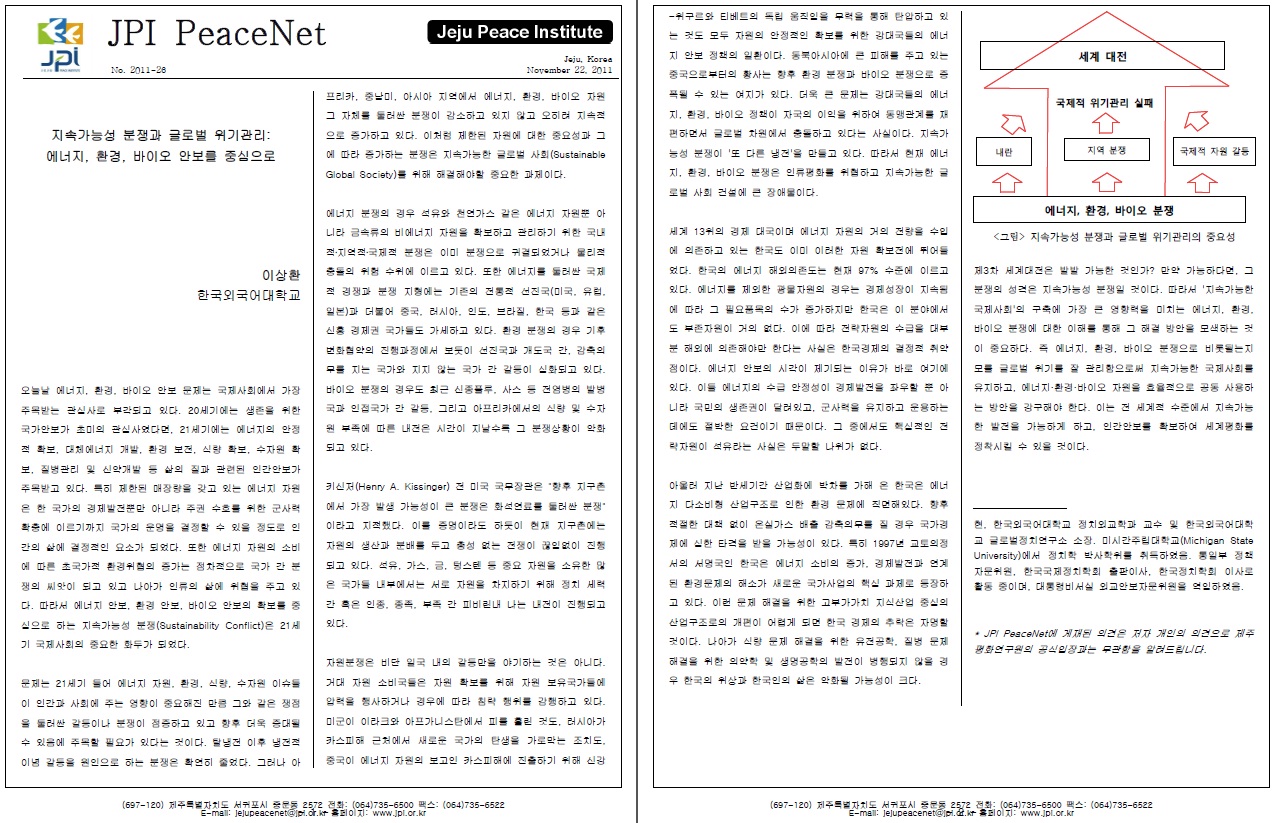
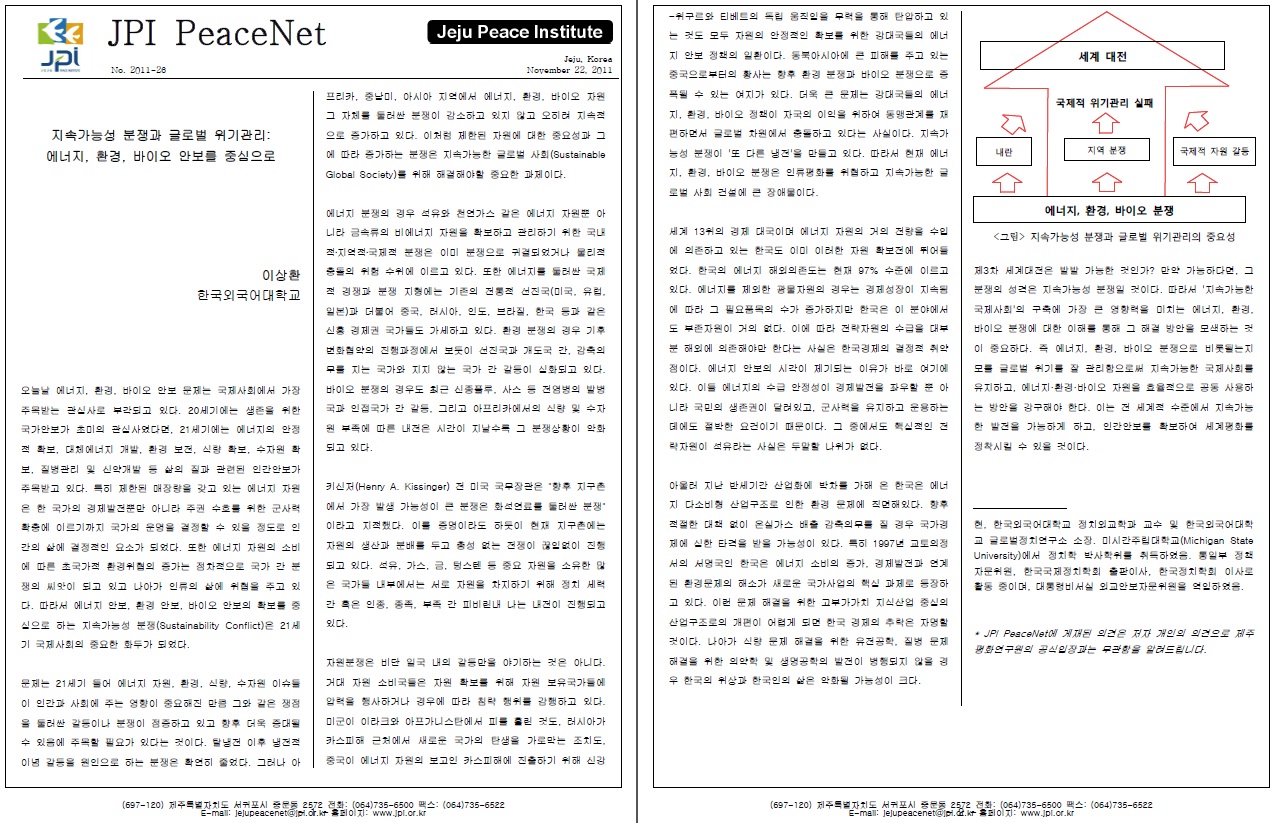
오늘날 에너지, 환경, 바이오 안보 문제는 국제사회에서 가장 주목받는 관심사로 부각되고 있다. 20세기에는 생존을 위한 국가안보가 초미의 관심사였다면, 21세기에는 에너지의 안정적 확보, 대체에너지 개발, 환경 보전, 식량 확보, 수자원 확보, 질병관리 및 신약개발 등 삶의 질과 관련된 인간안보가 주목받고 있다. 특히 제한된 매장량을 갖고 있는 에너지 자원은 한 국가의 경제발전뿐만 아니라 주권 수호를 위한 군사력 확충에 이르기까지 국가의 운명을 결정할 수 있을 정도로 인간의 삶에 결정적인 요소가 되었다. 또한 에너지 자원의 소비에 따른 초국가적 환경위협의 증가는 점차적으로 국가 간 분쟁의 씨앗이 되고 있고 나아가 인류의 삶에 위협을 주고 있다. 따라서 에너지 안보, 환경 안보, 바이오 안보의 확보를 중심으로 하는 지속가능성 분쟁(Sustainability Conflict)은 21세기 국제사회의 중요한 화두가 되었다. 문제는 21세기 들어 에너지 자원, 환경, 식량, 수자원 이슈들이 인간과 사회에 주는 영향이 중요해진 만큼 그와 같은 쟁점을 둘러싼 갈등이나 분쟁이 점증하고 있고 향후 더욱 증대될 수 있음에 주목할 필요가 있다는 것이다. 탈냉전 이후 냉전적 이념 갈등을 원인으로 하는 분쟁은 확연히 줄었다. 그러나 아프리카, 중남미, 아시아 지역에서 에너지, 환경, 바이오 자원 그 자체를 둘러싼 분쟁이 감소하고 있지 않고 오히려 지속적으로 증가하고 있다. 이처럼 제한된 자원에 대한 중요성과 그에 따라 증가하는 분쟁은 지속가능한 글로벌 사회(Sustainable Global Society)를 위해 해결해야할 중요한 과제이다. 에너지 분쟁의 경우 석유와 천연가스 같은 에너지 자원뿐 아니라 금속류의 비에너지 자원을 확보하고 관리하기 위한 국내적·지역적·국제적 분쟁은 이미 분쟁으로 귀결되었거나 물리적 충돌의 위험 수위에 이르고 있다. 또한 에너지를 둘러싼 국제적 경쟁과 분쟁 지형에는 기존의 전통적 선진국(미국, 유럽, 일본)과 더불어 중국, 러시아, 인도, 브라질, 한국 등과 같은 신흥 경제권 국가들도 가세하고 있다. 환경 분쟁의 경우 기후변화협약의 진행과정에서 보듯이 선진국과 개도국 간, 감축의무를 지는 국가와 지지 않는 국가 간 갈등이 심화되고 있다. 바이오 분쟁의 경우도 최근 신종플루, 사스 등 전염병의 발병국과 인접국가 간 갈등, 그리고 아프리카에서의 식량 및 수자원 부족에 따른 내전은 시간이 지날수록 그 분쟁상황이 악화되고 있다. 키신저(Henry A. Kissinger) 전 미국 국무장관은 "향후 지구촌에서 가장 발생 가능성이 큰 분쟁은 화석연료를 둘러싼 분쟁"이라고 지적했다. 이를 증명이라도 하듯이 현재 지구촌에는 자원의 생산과 분배를 두고 총성 없는 전쟁이 끊임없이 진행되고 있다. 석유, 가스, 금, 텅스텐 등 중요 자원을 소유한 많은 국가들 내부에서는 서로 자원을 차지하기 위해 정치 세력 간 혹은 인종, 종족, 부족 간 피비린내 나는 내전이 진행되고 있다. 자원분쟁은 비단 일국 내의 갈등만을 야기하는 것은 아니다. 거대 자원 소비국들은 자원 확보를 위해 자원 보유국가들에 압력을 행사하거나 경우에 따라 침략 행위를 감행하고 있다. 미군이 이라크와 아프가니스탄에서 피를 흘린 것도, 러시아가 카스피해 근처에서 새로운 국가의 탄생을 가로막는 조치도, 중국이 에너지 자원의 보고인 카스피해에 진출하기 위해 신강-위구르와 티베트의 독립 움직임을 무력을 통해 탄압하고 있는 것도 모두 자원의 안정적인 확보를 위한 강대국들의 에너지 안보 정책의 일환이다. 동북아시아에 큰 피해를 주고 있는 중국으로부터의 황사는 향후 환경 분쟁과 바이오 분쟁으로 증폭될 수 있는 여지가 있다. 더욱 큰 문제는 강대국들의 에너지, 환경, 바이오 정책이 자국의 이익을 위하여 동맹관계를 재편하면서 글로벌 차원에서 충돌하고 있다는 사실이다. 지속가능성 분쟁이 '또 다른 냉전'을 만들고 있다. 따라서 현재 에너지, 환경, 바이오 분쟁은 인류평화를 위협하고 지속가능한 글로벌 사회 건설에 큰 장애물이다. 세계 13위의 경제 대국이며 에너지 자원의 거의 전량을 수입에 의존하고 있는 한국도 이미 이러한 자원 확보전에 뛰어들었다. 한국의 에너지 해외의존도는 현재 97% 수준에 이르고 있다. 에너지를 제외한 광물자원의 경우는 경제성장이 지속됨에 따라 그 필요품목의 수가 증가하지만 한국은 이 분야에서도 부존자원이 거의 없다. 이에 따라 전략자원의 수급을 대부분 해외에 의존해야만 한다는 사실은 한국경제의 결정적 취약점이다. 에너지 안보의 시각이 제기되는 이유가 바로 여기에 있다. 이들 에너지의 수급 안정성이 경제발전을 좌우할 뿐 아니라 국민의 생존권이 달려있고, 군사력을 유지하고 운용하는 데에도 절박한 요건이기 때문이다. 그 중에서도 핵심적인 전략자원이 석유라는 사실은 두말할 나위가 없다. 아울러 지난 반세기간 산업화에 박차를 가해 온 한국은 에너지 다소비형 산업구조로 인한 환경 문제에 직면해있다. 향후 적절한 대책 없이 온실가스 배출 감축의무를 질 경우 국가경제에 심한 타격을 받을 가능성이 있다. 특히 1997년 교토의정서의 서명국인 한국은 에너지 소비의 증가, 경제발전과 연계된 환경문제의 해소가 새로운 국가사업의 핵심 과제로 등장하고 있다. 이런 문제 해결을 위한 고부가가치 지식산업 중심의 산업구조로의 개편이 어렵게 되면 한국 경제의 추락은 자명할 것이다. 나아가 식량 문제 해결을 위한 유전공학, 질병 문제 해결을 위한 의약학 및 생명공학의 발전이 병행되지 않을 경우 한국의 위상과 한국인의 삶은 악화될 가능성이 크다. <그림> 지속가능성 분쟁과 글로벌 위기관리의 중요성 제3차 세계대전은 발발 가능한 것인가? 만약 가능하다면, 그 분쟁의 성격은 지속가능성 분쟁일 것이다. 따라서 '지속가능한 국제사회'의 구축에 가장 큰 영향력을 미치는 에너지, 환경, 바이오 분쟁에 대한 이해를 통해 그 해결 방안을 모색하는 것이 중요하다. 즉 에너지, 환경, 바이오 분쟁으로 비롯될는지 모를 글로벌 위기를 잘 관리함으로써 지속가능한 국제사회를 유지하고, 에너지·환경·바이오 자원을 효율적으로 공동 사용하는 방안을 강구해야 한다. 이는 전 세계적 수준에서 지속가능한 발전을 가능하게 하고, 인간안보를 확보하여 세계평화를 정착시킬 수 있을 것이다. 이 글에 포함된 의견은 저자 개인의 견해로 제주평화연구원의 공식입장과는 무관합니다. * 현, 한국외국어대학교 정치외교학과 교수 및 한국외국어대학교 글로벌정치연구소 소장. 미시간주립대학교(Michigan State University)에서 정치학 박사학위를 취득하였음. 통일부 정책자문위원, 한국국제정치학회 출판이사, 한국정치학회 이사로 활동 중이며, 대통령비서실 외교안보자문위원을 역임하였음. -
- 저자
- Artyom LUKIN(Far Eastern Federal University)
- 발간호
- 2011-25
Despite having a Pacific coastline of 16,700 miles, Russia is a late-comer in regards to Asia-Pacific regionalism. Due to the Cold War, the Soviet was shut out from regional cooperation, having instead to rely on bilateral ties with few allies. Following the end of the bipolar confrontation in the early 1990s, Russia strove to integrate itself into Asia-Pacific multilateral bodies.Despite joining APEC and ARF, Russia, due to domestic turmoil, ceased to be a major factor in the Asia-Pacific during the 1990s. However, during Putin’s and Medvedev’s presidential tenures, Russia managed to substantially improve its internal situation, enabling Moscow to embark on more pro-active foreign policies in the 2000s.One of the signs of Russia’s return to the Asia-Pacific has been its involvement in the region’s key security forums. In 2003, Russia became one of the co-sponsors of the Six-Party talks. In 2010, Russia finally secured an invitation to join the East Asia Summit, along with the United States. In 2010 Russia also joined the ASEAN Defense Ministers Meeting process (ADMM+8). Thus Russia now holds membership in all the Asia-Pacific multilateral security-political bodies SPT, ARF, ADMM+8, and EAS.Russia views its involvement in the Asia-Pacific security forums as a kind of guarantee that its voice will be heard and heeded. Russia’s preferred model for the Asia-Pacific political order is a multi-polar concert system, where Moscow is one of the major players, along with Beijing, Washington, Tokyo, New Delhi, and perhaps Seoul and Jakarta. The Kremlin emphasizes the role of the Six-Party talks as not only the diplomatic vehicle for North Korea denuclearization, but also as the mechanism for “the creation of reliable political and legal guarantees of security in Northeast Asia”. At the same time, Russia wants to see the East Asia Summit as an umbrella political grouping in the Asia-Pacific.While Russia has secured full representation in the Asia-Pacific political institutions, in the economic arena its presence can be characterized as very modest at best. Russia accounts for roughly one per cent of the region’s total trade. APEC remains the only regional economic grouping Russia participates in. Russia is one of the very few economies in the Asia-Pacific that have no free trade agreements in the region. Moscow clearly sees the danger of its increasing economic marginalization in the Asia-Pacific and seems determined to change this. In 2010, Russia launched formal FTA negotiations with New Zealand. FTAs with Vietnam and Singapore are also being studied.Russia’s efforts to engage with the Asia-Pacific is one element in its three-pronged strategy of regional integration, the other two dimensions being the Russian-led integration of the post-Soviet space and closer cooperation with the European Union. Moscow’s paramount goal is to secure economic reintegration of the post-Soviet space, which should come in the form of the Eurasian proposed by Vladimir Putin in October 2011. The number two priority is integration with the European Union, which accounts for the bulk of Russia’s foreign trade. Indeed, according to Putin, the Eurasian should become part of “Greater Europe”. At the same time, Moscow has an ambitious goal of turning the Eurasian into a link between Europe and the Asia-Pacific.Russia’s integration into the highly competitive Asia-Pacific markets will only make sense if it can identify and exploit niche areas where its economy has comparative advantages. It appears that Russia’s preferred model of economic integration into the Asia-Pacific has similarities to Canada’s and Australia’s in that it seeks to combine large-scale exports of natural resources with the strong emphasis on innovative sectors such as high-tech, science and higher education. It remains to be seen, of course, whether Russia will be as successful as Canada and Australia in pursuing this path.The success of Russia’s efforts at regional integration significantly depends on whether it has the support of the established Asia-Pacific powers. China is Russia’s main “strategic partner” in the region. In 2010 it overtook Germany to become Russia’s biggest trading partner. However, it is doubtful that China will ever make it a priority to help Russia become a full-fledged member of the Asia-Pacific system of economic cooperation. Beijing is quite content with having Russia as a reliable supplier of raw materials and is interested in keeping this resource base to itself rather than facilitating Russia’s links to other Asia-Pacific markets.Another major Asia-Pacific economy, Japan, although presumably interested in weaning Russia away from growing dependence on China, is unlikely to do much to assist Russia’s regional aspirations. This is, of course, mainly because of the ill-fated dispute over the South Kuriles/Northern Territories still poisoning relations between Moscow and Tokyo.This leaves another Asia-Pacific power, the United States. It is remarkable that of all the areas, where Moscow’s and Washington’s geopolitical concerns overlap, it is the Asia-Pacific where their interests are least conflicting and most compatible, whereas in Eastern Europe, the Caucasus, and Central Asia, Russia and America are competitors rather than partners. These two powers do not have irreconcilable disagreements in the Pacific. Although Moscow’s influence in Northeast Asia has grown somewhat in recent years, it is too weak to be perceived by Washington as an actual, or even potential, challenge. Russia’s central geopolitical interest in the region is to retain effective control over its Pacific territories, not to expand at the expense of others. This is well understood in Washington. It is also important that both Russia and the United States want to hedge against geopolitical uncertainties stemming from China’s rise.Being non-Asian powers culturally and historically, both Russia and the United States face the risk of being marginalized if the Northeast Asian/East Asian integration evolves towards an exclusive Asian club. That is why Russia and the United States are naturally interested in preserving the trans-Pacific dimension of Asia-Pacific institution building. APEC, as the leading trans-Pacific institution, could become a good venue for promoting Russia’s and America’s common interests in the Asia-Pacific. Furthermore, joining the American-led Trans-Pacific Partnership, as a long-term prospect, might be a way for Russia to expand its ties to the Asia-Pacific, as well as strengthen its relationship with the United States.이 글에 포함된 의견은 저자 개인의 견해로 제주평화연구원의 공식입장과는 무관합니다.* Artyom LUKIN is Associate Professor and Deputy Director for Research at the School of Regional and International Studies, Far Eastern Federal University (Vladivostok, Russia). His main research interests focus on regional security and international political economy in the Asia-Pacific and Northeast Asia. Artyom LUKIN has authored over 40 scholarly publications in Russian and English. -
G20에 아시아의 역할 조회수 97
- 저자
- 채욱(대외경제정책연구원)
- 발간호
- 2011-24
많은 이유로 G20이 세계 최고의 경제 포럼이라는 평가를 받는 것은 당연할지도 모른다. 이러한 평가는 초기 G7 구성 과정상의 문제와 종종 연관되어진다. G7의 가장 눈에 띄는 문제 중의 하나는 G7이 선진국으로만 구성되었기 때문에 전 세계의 경제문제와 관련해 중대한 결정을 내릴 특권이 있다고 당당하게 주장할 수 없다. G20이 앞으로 권위를 계속 유지하려면 개발도상국 특히 아시아의 협조가 필요하다. 현재 개발도상국은 전 세계 GDP의 40%정도를 차지하고, 그 비율은 앞으로 수 년간 꾸준히 증가할 것으로 보인다. 아시아의 경제가 현재와 같은 속도로 계속 성장한다면 2050년까지 전 세계 생산량의 반을 아시아에서 생산할 것으로 예측하고 있다. 이러한 예측 때문에 많은 경제학자와 미래학자는 전 세계 경제의 무게중심이 아시아로 이동할 것이라고 보고 있다. 그런데 사실 무게중심은 이미 이동하고 있다.글로벌 경제위기의 발생과 함께 2008년 워싱턴에서 열린 첫 번째 회의부터 지난해 서울에서 열린 정상회담까지 G20이 위기에 대응하기 위해 진행한 모든 노력 단계마다 아시아는 강하게 존재감을 보여왔다. 그리고 국제사회 전체가 위기 극복을 위해 정책면에서 적극적으로 협력하고, 글로벌 경제 거버넌스를 이루기 위한 기본 청사진을 그리려면 아시아 국가들의 협력이 필수적이다. 글로벌 불균형, 국제 금융기관의 개혁, 글로벌 금융 안전망 구축, 발전문제를 논의하기 위한 결의안뿐만 아니라 모든 아젠다와 관련한 주요 문제 전반적으로 아시아 국가들이 가지고 있는 무게와 영향력을 실감할 수 있다. G20이 전 세계 최고의 경제 포럼으로서의 위치를 유지하기 위해서는 아시아 국가들이 끊임없이 역동적인 역할을 수행해야 한다는 것은 당연하다. 이 점은 전 세계 제2 및 제3의 경제대국이 아시아에 있을 뿐만 아니라 전 세계 인구의 60%가 아시아인이라는 사실을 통해서도 잘 알 수 있다. 또한 아시아 지역이 전 세계 외화보유고의 반 이상을 차지하고 있다는 점으로도 아시아의 비중을 볼 수 있다. 글로벌 불균형의 주요 요인이면서, 동시에 불균형을 해결하는 해법을 제시할 수 있다는 점에서 아시아가 세계 경제에서 차지하고 있는 위치는 독특하다. 글로벌 불균형은 G20이 직면한 가장 중요하고 난해한 문제이기 때문에 이를 해결하기 위해 가장 많은 노력을 기울이고 있다. 미국식 소비지상주의를 가장 중요한 유발요인으로 쉽게 지목할 수 있겠지만 아시아 경제구조 안에 견고하게 확립되어 있는 생산 분화도 마찬가지로 책임을 면하기 어렵다. 원자재나 생산재를 한국, 일본, 동남아시아가 무관세 혹은 저관세로 중국에 수출하고 이러한 원자재나 생산재를 중국에서 가공하거나 조립하여 미국이나 유럽에 수출하는 방식으로 아시아의 경제구조가 구축되어 있는 데 이러한 과정에서 글로벌 불균형이 심화되고 있다. 그와 같은 무역이나 생산구조를 본격적으로 개혁하면 만연한 글로벌 불균형을 완화할 수 있는 것은 분명하다. 무역과 생산구조의 개혁은 원자재와 생산재뿐만 아니라 완제품에 대해서도 관세와 비관세 장벽을 완전히 허무는 아시아 국가간의 무역 자유화를 통해 실현할 수 있다. 불균형을 해결하기 위한 또 하나의 처방은 아시아 금융 시장의 안정성을 더욱 높이기 위해서 아시아 국가 간의 통화협력을 강화하는 것이다. 이와 같은 조치를 통해 각 국가가 외환보유고 확대에 덜 집착하도록 유도할 수 있다. 이러한 점에서 동아시아 국가 사이에 형성된 치앙마이 이니셔티브 다자화(CMIM: Chiang Mai Initiative) 체제를 더욱 강화하고 확대할 필요가 있다. G20과 전 세계에게 중대한 발전문제와 관련하여 아시아 국가가 더욱 적극적으로 역할을 수행할 것이라는 기대를 하고 있다. 특히 아시아는 주요 원조국과 수혜국이 공존하는 지역임을 주목할 필요가 있다. 아시아 지역에는 한국, 일본, 떠오르는 경제대국 중국, 남남 협력을 주도하고 있는 인도와 같이 OECD 개발원조위원회 회원국이 있는 동시에 일부 동남아시아 국가와 같은 막대한 국제 원조의 수혜국이 있다. 아시아의 지역개발을 위한 협력체제를 아시아 내에서 조직한다면 원조와 개발을 목표로 한 글로벌 체제를 개선할 가능성이 아주 높아질 것이다. 경제적 성장과 함께 냉철한 결단력을 발휘하고 노력을 기울였기 때문에 아시아 경제는 꾸준히 주목받을 수 있는 유리한 위치에 있었다. 그러나 현재 G20이 글로벌 차원의 중요한 문제를 해결하기 위한 정책을 결정하는 과정에서 아시아 국가들에게 더욱 적극적인 역할을 요구하고 있기 때문에 아시아 국가는 정치 및 경제적 역량 면에서 더욱 강해져야 할 필요가 있다. 이와 같은 요구를 충족하기 위해서 아시아 국가들은 자국의 시장 시스템과 민주적인 제도를 강화해야 할 것이다.이 글에 포함된 의견은 저자 개인의 견해로 제주평화연구원의 공식입장과는 무관합니다.* 현 대외경제정책연구원 원장. 국민경제자문회의 위원으로 활동하고 있음. -
북핵위기와 6자회담 조회수 97
- 저자
- HEO Uk(University of Wisconsin-Milwaukee)
- 발간호
- 2011-15
북한 핵 프로그램은 미국과 남한 안보에 중대한 위협이 되고 있다. 이 문제를 해결하기 위해 1994년 제네바합의(Geneva Agreed Framework)가 채택되었다. 그러나 워싱턴은 북한의 우라늄에 기초한 핵 프로그램을 또 다시 발견하였고 제네바합의는 종결되었다. 그러나 부시 행정부는 대화를 계속하였고, 북한은 심지어 핵 프로그램 해체에 동의하였다. 오바마 집권 후 워싱턴은 대화를 재개하기 전에 북한이 비핵화 의지를 보여주기를 기다리며 별다른 행동을 취하지 않는, 소위 ‘전략적 인내(strategic patience)’를 지켜왔다. 여러 차례의 대화와 2005년 핵 프로그램 해체 약속에도 불구하고, 북한은 2006년 10월 9일과 2009년 5월 25일 핵무기 실험을 감행하며 6자회담의 무효성을 여실히 보여주었다. 그런데도 여전히 6자회담은 북한 핵문제를 다루는 유일한 접근방법이다. 왜 북한은 핵무기를 원하는 것일까? 그리고 미국은 6자회담을 통해 무엇을 얻으려는 것일까? 북한정부는 자국의 핵 프로그램이 전력공급 부족을 해결하기 위한 것이라고 주장한다. 그러나 핵보유국이 되려는 평양의 지속적인 노력을 살펴볼 때 이는 결코 사실일 수 없다. 오히려 북한의 핵 프로그램은 정권생존의 보험 역할을 하고 있다. 이를 지지해주는 세 가지 이유들이 있다. 첫째, 북한은 한국전쟁 직후 핵 프로그램을 시작하였다. 당시 김일성은 소련연방으로부터 원자로를 얻어내려 애썼다. 김일성은 전쟁 동안 유엔군이 압록강까지 전진하면서 자신의 국가가 거의 사라질 뻔한 위기를 겪었다. 중국의 개입이 없었으면 북한은 사라졌을 것이다. 전쟁 후 김일성은 정권 안보에 핵무기가 반드시 필요하다고 생각했을 것이다. 또한 김일성은 미국이 핵으로 중국을 위협하는 모습을 지켜보며 자신에게도 핵무기가 필요하다고 생각했을 것이다. 1950년대 소련연방은 원자로 제공을 거부했지만, 북한의 계속적인 요구에 결국 1965년 연구용 5MW 원자로를 제공하게 되었다. 북한 핵 프로그램은 1980년대 미국 위성사진에 재처리공장 건설 장면이 노출되면서 세계의 관심을 끌기 시작했다. 사용된 핵연료봉은 플루토늄을 분리하기 위해 재처리된다. 플루토늄은 무기급 물질이다. 하지만 민간 전력용 핵 프로그램에서는 재처리 공장이 필요하지 않다. 그러므로 북한이 핵무기 개발 의도를 가지고 있는 것이 분명했다. 둘째, 1994년 미국과 북한은 제네바합의에 서명했다. 즉 북한은 모든 핵 프로그램을 동결하고, 한반도 비핵화 선언을 실천하기로 동의한 것이다. 대신 남한, 일본, EU는 한반도에너지개발기구(KEDO: Korean Energy Development Organization)를 조직하여 2개의 1,000MW 경수로를 건설하기로 약속하였다. 경수로를 건설하는 동안 미국은 북한의 에너지 손실을 보상하기 위해 매년 원유 50만 톤을 제공하기로 약속하였다. 남한은 제네바합의를 이행할 뿐만 아니라 수십억 달러의 경제원조와 투자를 제공하기로 하였다. 북한이 당시 단 하나의 5MW 흑연감속로를 보유하고 50MW와 200MW 원자로를 건설 중이었다는 사실을 고려할 때, 1,000MW 경수로 2개를 건설하고 경수로 건설 기간 동안 매년 50만 톤의 원유를 공급하는 것은 북한 전력공급 문제를 해결해주는 것 이상의 과한 조치였다. 그럼에도 불구하고 북한은 모든 원조를 받는 동안에도 비밀리에 고농축우라늄을 개발하고 있었다. 2000년 남북정상회담, 미 국무부 매들린 올브라이트(Madeleine Albright) 장관의 평양 방문, 북한 인민군 차수 조명록의 워싱턴 방문 등도 모두 핵무기 개발 음모를 감추기 위한 정치적 술책이었다. 북한이 원조의 전제조건으로서 핵 프로그램 포기에 단 한 번도 동의하지 않았다는 사실은 북한이 핵보유국이 되고자하는 분명한 의지를 확인시켜준다. 셋째, 농업부문의 구조적 문제(예를 들어 비료 부족과 불충분한 농지)와 함께 반복되는 가뭄과 기근 때문에 북한은 1990년대 초부터 지속적인 식량부족과 경제적 어려움을 겪어왔으며, 수십만 명의 사람들이 굶어 죽었다는 보도도 있다. 그러나 북한은 인프라를 향상시키고 경제를 개발하는데 필요한 자본이 없다. 한국전쟁 후 미국의 경제제재로 북한은 외국자본의 직접투자를 유치하거나 IMF 대출을 받을 수 없게 되었다. 현재 북한은 김정은 권력승계의 정치적 합법성을 정당화하고, 김정일 정권이 선언한 강성대국 원년이자 김일성 탄생 100주년인 2012년을 축하하기 위해 경제적 원조가 어느 때보다 절실한 상황이다. 이런 이유로 북한은 가능한 많은 경제 원조를 받으려고 애쓰고 있다. 따라서 김정일 정권은 미국과의 협상에서 최대한 많은 것을 얻기 위해 핵카드를 꺼내는 ‘벼랑 끝 전략(brinkmanship)’을 사용하고 있다. 북한은 핵 프로그램을 진행한 이후 미국과의 협상도구로서 미사일 프로그램뿐만 아니라 핵무기를 이용해왔다. 북한은 이러한 협상도구들을 이용해 경제 원조를 얻어내고 경제제재를 완화시켜 정권의 안전을 보장받고자 한다. 6자회담으로는 북한의 핵무기 개발을 과거에도 막을 수 없었고 미래에도 막을 수 없을 것이다. 그렇다면 미국정부가 6자회담에서 얻으려고 하는 것은 무엇일까? 미국정부는 다른 주요 지역 플레이어들이 참여하지 않았던 북미 양자간 합의인 1994년도 제네바합의의 한계성이 재현되지 않도록 다자간 대화를 무엇보다 원하고 있다. 평양이 제네바합의를 어겼을 때 중국과 러시아가 합의 당사자가 아닌데다 북한에 압력을 가하는 것에 반대했기 때문에 워싱턴에서 할 수 있는 일이 별로 없었다. 만약 중국과 러시아가 협상에 참여한다면 북한이 합의를 위반하기 어려울 것이다. 또한 미국이 평양의 위반 행동에 대해 중국과 러시아가 처벌을 가하도록 설득하기가 보다 수월해질 것이다. 북한은 핵무기를 보유하기로 작정한 것처럼 보인다. 미국정부는 북한의 핵무기 보유에 대한 입장에 변화를 보이고 있다. 미국 관리들은 북한이 많은 핵무기를 보유한 것으로 추정한다고 말해왔다. 과거에는 북한 핵문제와 관련하여 워싱턴은 북한의 핵실험을 용납할 수 없는 한계선으로 잡고 있었다. 그러나 최근에는 핵무기 또는 관련 물질의 이전 금지, 특히 테러리스트 단체 혹은 이란이나 시리아 같은 반미국가로의 이전 금지에 보다 초점을 맞추고 있다. 이는 용납할 수 없는 한계선의 변화를 의미한다. 그러므로 앞으로 6자회담은 북한이 핵무기 물질을 계속 생산하는 것과 핵물질을 다른 국가에 수출하는 것을 금지하는데 초점을 맞출 것이다.이 글에 포함된 의견은 저자 개인의 견해로 제주평화연구원의 공식입장과는 무관합니다.* 현 위스콘신대학 밀워키 캠퍼스 정치학과 교수. 텍사스 A&M 대학에서 박사 학위를 취득하였음. 국제 안보와 한국 정치에 연구 초점을 맞추고 있으며, Journal of Politics, British Journal of Political Science, Political Research Quarterly, Journal of Conflict Resolution, International Studies Quarterly, Comparative Politics, and Comparative Political Studies 등과 같은 세계적인 정치학 학회지에 논문을 발표해왔음. 또한 ‘1980년 이후의 한국(South Korea since 1980, Cambridge University Press 2010)’과 ‘세계 속의 한국의 부상: 권력, 경제개발, 외교(South Korea’s Rise in the World: Power, Economic Development, and Foreign Policy, Cambridge University Press, 2013 출간 예정)’를 테렌스 뢰리그(Terence Roehrig)와 공저하였음. 재미한국정치연구학회 회장을 역임하였음. -
유럽의 재정위기가 아시아에 주는 함의 조회수 101
- 저자
- 이옥연(서울대학교)
- 발간호
- 2011-23
올해 들어 세 번째로 유럽정상회담을 통한 유럽 재정위기 타결안이 제시되었다. 재정위기의 진원지인 그리스의 현재 GDP 대비 정부 부채 비율은 166퍼센트에 달한다. 이를 2020년까지 120퍼센트로 줄이기 위해 차관을 제공한 은행으로부터 그리스 정부의 채무 부담을 절반으로 삭감한다는 합의를 이끌어내는 성과를 거두었다. 더불어 문제 국가로 지목된 이탈리아와 스페인의 재정파탄을 방지하기 위해 유럽의 구제금융 기금인 재정 안정 기관(European Financial Stability Facility)의 재원을 증대하기로 합의했다. 이는 독일 메르켈 총리가 일컫듯 2차 세계대전 이후 최대 위기인 현 재정위기로 인해 유럽이 파국으로 치닫는 불행한 역사를 되풀이하지 않으려는 유럽의 결의를 보여준다. 그러나 이 포괄적 해결책도 재원 증대의 구체적 방안을 제시하지 않았고, 통화정책의 단일화에 참여하는 17개국의 재정정책 단일화에 대한 실질적 조치를 강화하지 않았다. 비록 유럽 정상이 모여 밤샘 작업을 한 끝에 이룬 업적임에도 불구하고, 저비용의 말 잔치를(words are cheap) 고비용의 해결 방안으로 구현시키려면 앞으로도 수차례에 걸쳐 구수회담이 이어질 것이다. 그렇다면 현재진행형인 유럽의 재정위기가 아시아에게 어떤 함의를 지닐까? 단일화폐의 통용은 필연적으로 각 회원국의 재정 건전성(fiscal soundness)을 요구한다. 그러나 각 회원국 간 재정 건전성의 간극이 크다. 재정적으로 건전한 독일보다 재정 건전성이 결여된 포르투갈, 이탈리아, 아일랜드, 스페인 및 그리스는 부채상환 능력이 부족하다. 문제는 각 회원국의 부채가 상호 깊숙이 연계되어 있다는 데 있다. 왜냐하면 유로존에 참여한다는 점을 악용해 “불량” 국가들은 동등한 이자율로 차관을 확보해 정부지출의 재원을 충원하였기 때문이다. 정부 재원을 자체적으로 충당하려면 세원을 확보해야하는데 이는 저성장 국가에게 정치적 자살행위에 해당한다. 결국 그리스의 재정파탄은 사회 소요임에도 불구하고 긴축재정을 전제로 한 유럽과 국제 금융구제에 의해서만 간신히 해결의 실마리를 찾았다. 동시에 방만한 재정운영을 감독하는 권한을 유럽차원의 초국가기구에게 부여해야한다는 각성도 일었다. 무엇보다 그리스의 재정파탄을 방치하면 자국의 금융기관에 막대한 타격을 입힐 것을 우려한 독일과 프랑스 등 채권 국가들은 서둘러 해결책을 고안하는데 합의했다. 그러나 그리스의 재정파탄이 가져올 일파만파의 혼란을 차단할 금융구제 방안 대신 미봉책만 제시할 뿐이었다. 더구나 파행적 재정운영을 미연에 방지할 수 있는 금융기관에 대한 감독 권한의 제도화나 재정정책의 단일화는 아직도 요원하다. 전후 유럽은 무력 충돌로 얼룩진 과거를 청산하고 새로운 지역 질서를 건설할 목적으로 국가 간 협력증대를 통해 공동의 평화와 번영을 모색하는 유럽통합을 추진했다. 비록 오랜 시간이 소요되었지만, 결국 유럽연합이라는 초국가기구로 유럽을 재편성했을 뿐 아니라 국경 없는 쉥겐 지역(Schengen Area)과 단일화폐가 통용되는 유로존(Eurozone)을 성공적으로 출범시켰다. 나아가 상상의 공동체인 유럽을 마침내 27개국의 회원국이 참여하는 실질적 공동체로서 공간적으로 확대하는 위업을 달성했다. 이러한 쾌거는 범아시아 공동체를 구상하는 아시아 국가에게 고무되는 역사적 사건임에 분명하다. 그러나 영토를 전제로 한 국민국가에 기반을 두는 주권과 초국가기구로의 일부 권력이양을 수반하는 통합 간 긴장 자체가 해소되지는 않았다. 달리 말하자면, 근대국가도 국제기구도 아닌 초국가기구로서 유럽연합이 과연 위계질서에 의거하지 않고 국가를 초월하는 새로운 차원의 권위를 제대로 창출할 수 있는지에 대한 의구심을 종식하지는 못했다. 이를 두고 유럽의 국가주권과 지역통합 간 긴장은 자연스러운 현상이며 오히려 국가주권과 지역통합 간 관계에 관한 새로운 발상이 요구된다는 논의가 이어졌다. 이러한 고민도 유럽보다 지역 통합에 저해요인이 많은 아시아 국가에게 교훈으로 다가왔다. 긴장 속의 국가주권과 지역통합 간 관계를 설정 또는 재설정하는 노력은 궁극적으로 통합의 제도화로 이어진다. 왜냐하면 국가주권이 선점한 권위 일부를 신설된 초국가기구에 이양하는 과정에서 이러한 부분적 권위의 이양이 국가주권의 잠식이나 위축을 의미하기보다 새로운 형태와 방식으로 국가주권을 발현할 수 있는 기회를 제공한다는 헌법에 준하는 근거가 필요하기 때문이다. 즉, 국가주권과 지역통합은 상쇄하는 영합적(zero-sum) 관계가 아니라 보완하거나 필요에 따라서 대체하는 정합적(positive-sum) 관계라는 공감대를 제도로서 내재화해야 한다. 진정한 공동체를 지향하는 유럽의 행보가 바로 이러한 관계 설정 또는 재설정의 제도화 단계에서 제동에 걸리곤 했다. 이 역시 아시아가 지엽적으로 경험한 바이다. 설령 국가주권과 지역통합 간 긴장은 자연스러운 현상이라는 주장에 논리적 결함이 없더라도 정서적 저항을 이완시키기에는 역부족이다. 왜냐하면 긴장 관계는 필요에 따라 우호적일 수도 있지만, 경쟁을 전제하므로 대체로 적대적이고 배타적일 가능성이 농후하기 때문이다. 즉 우호적 긴장 관계는 공동의 평화와 번영을 증대하려는 의지에 의해 재편성된 인위적 결과물에 지나지 않는다. 따라서 그 정당성에 대한 도전에 직면하는 경우, 응전의 방식으로 배타적 관계로 환원될 소지가 크다. 유럽에서는 재정위기로부터 자국의 경제에 대한 타격을 줄이기에 급급한 각개격파(各個擊破)로 드러난다면, 아시아에서는 근대적 영토 분쟁에 더해 역사 새로 쓰기로 나타난다. 현재 유럽에서는 국가주권과 지역통합 간 긴장이 고조되자, 우호적 관계라는 불편한 옷을 벗어던지고 익숙한 배타적 관계로 갈아입는 장면을 반복해서 목격한다. 유럽 공동체의 초석을 제공하는데 기여했다고 자부하는 네덜란드는 공공연히 유로존의 탈퇴를 거론한다. 유럽 지역통합의 수혜자로서 경제적 성장을 달성한 슬로바키아는 유럽차원의 금융구제 방안을 일차적으로 거부했다. 비록 재정위기의 진원지는 아니지만 재정파탄의 벼랑으로 몰린 이탈리아는 국가신용단계가 강등되자 별로 놀라운 일도 아니라며 애써 시큰둥한 반응을 보였다. 유럽연합에 가입했으면서도 유로존에서 발뺌한 영국은 유로존의 참여 유보(opt-out)가 현명한 처사였음을 거들먹거리며 심지어 유럽연합의 탈퇴 여부를 국민투표로 결정하자고 집권당인 보수당이 발안했으나 거부되었다. 유럽헌법 조약의 비준이 난관에 봉착하자 그 대안으로 우여곡절 끝에 체결된 리스본 조약에 의하면, 유로존 회원국의 통화정책 수립은 유럽연합의 독자 영역이다. 즉 유럽 국가가 아닌 초국가기구인 유럽연합에게만 권한이 부여된다. 그러나 실제로 단일화폐의 통용을 유지시킬 수 있는 금융 감독 권한이 부재한 현실을 감안하면 이는 ‘그림의 떡’이다. 더불어 유럽 차원의 법안은 사실상 공용어(lingua franca)인 영어 이외 22개의 언어로 번역되어야 하는 부담을 내재한다. 이는 단순히 복수 언어 간 균등한 번역의 어려움에 그치지 않고 특정 용어의 선택이 지니는 법적 구속력의 간극으로 이어지는 제약을 가리킨다. 게다가 각 회원국의 금융 감독에 관한 법-제도 간 차이점을 상정하면, 유로존 회원국의 통화정책 수립을 실질적으로 유럽연합의 독자 영역으로 구축하느냐에 따라 작금의 재정위기를 계기로 유럽 통합의 향방이 결정된다. 게다가 통화정책과 재정정책은 밀접한 상관관계에 있지만, 유로존의 현실은 이와 동떨어져 있다. 최근 수면 위로 드러난 재정위기는 또한 유럽의 정체성에 관한 근본적 질문을 던진다. 오랜 분쟁의 역사를 뒤로 하고 공동의 평화와 번영을 추구하려는 유럽의 지역통합을 돌이킬 수 없는 정치적 용단으로 명명한다. 이런 맥락에서 단일화폐의 통용을 가능하게 한 유로존의 재정위기는 유럽 공동체의 내폭으로 비화될 수 있기 때문에 엘리트나 일반 시민에게 초미의 관심사이다. 그러나 이에 가려진 수면 밑의 위기인 사회적 통합 문제도 재정위기에 깊숙이 연계되어 있다. 유럽이란 무엇인가에 대한 원론적 질문에 기능적으로 유로가 통용화폐인 공간이 좁은 의미에서 유럽이라고 답할 수 있다. 그렇다면 좀 더 넓은 의미에서 그 공간에서 거주할 권리와 그에 따른 의무를 향유할 구성원은 어떤 자격 조건에 의해 정해지는지에 대한 심의를 필연적으로 수반한다. 아직도 유럽의 정체성 논의는 여러 이유로 기능적 측면에 제한된다. 그나마 하나의 유럽을 꿈꾸는 이상에 들떠 있을 때 단일화폐를 수용했을 뿐 환상이 사라지고 병증이 발견되자마자 치유하기보다 잠재우기에 더 분주한 양상이다. 만약 유럽의 구성원 중 이질적 집단이 재정위기에 가장 취약한 계층에 속하는 경우, 통합이라는 명분 아래 제외와 은닉이 병행되는 모순을 어렵지 않게 예측할 수 있다. 아시아는 유럽 공동체의 행보를 목격하며 공동체 구축이 시작에 불과하다는 사실을 재확인할 수 있다. 공동체 구축 자체는 새로운 정치적 생명체의 탄생을 위한 난산 중의 난산이라는 사실을 유럽이 보여주었고 아시아도 경험했다. 그러나 정작 출범한 공동체에게 스스로 숨을 내쉴 수 있는 생명력을 부여하려는 각고의 노력이 이어지지 않으면, 이 공동체는 탄생과 동시에 급속한 노화를 거쳐 급기야 미라가 되는 수모를 겪게 된다. 이 생명력을 불어넣는 작업은 지역 차원의 거버넌스(regional governance)를 명문화하는 기본법 또는 헌법체제의 구축, 명분상에 그치지 않고 실질적으로 작동하는 경로를 구비한 다층 정치적 권위체(multi-level political authority)의 운용, 그리고 궁극적으로 사고 발생으로 인한 피해의 규모를 줄이는 사후 조치와 더불어 사고 발생을 미연에 방지할 수 있는 위기관리의 제도화(institutionalization of crisis management) 등을 요구한다. 60년 전 장 모네는 유럽의 지역통합을 설계하면서 “사람 없이 가능한 일은 하나도 없지만, 제도가 마련되지 않으면 영구적일 수 없다”라고 평했다. 유럽의 국가주권과 지역통합 간 긴장이 고조되면서 유럽 공동체가 헛돌면, 유럽은 이 난국을 타개할 장 모네가 필요하다고 개탄한다. 유럽에서는 최소한 장 모네가 있었기 때문에 공동체를 출범시켰다고 아시아는 푸념한다. 그러나 지금 목전에 전개되는 유럽을 바라보면서 아시아의 푸념은 지극히 피상적 수준에 그친다는 점을 유념해야 한다. 상상의 공동체를 시공간적으로 구현하는 노력은 정치적 통합을 전제하지만, 이 공동체가 시공간상에서 구성원을 구속하는 권위체로 작동하려면 사회적 통합을 필요로 한다. 장 모네의 평에 감히 첨언한다면 “사람 없이 가능한 일은 없고 제도를 통해야 영구적이 되지만, 이도 역시 사람 없이 불가능하다.” 유럽의 재정위기는 오랜 준비 기간에도 불구하고 살얼음판에서 관중과 선수에게 집단 최면을 걸어 빙상경기를 펼친 데 연유한다. 더구나 응급 처치만 구비했을 뿐 위기관리에 대한 체계적 준비는 불충분했다. 그럼에도 불구하고 장기간에 걸쳐 점진적으로 양적 성장을 거듭한 유럽은 위기관리 체제를 재정비할 잠재력을 지닌다. 따라서 의지만 있다면 살얼음판을 완벽한 빙상경기장으로 바꿀 수 있다. 아시아도 2008년의 경제위기를 해결하는 저력을 보여주었다. 불행하게도 유럽이나 미국보다 앞선 눈부신 경제발전에도 불구하고, 아시아는 능동적으로 새로운 세계질서를 구축하기보다 유럽 또는 미국이 주축이 된 세계질서를 수동적으로 수용하는 구습에서 벗어나지 못한다. 만약 공동체 구축의 능력 자체보다 의지가 결여된다면, 공동체 구축은 시작도 못할뿐더러 설령 공동체가 출범해도 생명력을 상실한 채 문서상으로만 존재하거나 아니면 아무도 영주할 수 없는 사상누각에 지나지 않는다. 능력이 없는 경우에는 업적 평가 자체가 무의미하다. 그러나 능력이 있으면서도 의지가 없어서 ‘기대 이하’의 성과를 거둔다면 힐난을 면할 수 없다. 아시아에게 쏠리는 기대가 점차 커지는데 아시아는 세계질서의 무대 가장자리에서 조역만 맡을 수 없다. 물론 혹자는 이러한 조역 담당을 자처하는 아시아의 행태를 전략적 선택으로 정의하기도 한다. 그러나 만약 아시아가 진정으로 공동체를 구축하려는 과제를 숙원으로 받아들인다면, 아시아에게 유럽의 과거와 현재는 어떻게 지역통합의 다리 위로 국가주권의 강을 건너야 하는지 보여준다. 아시아에서는 유독 국가주권의 강 물살이 거세기 때문에 다리를 두들겨가며 건너는 일도 중요하지만 다리를 건너야 한다는 사명감 자체를 먼저 갖춰야 한다. 아시아의 장 모네가 정치적 용단을 이끌어내는 기적을 바라기보다 아시아는 충분히 도강(渡江)할 수 있다는 생각의 전환을 동원하는 편이 현실적이다. 즉, 아시아란 무엇인가에 대한 인지적 동원(cognitive mobilization)에도 소홀하지 않아야 한다. 또한 유럽의 우왕좌왕은 아시아에게 공동체 내 위기관리 체계를 구비하는 최상의 시기가 바로 출범 이전이라는 점을 시사한다. 왜냐하면 거센 물살은 다리 밑으로만 지나지 않고 간혹 다리 위를 덮쳐 생명을 위협하기 때문이다.이 글에 포함된 의견은 저자 개인의 견해로 제주평화연구원의 공식입장과는 무관합니다.* 현 서울대학교 정치외교학부 교수. 미국 캘리포니아 주립대학 데이비스를 졸업하고 미시건대학교 앤아버 정치학과에서 박사 학위를 취득함. 국방대학교 교수 역임. 현재 네덜란드 레이든(Leiden)대학교 방문교수. 저서로 <통합과 분권의 연방주의 거버넌스>, “Befuddling Executive Power with Executive Unilateralism in the Unitary Executive,” “종교적 정체성, 정치적 정체성, 유럽의 정체성” 등 다수의 논문이 있음. -
두만강개발사업과 동북아시아 경제협력 조회수 96
- 저자
- ZHU Shu(두만강개발사업 사무국)
- 발간호
- 2011-14
지역경제협력의 플랫폼, 두만강개발사업 1990년대 유엔개발계획(UNDP: United Nations Development Programme)에서 시작한 두만강개발사업(GTI: Greater Tumen Initiative, 전 두만강지역개발계획프로그램(Tumen River Area Development Programme))은 중국, 몽고, 한국, 러시아연방을 회원국으로 활발한 경제협력의 다면적 다정부 플랫폼이 되어왔다. 1995년 북한을 포함한 5개의 최초 회원국들1)이 서명했던 협약에 따르면, 두만강개발사업의 주요 목적은 동북아시아 국민과 국가들을 위해 더 큰 성장과 지속가능한 개발을 이루어낼 수 있도록 두만강 지역에 지리적 초점을 맞추어 경제협력을 강화하는데 있다. UNDP의 지원을 받는 두만강개발사업은 회원국 간 정책대화를 확대하고, 교통 인프라, 에너지 안보, 관광개발, 무역촉진, 투자증진 등과 같은 분야에서 지역협력에 유리한 환경을 조성하는 촉매제 역할을 하고 있다.두만강개발사업 회원국들은 매년 정부간 자문위원회의(Consultative Commission Meeting, 차관급)를 개최한다. 또한 협력활동을 촉진하기 위해 두만강개발사업 사무국을 운영하고, 각 부문의 고위급관리로 구성되는 다정부 이사회를 설립하는 등 재정적·제도적 도구를 발전시켜왔다. 두만강개발사업은 UNDP의 지원을 받는 동시에 다양한 주요 국제적·지역적 NGO, 금융기관, 학계, 민간부문들과 협력하고 있다. 예를 들어 두만강개발사업 기업자문위원회(Business Advisory Council)는 지역경제협력 분야에서 민간부문의 참여를 격려하고 지지하기 위해 민관 파트너십 메커니즘으로서 창설되었다. 동북아시아의 경제협력 및 개발은 거대한 잠재력을 가지고 있다. 동시에 동북아시아는 역사적 분쟁, 국제적 권력투쟁, 한반도 긴장상태, 다양한 정치체계, 개발과 관련된 이해갈등으로 인한 지정학적 복잡성을 보이고 있다. 두만강개발사업을 통한 협력은 경제성장 촉진을 목표로 하고 있지만, 다른 한편으로는 이웃국가 사이의 상호신뢰를 강화하는 주요 수단이 되어 동북아시아의 평화와 안정에 간접적으로 기여할 수 있다. 북한 및 일본과 두만강개발사업 동북아시아에 초점을 맞춘 협력 사업으로써 두만강개발사업은 동북아시아에서 북한 및 일본과의 관계를 중요 의제로 다루어왔다. 예를 들어 2010년 9월 중국 장춘에서 열린 제11회 두만강개발사업 자문위원회의에서 회원국들은 지역협력에 모든 동북아시아 국가들이 참여하는 것이 중요하다고 강조하였다.2) 북한의 두만강개발사업 재참여와 관련하여, 지역 정세가 긍정적인 방향으로 변화하고 있다. 첫째, 두만강개발사업 회원국인 중국이 북한의 두만강개발사업 재참여를 지지하고 있다. 북한이 가장 중요한 우방국인 중국의 격려를 받는다면, 두만강개발사업 재참여에 대한 관심과 확신을 높일 수 있을 것이다. 6월초 북한과 중국은 세 개의 경제특구(황금평, 위화도, 북한 탈퇴 전 두만강개발사업 핵심지역 중 하나였던 라선경제무역지대) 설치에 합의하였다. 이 세 개의 경제특구를 통하여 양국 간 경제·무역협력뿐만 아니라 세계의 다른 지역과의 경제·무역협력을 증진시켜줄 수 있다. 이 경제특구들은 동북아시아 지역에서 북한과 중국의 경제가 성장하는데 긍정적인 영향을 줄 것으로 기대된다. 북한과 중국의 긴밀한 경제협력과 북한의 경제개발에 대한 열정을 고려해봤을 때, 북한이 두만강개발사업 회원국들의 재참여 제안을 신중히 검토할 가능성이 높다. 북한은 두만강개발사업을 이용해 보다 쉽게 경제특구뿐만 아니라 북한 경제를 전반적으로 발전시킬 수 있을 것이다. 둘째, 북한은 경제개혁과 재생 가능한 에너지 같은 분야에서의 발전을 지지해줄 파트너들이 필요하다. 북한은 자원, 정보, 기술, 경험이 부족하다. 그러므로 두만강개발사업 재참여는 보다 많은 자원을 확보하고, 회원국가 및 국제 파트너들의 지지를 받을 수 있는 현실적인 대안이 될 수 있다. 셋째, 북한의 천안함 어뢰 발사와 연평도 포격으로 인한 남북한 사이의 분쟁에도 불구하고, 두만강개발사업을 통해 남북한 경제협력이 재개되거나 적어도 논의될 수 있을 것이다. 또 두만강개발사업 회원국의 지지를 받아 남북한은 점진적으로 신뢰를 구축할 수 있을 것이다. 두만강개발사업 틀 안에서 북한과 경제협력을 재개한다면, 이는 북한과의 관계 개선에 대한 남한정부의 연속성 있는 노력을 보여주는 것이다. 이는 2012년이 대한민국 대선이 치뤄지는 해라는 것을 고려할 때 매우 중요한 조치가 될 것이다. 두만강개발사업 회원국들과 북한 사이의 협력은 우선 정부관리 역량구축이나 라선경제무역지대 투자증대와 같은 구체적인 프로젝트 활동을 가지고 시작할 수 있을 것이다. 그리고 협력의 기반이 다져지면 두만강개발사업 틀 안에서 협력 증대를 위한 논의를 확대해나갈 수 있을 것이다. 일본 서해안지방의 현정부가 일본중앙정부보다 두만강개발사업에 더 큰 관심을 보이고 있다. 돗토리, 니가타, 아키타와 같은 서해안지방은 투자 및 무역활동뿐만 아니라 동북아시아 교통네트워크 구축과 관광증진활동 분야에서 두만강개발사업 회원국들과 활발하게 협력하고 있다. 최근 일본 서해안지방 현정부에서 두만강개발사업 협력에 대한 관심이 계속적으로 증가하고 있다. 실제적인 협력활동을 통해 두만강개발사업 회원국과 일본 사이의 전략적 파트너십을 구축하고 있으며, 이는 또한 가까운 미래에 일본의 두만강개발사업 참여를 위한 견고한 기반이 되고 있다. 두만강개발사업 지방협력 매커니즘(GTI Local Cooperative Mechanism)은 지역 프로젝트와 협력활동을 공동 촉진하는데 (일본과 북한뿐만 아니라 두만강개발사업 모든 회원국을 포함하는) 동북아시아 지역 지방정부들의 참여를 격려하기 위해 창설되었다. 이 메커니즘은 지방수준에서의 실질적인 협력이 이루어지도록 돕는 특별 협력네트워크 역할을 하고 있다. 동북아시아의 협력 전망 약 20년 간 발전해 온 두만강개발사업은 지금 교차점에 서 있다. 두만강개발사업은 두만강 지역에 초점을 맞춘 UNDP 프로그램에서 동북아시아 전 지역을 타깃으로 하는 발전된 다정부 협력 플랫폼으로 변신하고 있다. 두만강개발사업은 민간부문 참여를 독려하고 이와 더불어 지방수준에서 구체적인 프로젝트 협력을 증진시키고, 동북아시아 국가 간의 의견교환 및 정책대화를 촉진시키는데 있어 주요 역할을 하고 있다.두만강개발사업은 앞으로 북한과 일본이 참여해야만 동북아시아 지역협력의 플랫폼으로서의 잠재력을 발현할 수 있을 것이다. 두만강개발사업에 대한 일본 서해안지방 현정부에서 관심이 증가하고 있는 점과 북한의 경제개방을 위한 움직임이 동북아시아 통합을 향하여 두만강개발사업에 긍정적인 영향을 미치고 있다.1) 두만강개발사업의 전신인 두만강지역개발프로그램이 1995년 UNDP의 지지를 받으며 북한, 중국, 한국, 몽고, 러시아연방 등 5개의 최초 회원국들의 서명을 받아 공식적으로 출범하였다. 북한은 2009년 11월 두만강개발사업에서 탈퇴했다.2) 장춘 선언이 글에 포함된 의견은 저자 개인의 견해로 제주평화연구원의 공식입장과는 무관합니다.* 現 UNDP의 지원을 받는 동북아시아의 다정부 협력 메커니즘인 두만강개발사업 사무국(GTI Tumen Secretariat) 수석프로그램담당관(Senior Programme Officer). 유럽 에라스무스 문두스 프로그램(European Erasmus Mundus programme) 석사과정에서 비교지방개발을 전공하였으며, 대중매체 및 개발부문에 다양한 경험을 가지고 있음.