-
 홈
홈
-
Publications
- JPI PeaceNet
JPI PeaceNet
전체 630건
-

- 저자
- CHO Sung-Kwoun (Hansung University)
- 발간호
- 2009-14
I. Globalization and the Rise of Transnational ThreatsEntering the globalization era, many scholars at home and abroad tried to find a new framework of the international order. Apparently, the 90s were a transition period of such efforts. Globalization conveniently integrated human societies in the world into a network.Unfortunately, the underworld is also enjoying this convenience, creating new threatening factors to the human environment globalization of international terrorism, drug trafficking, and organized crime. Global activities of the underworld pose a great threat not only to national and international security but also to human security. What is more, the concept of traditional security threats has changed because of them. Thus, if the 20th century can be called ‘the age of war and ideology fight,’ the 21st century is likely to be dubbed ‘the age of fighting terror and crime.’2. The Trends of Transnational ThreatsRecently, transnational threats are closely interrelating and growing. They still exist in countries, where democracy and socioeconomic stability were rooted or consolidated long ago. However, their activities are highly passive and limited, thanks to well-established systems in the nations. Meanwhile, in such countries, where democracy and government are not deeply placed, transnational criminal activities are more violent and aggressive, building a symbiotic relationship with the nation itself. The relationship is likely to generate new, continuous threats to global governance by proliferating more of them and causing problems in the near future. Let’s take a look at the recent trends about these threats.First, interrelations exist between terrorist organizations and drug rings. Links between terrorist organizations and drug rings began with the Colombian Medellin cartel and the Revolutionary Armed Forces of Columbia (FARC) in the early and mid 80s. Links were revealed of the Taliban of Afghanistan in the 90s and between Central and South America drug rings in the triangular area of Brazil, Argentina and Colombia and Middle East militant groups, Hezbollah and Hamas in the 21st century. A basic pattern of the interrelation occurs as follows. That is, drug rings supply terrorist organizations to transport drugs and terrorists in turn provide drug bands weapons or terror technologies.Enhancement of the international regime after 9.11 was the main reason for the connection between terrorist organizations and drug dealers. The international community, with the U.S. at the center, prohibits money laundering to cut terrorist funds. Hence, amid insufficient funding, terrorist groups had to find the easiest way to secure money for their activities, which was drug smuggling. Drug rings also adopted a new method in their activities, as the international controlling regime against worldwide drug trafficking has strengthened. In other words, as drug dealers assigned transportation and consumption to terrorists or criminals, rather than controlling all stages of drug smuggling a ‘production-conveyance-consumption-reinvestment’ model has evolved. This reduced risks of arrests, although profits were also slashed.Second, is the interrelation between drug traffickers and criminal circles. Their connections are relatively old, dating back to the 1930s. At that time, the notorious case was the French Connection, a heroin smuggling operation. It took place for about 30 years between the French Corsican, a drug ring and La Cosa Nostra, part of the American Mafia. Since the end of World War II, until the 90s another heroin smuggling ring has continued between a drug ring in the Southeast Asian triangle and the Chinese Triad of inland and the U.S.For cocaine, illicit sales between Columbia drug dealers and Mexican criminals, and Colombia drug rings and the Sicily Mafia or Russia mafia can be mentioned. In the case of marihuana, there is the connection between Jamaican Posses and American motorcycle gangs.The Taliban of Afghanistan represents the most serious case in recent years. Heroin produced by the Taliban penetrates into Western Europe through Central Asian and Eastern European criminals. Basically, drug rings supply drugs to criminal groups as conveyers, and criminals pay with money and various criminal techniques.Third, is the interrelation between criminal circles and terrorist organizations. There were worries about this kind of connection between the Chechen guerrillas and Al-Qaeda, and the Russian mafia in the 90s. These links are that criminals provide criminal tactics, weapons of mass destruction (WMD) or raw material to terrorist circles and terrorists in turn supply weapons and terrorist methods. Criminal groups buy weapons of mass destruction (WMD) not against their government, but just to earn more by selling weapons to terrorists. Nuclear smuggling by criminals is another concern.The most important point of the links between terrorist organizations and criminal circles is that criminal rings, unlike terrorist groups, plunder off, live on, or with each other in capitalism and slowly corrupt the substructure of capitalism, widening the radius of their activities. Criminals are expanding their sphere, regardless of borders in smuggling drugs, nuclear technology, humans, waste, prostitution, and money laundering in order to pursue their own interests. Weapons of criminals are not ‘violence’ but ‘bribes’. Profits can be maximized, when corruption by bribes prevails in a nation and criminal groups ultimately formulate symbiotic relations with political authorities.3. The Prospects of Transnational ThreatsAfghanistan is the most probable area, where the transnational threats such as terrorists, and drug and criminal groups connect with one another. That is because Afghanistan, an inland country, has relatively free border passages, located in the middle of Iran (south), Turkmenistan (east), Pakistan (west) and Russia (north). Symbiotic relationships are commonplace between political powers and drug rings in Afghanistan’s neighboring states.In addition, Afghanistan produces 90% of the world’s opium and continuously supplies heroin refined from opium to Western Europe and the United States through Central Asia and Russia and Eastern Europe. A great part of drug transport routes in Central Asia and Eastern Europe are occupied by the Russian mafia and in Eastern Europe and the Balkans by the Mafia. Therefore, it is relatively easy for the Taliban of Afghanistan to buy biochemistry and radioactive weapons from Russia or Eastern Europe Mafia groups.The Taliban was temporarily disintegrated by U.S. Armed Forces’ and Afghan fighting after 9.11, but the Taliban’s influential power in Afghanistan is being strengthened as time passes. Since the Taliban’s anti-American sentiment is extreme, the possibility that the Taliban would purchase and transport weapons of mass destruction (WMD) from transnational criminal organizations is very high, if not results in a direct terrorist attack toward American territory. Stationing U.S. forces in Afghanistan, thus, is likely to be continued for a considerable period, because political stability in Afghanistan is essential to control and monitor such things as drug control and WMD distribution, geopolitical restraints on China and Russia and pipelines starting from the Caspian Sea. Accordingly, fights with the Taliban and U.S. Forces in Afghanistan seems to be protracted.4. Countermeasures to the Transnational ThreatsWhy are transnational threats so problematic? They undermine a nation’s rule of law and public order and distort a sound economy. Their properties are similar to a contagious disease, they proliferate with globalization flows in countries where stable democracy and healthy market economies exist. More importantly, transnational threats are not only aimed at countries or state facilities. Almost all threats, except for some terrorist organizations, mainly focus on exploiting individuals, companies and social groups. Thus, countermeasures by the government against transnational threats have a lot of limits. Of course, the government should take a leading role in preparing measures for such threats, as it will be difficult to achieve their objectives without cooperation of individuals, companies, and civic groups. For this reason, if individuals or companies take out insurance policies for an uncertain future, the cooperation among individuals, companies, and civic society should also be guaranteed.이 글에 포함된 의견은 저자 개인의 견해로 제주평화연구원의 공식입장과는 무관합니다.* Sung-Kwoun Cho, Hansung University -
초국가적 위협: 경향과 전망 조회수 6
- 저자
- 조성권(한성대학교)
- 발간호
- 2009-14
I. 세계화와 초국가적 위협의 부상 세계화이래 많은 국내외 학자들은 새로운 국제질서의 틀을 찾으려고 노력했다. 90년대는 그러한 노력의 과도기로 평가할 수 있다. 세계화는 지구상의 인간사회를 하나의 통합된 네트워크로 묶게 만들어 편리한 기능을 발생시켰다. 그러나 그런 편리성은 지하세계에도 적용되어 인간환경을 위협하는 새로운 요인들을 생성시켰다. 한마디로 국제테러, 마약밀매, 조직범죄의 세계화이다. 이들의 글로벌 활동은 국가 및 국제안보는 물론 인간안보에도 매우 위협적이고 기존의 안보위협에 대한 개념적 정의도 새롭게 유도하게 만든다. 이런 맥락에서 20세기가 ‘전쟁과 이데올로기 투쟁의 시대’였다면, 21세기는 ‘테러와 범죄와의 투쟁의 시대’가 될 가능성이 높다.2. 초국가적 위협의 경향 최근 초국가적 위협들은 밀접하게 상호연계하며 발전하고 있다. 이들은 민주주의와 사회경제적 안정이 오래 전에 정착되거나 혹은 공고화된 국가들에서도 여전히 활동한다. 그러나 강력한 국가에서 그들의 활동은 상당부분 통제되기 때문에 매우 음성적이며 제한적이다. 반면 민주주의와 국가형성이 미약하거나 실패한 국가들에서 이들은 국가와 공생관계를 형성하면서 보다 더 폭력적이며 양성적으로 활동한다. 이런 공생관계는 가까운 장래 초국가적 위협들을 더욱 활성화시키고 문제를 야기함으로써 지속적으로 글로벌 거버넌스에 새로운 위협을 제공할 가능성이 있다. 간략히 이들 위협에 대한 최근의 경향을 살펴보자. 첫째, 테러조직과 마약조직의 상호연계이다. 테러조직과 마약조직의 상호연계는 80년대 초중반 콜롬비아의 메데진 카르텔(Medellin cartel)과 콜롬비아 무장혁명군(FARC)에서 시작되어, 90년대는 아프간의 탈리반, 21세기에는 브라질, 아르헨티나, 콜롬비아의 삼각지대에서 중남미 마약조직과 중동 무장단체인 하마스와 헤즈볼라의 연계가 확인됐다. 이들 연계의 기본패턴은 마약공급자로서의 마약조직이 마약운반책으로서의 테러조직에게 마약을 제공하고 테러조직은 마약조직에게 무기를 제공하거나 테러기술을 제공하는 것이다. 테러조직이 마약조직과 연계하는 가장 중요한 이유는 9/11 이후 미국을 중심으로 국제사회에서 테러자금의 흐름을 차단하기 위해 자금세탁을 통제하는 국제레짐의 강화이다. 이로 인해 테러조직들은 자금 확보가 쉽지 않은 상황에서 점차로 새로운 활동자금의 확보차원에서 가장 손쉽게 자금 확보를 할 수 있는 것을 마약밀매에서 발견했다. 마약조직 또한 글로벌 차원의 마약밀매에 대한 국제통제레짐이 강화됨에 따라 새로운 활동방식을 도입했다. 즉 마약조직은 ‘생산-운반-소비-재투자’라는 마약밀매의 모든 단계를 통제하기 보다는 운반과 소비를 테러조직 혹은 범죄조직에게 분업화시킴으로서 비록 수익률은 감소하더라도 체포위험률을 피했다. 둘째, 마약조직과 범죄조직의 상호연계이다. 이들의 상호연계는 비교적 오래되어 1930년대 로 거슬러 올라간다. 당시 대표적인 사례가 프랑스 코르시칸 마약조직과 미국 마피아(La Cosa Nostra)사이에서 약 30년간 이루어진 국제 헤로인밀매인 프렌치커넥션(French Connection)이다. 2차 대전 이후 90년대까지 지속적으로 이루어진 동남아 황금의 삼각지대에서 동남아지역에서 활동하는 마약조직과 중국계 삼합회 혹은 미국에서 활동하는 중국계 삼합회가 연계한 국제헤로인밀매이다. 코케인 밀매의 경우 대표적인 것은 콜롬비아 마약조직들과 멕시코 범죄조직의 연계와 콜롬비아 마약조직과 시칠리 마피아 혹은 러시아 마피아와의 연계이다. 마리화나 밀매의 경우 자메이카 포세스(Jamaican Posses)와 미국 모터사이클 갱 사이의 연계이다. 최근 가장 심각한 사례는 아프간의 탈리반이다. 탈리반이 생산하는 헤로인은 중앙아시아 및 동유럽 범죄조직을 통해 서유럽으로 진출한다. 이들 연계의 기본패턴은 마약공급자로서의 마약조직이 마약운반 및 공급책으로서의 범죄조직에게 마약을 제공하고 범죄조직은 마약조직에게 마약대금 및 다양한 범죄기술을 제공한다. 셋째, 범죄조직과 테러조직의 상호연계이다. 이러한 형태의 연계에 대한 우려는 90년대에 체첸 게릴라 및 알-카에다와 러시아 마피아사이에서 나타났다. 이들 연계의 기본패턴은 범죄조직이 테러조직에게 범죄기술과 대량살상무기 혹은 원료를 제공하고 테러조직은 무기와 테러기술을 공급한다. 범죄조직들이 대량살상무기를 구입하는 이유는 이 무기를 일국에 대항하여 사용한다기보다는 구매의사를 피력하는 테러조직들에게 판매하여 더 많은 수익률을 올릴 수 있기 때문이다. 소위 범죄조직들에 의한 핵밀매이다. 테러조직이 범죄조직과 연계하는 가장 중요한 이유는 테러조직과는 달리 범죄조직들은 자본주의의 내부에서 약탈, 기생, 혹은 공생하면서 자본주의의 하부구조를 서서히 부패시키면서 그들의 활동반경을 넓히고 있기 때문이다. 범죄조직은 자국의 국경을 넘어 후진국이건 선진국이건 경제적 이득을 위해서는 마약밀매, 핵밀매, 무기밀매, 인간밀매, 폐기물밀매, 국제매춘, 돈세탁 등 가릴 것 없이 영역을 확장시키고 있다. 범죄조직의 무기는 ‘폭력’이 아니라 ‘뇌물’이다. 뇌물을 통한 부패가 형성되고 나아가 一國에서 부패문화가 만연되어 궁극적으로 범죄조직이 정치권력과의 공생관계를 형성할 때 이익을 극대화할 수 있다.3. 초국가적 위협의 전망 테러, 마약, 범죄조직들과 같은 초국가적 위협들이 상호 연계할 가능성이 가장 높은 지역은 아프간이다. 왜냐하면 아프간은 지정학적으로 비록 내륙이지만 남쪽은 이란, 동쪽은 투르크메니스탄, 서쪽은 파키스탄, 북쪽은 러시아가 위치해 비교적 자유롭게 국경선을 통과할 수 있다. 아프간 주변국들은 모두 부패가 만연되어 정치권력과 마약조직의 공생관계가 비일비재하다. 또한 아프간은 세계 아편생산량의 90%이상을 생산하고 아편에서 정제된 헤로인은 중앙아시아와 러시아 및 동유럽을 거쳐 서유럽 및 미국으로 지속적으로 공급될 것이다. 중앙아시아와 동유럽의 마약 운송루트에 대한 상당부분은 러시아 마피아 및 동유럽 및 발칸 마피아들이 장악하고 있다. 따라서 아프간 탈리반은 러시아 혹은 동유럽 마피아로부터 생화학 및 방사능관련 무기를 구입하기가 다른 지역에 비해 상대적으로 용이하다. 9/11 이후 미군의 아프간 공격으로 탈리반은 일시적으로 와해됐지만 아프간에서 탈리반의 영향력은 시간이 갈수록 강화되고 있다. 아프간 탈리반의 반미감정은 매우 높아 탈리반이 미국영토에 대한 직접적인 테러공격을 하지 못한다 하더라도 초국가적 조직범죄로부터 대량살상무기의 구입과 운반에 일정부분 공헌할 가능성은 매우 높다. 또한 미국은 아프간 마약에 대한 통제와 아프간을 경유한 대량살상무기의 유통에 대한 통제, 중국 및 러시아에 대한 지정학적 견제, 카스피해에서 출발하는 파이프라인 등 다양한 이유로 인해 아프간의 정치적 안정이 필수적 요인임으로 아프간의 미군주둔은 상당기간 지속될 가능성이 높다. 이런 맥락에서 아프간에서 탈리반과 미군의 투쟁은 장기화될 전망이다.4. 초국가적 위협에 대한 대책 초국가적 위협들은 왜 위협적인가? 이들은 일국의 법의 통치와 공공질서를 약화시키고 건전한 경제질서를 왜곡시킨다. 이런 경향은 마치 전염병과 같아 세계화의 흐름을 타고 안정된 민주주의와 건전한 시장경제가 존재한 국가들로 확산된다. 더욱 중요한 것은 초국가적 위협들이 국가 혹은 국가시설만을 목표로 하지 않는다는 사실이다. 일부 테러조직들을 제외하고 거의 모든 초국가적 위협들은 개인, 기업, 사회단체를 주요 착취의 목표로 설정한다. 이 때문에 초국가적 위협들에 대한 국가만의 대응정책에는 한계가 있다. 국가가 주도적으로 그런 위협들에 대한 대응책을 설정해야 하지만 개인, 기업, 시민단체의 협조 없이는 일정한 한계가 있다. 이 때문에 개인 혹은 기업들이 불확실한 미래에 대한 위험부담을 위해 보험을 가입하듯 개인, 기업, 시민사회 역시 국가에 대한 상호협력적 보험을 제공해야 한다.이 글에 포함된 의견은 저자 개인의 견해로 제주평화연구원의 공식입장과는 무관합니다.* 조성권(한성대학교) -
- 저자
- KIM Mi-Kyoung (Hiroshima City University-Hiroshima Peace Institute)
- 발간호
- 2011-19
Japan is a land of “Homo economicus.” Economic rationality is one of the most powerful motivations behind its policy behaviors. That explains, for instance, why the right wing camps keep on framing Japan’s 1941 Pearl Harbor attacks as an act of self-defense against the Roosevelt Administration’s fuel embargo. Fuel was Japan’s lifeline for its wartime economy, they argue. When there is a recurring theme in historical trajectory, making predictions of future behavior becomes less of a challenge. What the Japanese government is trying to do in the aftermath of the devastating March 11 earthquake and tsunami, again, reveals its preoccupation with economic calculations. Whilst citizens’ anti-nuclear sentiments are on the rise, the government is out to export its nuclear technology to developing countries. The two notable events of last September reveal two issue domains of domestic politics and international money-making are operating in separate fashion. In domestic realm, the Tokyo government is aware of citizens’ increasing rage with Fukushima’s nuclear contamination. The radiation exposure has resulted in the evacuation of 80,000 residents in the prefecture, and the number of internally displaced is expected to reach as many as 300,000 people. Its magnitude is estimated to be about 30 times bigger than that of Hiroshima’s “little boy.” In addition, the scope of contamination is expected to be 100 times larger than that of the Chernobyl disaster. It will take more than one year to treat the contaminated water stored in the basement of Fukushima Daiichi. The “clean energy” can be lethal and very expensive, the citizens now have learned. On September 20, an estimated 60,000 protestors gathered in the central Tokyo demanding the government to depart from its reliance on nuclear energy. It was one powerful reminder of public rage against the deceptive power establishments of TEPCO and relevant government offices. Japan, the one and only country to have suffered from atomic bombs, dropped on Hiroshima and Nagasaki, is one of the leading nuclear powers in the world. The beginning of Tokyo’s nuclear policy is a story of saddening irony. Mr. Yasuhiro Nakasone, a young politician back then later to become Prime Minister (1983-87), introduced a bill in March 1954 to a budget of 235 million yen for the development of nuclear energy for peaceful purposes. One paradox of the bill was that it was hurriedly passed in the advent of the return to Japan of the crew of the Fukuryu Maru (aka, Lucky Dragon) after it had been exposed to hydrogen bomb fallout in the US territory of Bikini Atoll. While the tuna fishermen’s radiation exposure fueled a nationwide anti-nuclear movement, the Tokyo government was pressing on to transform the country into a nuclear power in its usual surreptitious modus operandi. The power elites needed the energy source to sustain the post-war reconstruction. In nutshell, economic considerations in the 1950s paved the road for March 11 nuclear disaster. On September 23, the new Prime Minister, Mr. Yoshihiko Noda, delivered an illuminating speech at the United Nations. Mr. Noda, the first Japanese Prime Minister to have the podium to himself, addressed the issues that concern Japan’s place in the international community. One of the topics had to be on the Fukushima situation for the contaminants travel across national borders and oceans. To nobody’s surprise, he promised expeditious clean-up efforts, but, but, at the same time, he stated that his government will continue to explore the possibilities to export nuclear technology to developing countries. Tokyo’s talks with Vietnam, Turkey, China and India are currently underway. Japan signed MOUs with Bulgaria and Canada for nuclear technology cooperation in June of this year. With the technology accumulated from constructing 54 nuclear power plants, Japan obviously enjoys a competitive advantage in the energy market. And yet, its persistent interest in selling the potentially dangerous nuclear know-how to other countries is a disappointing reminder where domestic prerogatives are separated from its commitment to safer energy use. On the surface, nuclear know-how is nothing more than an energy technology. The experiences of Chernobyl and Fukushima, however, show that the devastating aftermaths have no parallel when compared to other energy sources. Should technology entail no moral values, an atomic bomb has to be nothing but a bomb. It is the bomb’s massive scale destructive capacity that entails moral value on the weapon. This debate is about respect for human rights and advancement of human security. The separation of economy from politics is nothing new to Japan. The defeated Japan under the Peace Constitution grabbed the opportune momentum to rebuild its war-torn economy by manufacturing wartime supplies during the Korean War. It also dispatched military personnel to the Korean peninsula under the UN banner. When the US, its staunch ally and the partner in a bilateral security pact, was fighting the Gulf War, Tokyo sent money, pejoratively termed as “checkbook diplomacy” by the Washington pundits, in lieu of self-defense personnel. Shifting gears between economy and politics demands tactical innovation and shrewd strategizing. And Japan is very good at it. Despite many efforts made on the domestic fronts, no matter how slow and ineffective, Tokyo is not free from the suspecting gaze of its own citizens. The compensation plans, for instance, are confronted with resistance from the disaster victims due to logistical and schematic reasons. The 60-page claim form accompanied by a 150-page explanation manual put a damper on the spirit of displaced residents. Some of them take it as an administrative invention to discourage the victims from filing claims. Others are hesitating to receive compensation considering the lingering health effects of radiation exposure. The government form clearly states that the compensation will be one-time deal. Haruki Murakami, the internationally acclaimed Japanese novelist, described Japan “a rich country without hopes.” Whereas wealth is a quantifiable concept, hope belongs to a metaphysical dimension of morality. Money does not have a color, but it still can have different tones. The tone of wealth determines whether money is something of respect sometimes, and belittlement at other times. In this day of compassionate capitalism, Japan needs to demonstrate its moral leadership by becoming more selective in its wealth-generating methods. Exporting nuclear technology is not a respectable way to accumulate more wealth in the aftermaths of Hiroshima and Fukushima. The community of nations would become a safer place with fewer nuclear weapons and nuclear power plants.이 글에 포함된 의견은 저자 개인의 견해로 제주평화연구원의 공식입장과는 무관합니다.* Mikyoung KIM is Associate Professor at the Hiroshima City University-Hiroshima Peace Institute. She has taught at Portland State University, USA, as Fulbright Visiting Professor (2004-5), and served with the US State Department-US Embassy in Seoul as a public diplomacy specialist (2000-4). She has published many referred articles and book chapters on memory, human rights and gender in Northeast Asia. She serves the Governing Boards of Association of Korean Political Studies (AKPS) and, International Political Studies Association (IPSA). KIM published Northeast Asia’s Difficult Past: Essays in Collective Memory (Palgrave Macmillan, 2010), and is a co-editor of North Korean Review (SSCI-index journal, http://www.mcfarlandpub.com/nkr.html) -
- 저자
- 이상환(한국외국어대학교)
- 발간호
- 2011-26
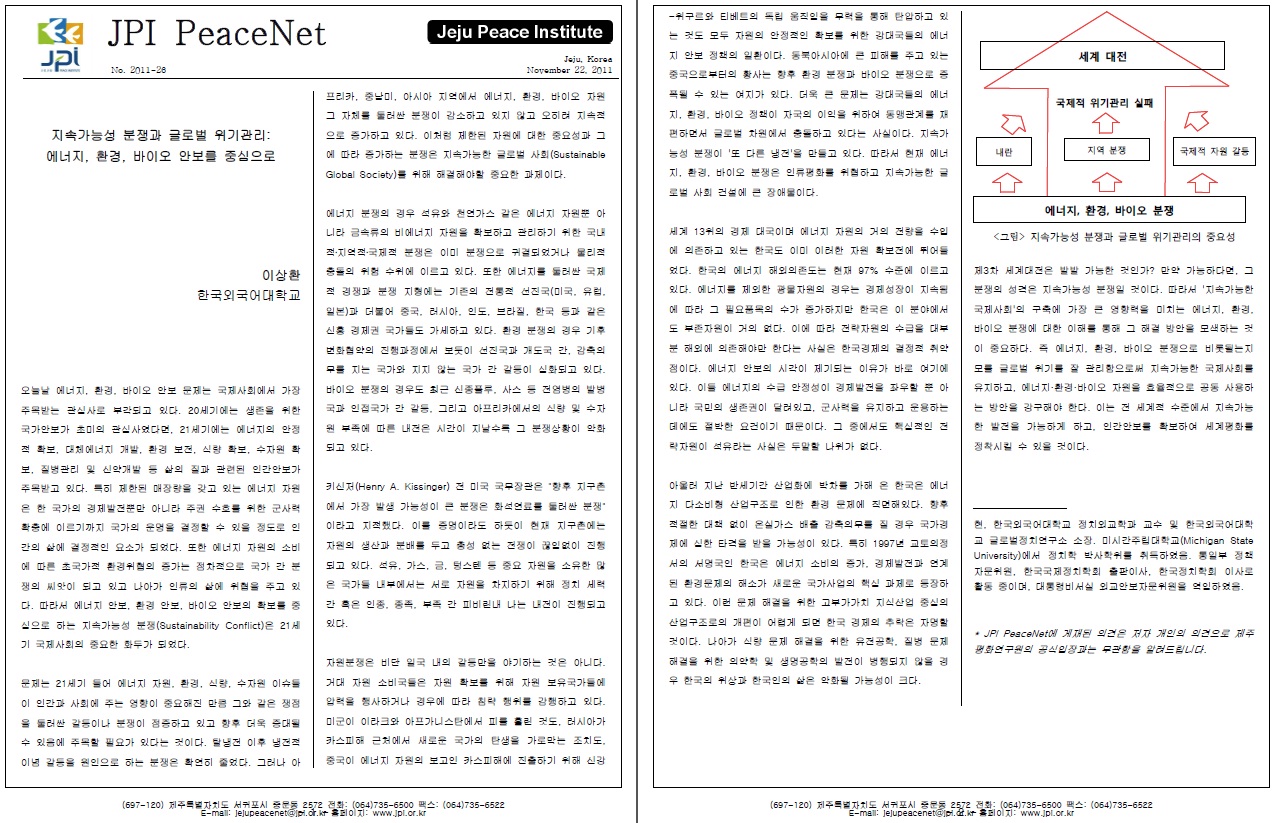
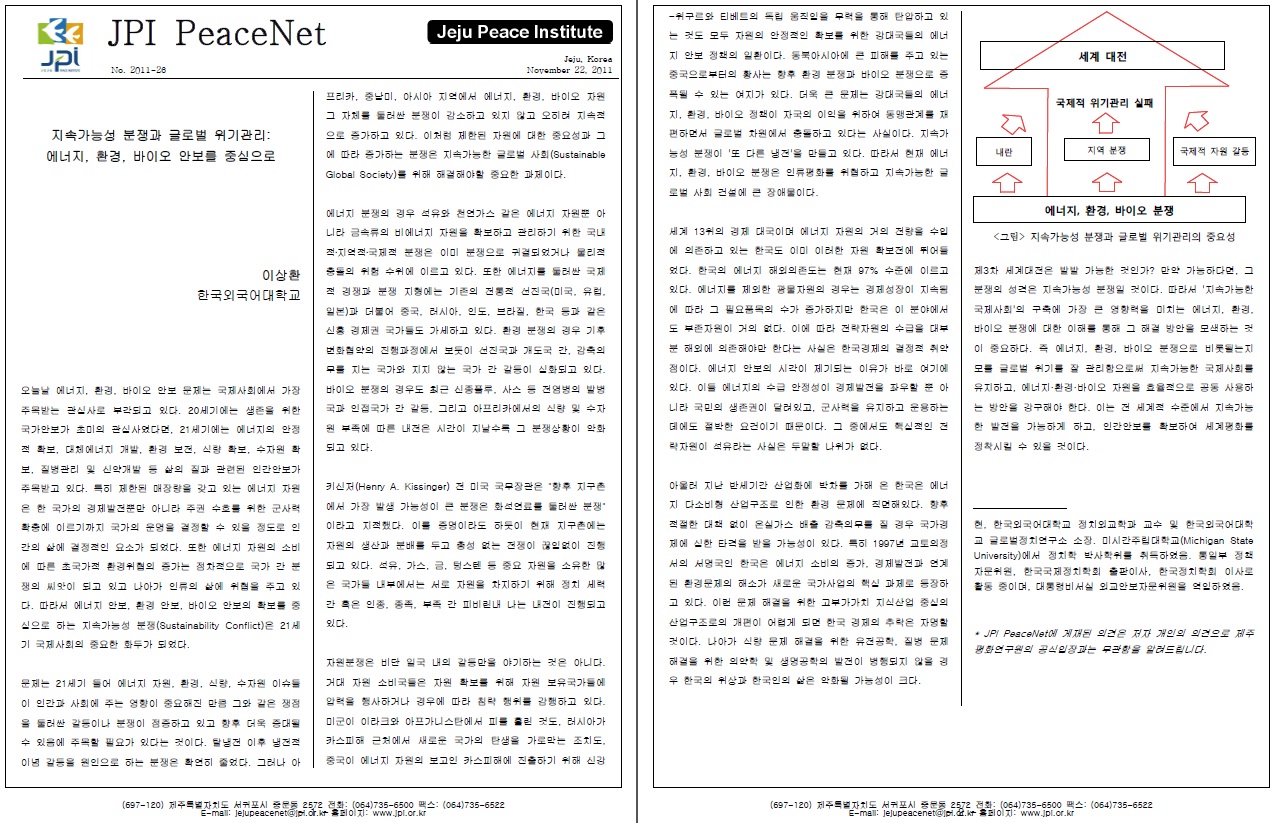
오늘날 에너지, 환경, 바이오 안보 문제는 국제사회에서 가장 주목받는 관심사로 부각되고 있다. 20세기에는 생존을 위한 국가안보가 초미의 관심사였다면, 21세기에는 에너지의 안정적 확보, 대체에너지 개발, 환경 보전, 식량 확보, 수자원 확보, 질병관리 및 신약개발 등 삶의 질과 관련된 인간안보가 주목받고 있다. 특히 제한된 매장량을 갖고 있는 에너지 자원은 한 국가의 경제발전뿐만 아니라 주권 수호를 위한 군사력 확충에 이르기까지 국가의 운명을 결정할 수 있을 정도로 인간의 삶에 결정적인 요소가 되었다. 또한 에너지 자원의 소비에 따른 초국가적 환경위협의 증가는 점차적으로 국가 간 분쟁의 씨앗이 되고 있고 나아가 인류의 삶에 위협을 주고 있다. 따라서 에너지 안보, 환경 안보, 바이오 안보의 확보를 중심으로 하는 지속가능성 분쟁(Sustainability Conflict)은 21세기 국제사회의 중요한 화두가 되었다. 문제는 21세기 들어 에너지 자원, 환경, 식량, 수자원 이슈들이 인간과 사회에 주는 영향이 중요해진 만큼 그와 같은 쟁점을 둘러싼 갈등이나 분쟁이 점증하고 있고 향후 더욱 증대될 수 있음에 주목할 필요가 있다는 것이다. 탈냉전 이후 냉전적 이념 갈등을 원인으로 하는 분쟁은 확연히 줄었다. 그러나 아프리카, 중남미, 아시아 지역에서 에너지, 환경, 바이오 자원 그 자체를 둘러싼 분쟁이 감소하고 있지 않고 오히려 지속적으로 증가하고 있다. 이처럼 제한된 자원에 대한 중요성과 그에 따라 증가하는 분쟁은 지속가능한 글로벌 사회(Sustainable Global Society)를 위해 해결해야할 중요한 과제이다. 에너지 분쟁의 경우 석유와 천연가스 같은 에너지 자원뿐 아니라 금속류의 비에너지 자원을 확보하고 관리하기 위한 국내적·지역적·국제적 분쟁은 이미 분쟁으로 귀결되었거나 물리적 충돌의 위험 수위에 이르고 있다. 또한 에너지를 둘러싼 국제적 경쟁과 분쟁 지형에는 기존의 전통적 선진국(미국, 유럽, 일본)과 더불어 중국, 러시아, 인도, 브라질, 한국 등과 같은 신흥 경제권 국가들도 가세하고 있다. 환경 분쟁의 경우 기후변화협약의 진행과정에서 보듯이 선진국과 개도국 간, 감축의무를 지는 국가와 지지 않는 국가 간 갈등이 심화되고 있다. 바이오 분쟁의 경우도 최근 신종플루, 사스 등 전염병의 발병국과 인접국가 간 갈등, 그리고 아프리카에서의 식량 및 수자원 부족에 따른 내전은 시간이 지날수록 그 분쟁상황이 악화되고 있다. 키신저(Henry A. Kissinger) 전 미국 국무장관은 "향후 지구촌에서 가장 발생 가능성이 큰 분쟁은 화석연료를 둘러싼 분쟁"이라고 지적했다. 이를 증명이라도 하듯이 현재 지구촌에는 자원의 생산과 분배를 두고 총성 없는 전쟁이 끊임없이 진행되고 있다. 석유, 가스, 금, 텅스텐 등 중요 자원을 소유한 많은 국가들 내부에서는 서로 자원을 차지하기 위해 정치 세력 간 혹은 인종, 종족, 부족 간 피비린내 나는 내전이 진행되고 있다. 자원분쟁은 비단 일국 내의 갈등만을 야기하는 것은 아니다. 거대 자원 소비국들은 자원 확보를 위해 자원 보유국가들에 압력을 행사하거나 경우에 따라 침략 행위를 감행하고 있다. 미군이 이라크와 아프가니스탄에서 피를 흘린 것도, 러시아가 카스피해 근처에서 새로운 국가의 탄생을 가로막는 조치도, 중국이 에너지 자원의 보고인 카스피해에 진출하기 위해 신강-위구르와 티베트의 독립 움직임을 무력을 통해 탄압하고 있는 것도 모두 자원의 안정적인 확보를 위한 강대국들의 에너지 안보 정책의 일환이다. 동북아시아에 큰 피해를 주고 있는 중국으로부터의 황사는 향후 환경 분쟁과 바이오 분쟁으로 증폭될 수 있는 여지가 있다. 더욱 큰 문제는 강대국들의 에너지, 환경, 바이오 정책이 자국의 이익을 위하여 동맹관계를 재편하면서 글로벌 차원에서 충돌하고 있다는 사실이다. 지속가능성 분쟁이 '또 다른 냉전'을 만들고 있다. 따라서 현재 에너지, 환경, 바이오 분쟁은 인류평화를 위협하고 지속가능한 글로벌 사회 건설에 큰 장애물이다. 세계 13위의 경제 대국이며 에너지 자원의 거의 전량을 수입에 의존하고 있는 한국도 이미 이러한 자원 확보전에 뛰어들었다. 한국의 에너지 해외의존도는 현재 97% 수준에 이르고 있다. 에너지를 제외한 광물자원의 경우는 경제성장이 지속됨에 따라 그 필요품목의 수가 증가하지만 한국은 이 분야에서도 부존자원이 거의 없다. 이에 따라 전략자원의 수급을 대부분 해외에 의존해야만 한다는 사실은 한국경제의 결정적 취약점이다. 에너지 안보의 시각이 제기되는 이유가 바로 여기에 있다. 이들 에너지의 수급 안정성이 경제발전을 좌우할 뿐 아니라 국민의 생존권이 달려있고, 군사력을 유지하고 운용하는 데에도 절박한 요건이기 때문이다. 그 중에서도 핵심적인 전략자원이 석유라는 사실은 두말할 나위가 없다. 아울러 지난 반세기간 산업화에 박차를 가해 온 한국은 에너지 다소비형 산업구조로 인한 환경 문제에 직면해있다. 향후 적절한 대책 없이 온실가스 배출 감축의무를 질 경우 국가경제에 심한 타격을 받을 가능성이 있다. 특히 1997년 교토의정서의 서명국인 한국은 에너지 소비의 증가, 경제발전과 연계된 환경문제의 해소가 새로운 국가사업의 핵심 과제로 등장하고 있다. 이런 문제 해결을 위한 고부가가치 지식산업 중심의 산업구조로의 개편이 어렵게 되면 한국 경제의 추락은 자명할 것이다. 나아가 식량 문제 해결을 위한 유전공학, 질병 문제 해결을 위한 의약학 및 생명공학의 발전이 병행되지 않을 경우 한국의 위상과 한국인의 삶은 악화될 가능성이 크다. <그림> 지속가능성 분쟁과 글로벌 위기관리의 중요성 제3차 세계대전은 발발 가능한 것인가? 만약 가능하다면, 그 분쟁의 성격은 지속가능성 분쟁일 것이다. 따라서 '지속가능한 국제사회'의 구축에 가장 큰 영향력을 미치는 에너지, 환경, 바이오 분쟁에 대한 이해를 통해 그 해결 방안을 모색하는 것이 중요하다. 즉 에너지, 환경, 바이오 분쟁으로 비롯될는지 모를 글로벌 위기를 잘 관리함으로써 지속가능한 국제사회를 유지하고, 에너지·환경·바이오 자원을 효율적으로 공동 사용하는 방안을 강구해야 한다. 이는 전 세계적 수준에서 지속가능한 발전을 가능하게 하고, 인간안보를 확보하여 세계평화를 정착시킬 수 있을 것이다. 이 글에 포함된 의견은 저자 개인의 견해로 제주평화연구원의 공식입장과는 무관합니다. * 현, 한국외국어대학교 정치외교학과 교수 및 한국외국어대학교 글로벌정치연구소 소장. 미시간주립대학교(Michigan State University)에서 정치학 박사학위를 취득하였음. 통일부 정책자문위원, 한국국제정치학회 출판이사, 한국정치학회 이사로 활동 중이며, 대통령비서실 외교안보자문위원을 역임하였음. -
- 저자
- Artyom LUKIN(Far Eastern Federal University)
- 발간호
- 2011-25
Despite having a Pacific coastline of 16,700 miles, Russia is a late-comer in regards to Asia-Pacific regionalism. Due to the Cold War, the Soviet was shut out from regional cooperation, having instead to rely on bilateral ties with few allies. Following the end of the bipolar confrontation in the early 1990s, Russia strove to integrate itself into Asia-Pacific multilateral bodies.Despite joining APEC and ARF, Russia, due to domestic turmoil, ceased to be a major factor in the Asia-Pacific during the 1990s. However, during Putin’s and Medvedev’s presidential tenures, Russia managed to substantially improve its internal situation, enabling Moscow to embark on more pro-active foreign policies in the 2000s.One of the signs of Russia’s return to the Asia-Pacific has been its involvement in the region’s key security forums. In 2003, Russia became one of the co-sponsors of the Six-Party talks. In 2010, Russia finally secured an invitation to join the East Asia Summit, along with the United States. In 2010 Russia also joined the ASEAN Defense Ministers Meeting process (ADMM+8). Thus Russia now holds membership in all the Asia-Pacific multilateral security-political bodies SPT, ARF, ADMM+8, and EAS.Russia views its involvement in the Asia-Pacific security forums as a kind of guarantee that its voice will be heard and heeded. Russia’s preferred model for the Asia-Pacific political order is a multi-polar concert system, where Moscow is one of the major players, along with Beijing, Washington, Tokyo, New Delhi, and perhaps Seoul and Jakarta. The Kremlin emphasizes the role of the Six-Party talks as not only the diplomatic vehicle for North Korea denuclearization, but also as the mechanism for “the creation of reliable political and legal guarantees of security in Northeast Asia”. At the same time, Russia wants to see the East Asia Summit as an umbrella political grouping in the Asia-Pacific.While Russia has secured full representation in the Asia-Pacific political institutions, in the economic arena its presence can be characterized as very modest at best. Russia accounts for roughly one per cent of the region’s total trade. APEC remains the only regional economic grouping Russia participates in. Russia is one of the very few economies in the Asia-Pacific that have no free trade agreements in the region. Moscow clearly sees the danger of its increasing economic marginalization in the Asia-Pacific and seems determined to change this. In 2010, Russia launched formal FTA negotiations with New Zealand. FTAs with Vietnam and Singapore are also being studied.Russia’s efforts to engage with the Asia-Pacific is one element in its three-pronged strategy of regional integration, the other two dimensions being the Russian-led integration of the post-Soviet space and closer cooperation with the European Union. Moscow’s paramount goal is to secure economic reintegration of the post-Soviet space, which should come in the form of the Eurasian proposed by Vladimir Putin in October 2011. The number two priority is integration with the European Union, which accounts for the bulk of Russia’s foreign trade. Indeed, according to Putin, the Eurasian should become part of “Greater Europe”. At the same time, Moscow has an ambitious goal of turning the Eurasian into a link between Europe and the Asia-Pacific.Russia’s integration into the highly competitive Asia-Pacific markets will only make sense if it can identify and exploit niche areas where its economy has comparative advantages. It appears that Russia’s preferred model of economic integration into the Asia-Pacific has similarities to Canada’s and Australia’s in that it seeks to combine large-scale exports of natural resources with the strong emphasis on innovative sectors such as high-tech, science and higher education. It remains to be seen, of course, whether Russia will be as successful as Canada and Australia in pursuing this path.The success of Russia’s efforts at regional integration significantly depends on whether it has the support of the established Asia-Pacific powers. China is Russia’s main “strategic partner” in the region. In 2010 it overtook Germany to become Russia’s biggest trading partner. However, it is doubtful that China will ever make it a priority to help Russia become a full-fledged member of the Asia-Pacific system of economic cooperation. Beijing is quite content with having Russia as a reliable supplier of raw materials and is interested in keeping this resource base to itself rather than facilitating Russia’s links to other Asia-Pacific markets.Another major Asia-Pacific economy, Japan, although presumably interested in weaning Russia away from growing dependence on China, is unlikely to do much to assist Russia’s regional aspirations. This is, of course, mainly because of the ill-fated dispute over the South Kuriles/Northern Territories still poisoning relations between Moscow and Tokyo.This leaves another Asia-Pacific power, the United States. It is remarkable that of all the areas, where Moscow’s and Washington’s geopolitical concerns overlap, it is the Asia-Pacific where their interests are least conflicting and most compatible, whereas in Eastern Europe, the Caucasus, and Central Asia, Russia and America are competitors rather than partners. These two powers do not have irreconcilable disagreements in the Pacific. Although Moscow’s influence in Northeast Asia has grown somewhat in recent years, it is too weak to be perceived by Washington as an actual, or even potential, challenge. Russia’s central geopolitical interest in the region is to retain effective control over its Pacific territories, not to expand at the expense of others. This is well understood in Washington. It is also important that both Russia and the United States want to hedge against geopolitical uncertainties stemming from China’s rise.Being non-Asian powers culturally and historically, both Russia and the United States face the risk of being marginalized if the Northeast Asian/East Asian integration evolves towards an exclusive Asian club. That is why Russia and the United States are naturally interested in preserving the trans-Pacific dimension of Asia-Pacific institution building. APEC, as the leading trans-Pacific institution, could become a good venue for promoting Russia’s and America’s common interests in the Asia-Pacific. Furthermore, joining the American-led Trans-Pacific Partnership, as a long-term prospect, might be a way for Russia to expand its ties to the Asia-Pacific, as well as strengthen its relationship with the United States.이 글에 포함된 의견은 저자 개인의 견해로 제주평화연구원의 공식입장과는 무관합니다.* Artyom LUKIN is Associate Professor and Deputy Director for Research at the School of Regional and International Studies, Far Eastern Federal University (Vladivostok, Russia). His main research interests focus on regional security and international political economy in the Asia-Pacific and Northeast Asia. Artyom LUKIN has authored over 40 scholarly publications in Russian and English. -
두만강개발사업과 동북아시아 경제협력 조회수 6
- 저자
- ZHU Shu(두만강개발사업 사무국)
- 발간호
- 2011-14
지역경제협력의 플랫폼, 두만강개발사업 1990년대 유엔개발계획(UNDP: United Nations Development Programme)에서 시작한 두만강개발사업(GTI: Greater Tumen Initiative, 전 두만강지역개발계획프로그램(Tumen River Area Development Programme))은 중국, 몽고, 한국, 러시아연방을 회원국으로 활발한 경제협력의 다면적 다정부 플랫폼이 되어왔다. 1995년 북한을 포함한 5개의 최초 회원국들1)이 서명했던 협약에 따르면, 두만강개발사업의 주요 목적은 동북아시아 국민과 국가들을 위해 더 큰 성장과 지속가능한 개발을 이루어낼 수 있도록 두만강 지역에 지리적 초점을 맞추어 경제협력을 강화하는데 있다. UNDP의 지원을 받는 두만강개발사업은 회원국 간 정책대화를 확대하고, 교통 인프라, 에너지 안보, 관광개발, 무역촉진, 투자증진 등과 같은 분야에서 지역협력에 유리한 환경을 조성하는 촉매제 역할을 하고 있다.두만강개발사업 회원국들은 매년 정부간 자문위원회의(Consultative Commission Meeting, 차관급)를 개최한다. 또한 협력활동을 촉진하기 위해 두만강개발사업 사무국을 운영하고, 각 부문의 고위급관리로 구성되는 다정부 이사회를 설립하는 등 재정적·제도적 도구를 발전시켜왔다. 두만강개발사업은 UNDP의 지원을 받는 동시에 다양한 주요 국제적·지역적 NGO, 금융기관, 학계, 민간부문들과 협력하고 있다. 예를 들어 두만강개발사업 기업자문위원회(Business Advisory Council)는 지역경제협력 분야에서 민간부문의 참여를 격려하고 지지하기 위해 민관 파트너십 메커니즘으로서 창설되었다. 동북아시아의 경제협력 및 개발은 거대한 잠재력을 가지고 있다. 동시에 동북아시아는 역사적 분쟁, 국제적 권력투쟁, 한반도 긴장상태, 다양한 정치체계, 개발과 관련된 이해갈등으로 인한 지정학적 복잡성을 보이고 있다. 두만강개발사업을 통한 협력은 경제성장 촉진을 목표로 하고 있지만, 다른 한편으로는 이웃국가 사이의 상호신뢰를 강화하는 주요 수단이 되어 동북아시아의 평화와 안정에 간접적으로 기여할 수 있다. 북한 및 일본과 두만강개발사업 동북아시아에 초점을 맞춘 협력 사업으로써 두만강개발사업은 동북아시아에서 북한 및 일본과의 관계를 중요 의제로 다루어왔다. 예를 들어 2010년 9월 중국 장춘에서 열린 제11회 두만강개발사업 자문위원회의에서 회원국들은 지역협력에 모든 동북아시아 국가들이 참여하는 것이 중요하다고 강조하였다.2) 북한의 두만강개발사업 재참여와 관련하여, 지역 정세가 긍정적인 방향으로 변화하고 있다. 첫째, 두만강개발사업 회원국인 중국이 북한의 두만강개발사업 재참여를 지지하고 있다. 북한이 가장 중요한 우방국인 중국의 격려를 받는다면, 두만강개발사업 재참여에 대한 관심과 확신을 높일 수 있을 것이다. 6월초 북한과 중국은 세 개의 경제특구(황금평, 위화도, 북한 탈퇴 전 두만강개발사업 핵심지역 중 하나였던 라선경제무역지대) 설치에 합의하였다. 이 세 개의 경제특구를 통하여 양국 간 경제·무역협력뿐만 아니라 세계의 다른 지역과의 경제·무역협력을 증진시켜줄 수 있다. 이 경제특구들은 동북아시아 지역에서 북한과 중국의 경제가 성장하는데 긍정적인 영향을 줄 것으로 기대된다. 북한과 중국의 긴밀한 경제협력과 북한의 경제개발에 대한 열정을 고려해봤을 때, 북한이 두만강개발사업 회원국들의 재참여 제안을 신중히 검토할 가능성이 높다. 북한은 두만강개발사업을 이용해 보다 쉽게 경제특구뿐만 아니라 북한 경제를 전반적으로 발전시킬 수 있을 것이다. 둘째, 북한은 경제개혁과 재생 가능한 에너지 같은 분야에서의 발전을 지지해줄 파트너들이 필요하다. 북한은 자원, 정보, 기술, 경험이 부족하다. 그러므로 두만강개발사업 재참여는 보다 많은 자원을 확보하고, 회원국가 및 국제 파트너들의 지지를 받을 수 있는 현실적인 대안이 될 수 있다. 셋째, 북한의 천안함 어뢰 발사와 연평도 포격으로 인한 남북한 사이의 분쟁에도 불구하고, 두만강개발사업을 통해 남북한 경제협력이 재개되거나 적어도 논의될 수 있을 것이다. 또 두만강개발사업 회원국의 지지를 받아 남북한은 점진적으로 신뢰를 구축할 수 있을 것이다. 두만강개발사업 틀 안에서 북한과 경제협력을 재개한다면, 이는 북한과의 관계 개선에 대한 남한정부의 연속성 있는 노력을 보여주는 것이다. 이는 2012년이 대한민국 대선이 치뤄지는 해라는 것을 고려할 때 매우 중요한 조치가 될 것이다. 두만강개발사업 회원국들과 북한 사이의 협력은 우선 정부관리 역량구축이나 라선경제무역지대 투자증대와 같은 구체적인 프로젝트 활동을 가지고 시작할 수 있을 것이다. 그리고 협력의 기반이 다져지면 두만강개발사업 틀 안에서 협력 증대를 위한 논의를 확대해나갈 수 있을 것이다. 일본 서해안지방의 현정부가 일본중앙정부보다 두만강개발사업에 더 큰 관심을 보이고 있다. 돗토리, 니가타, 아키타와 같은 서해안지방은 투자 및 무역활동뿐만 아니라 동북아시아 교통네트워크 구축과 관광증진활동 분야에서 두만강개발사업 회원국들과 활발하게 협력하고 있다. 최근 일본 서해안지방 현정부에서 두만강개발사업 협력에 대한 관심이 계속적으로 증가하고 있다. 실제적인 협력활동을 통해 두만강개발사업 회원국과 일본 사이의 전략적 파트너십을 구축하고 있으며, 이는 또한 가까운 미래에 일본의 두만강개발사업 참여를 위한 견고한 기반이 되고 있다. 두만강개발사업 지방협력 매커니즘(GTI Local Cooperative Mechanism)은 지역 프로젝트와 협력활동을 공동 촉진하는데 (일본과 북한뿐만 아니라 두만강개발사업 모든 회원국을 포함하는) 동북아시아 지역 지방정부들의 참여를 격려하기 위해 창설되었다. 이 메커니즘은 지방수준에서의 실질적인 협력이 이루어지도록 돕는 특별 협력네트워크 역할을 하고 있다. 동북아시아의 협력 전망 약 20년 간 발전해 온 두만강개발사업은 지금 교차점에 서 있다. 두만강개발사업은 두만강 지역에 초점을 맞춘 UNDP 프로그램에서 동북아시아 전 지역을 타깃으로 하는 발전된 다정부 협력 플랫폼으로 변신하고 있다. 두만강개발사업은 민간부문 참여를 독려하고 이와 더불어 지방수준에서 구체적인 프로젝트 협력을 증진시키고, 동북아시아 국가 간의 의견교환 및 정책대화를 촉진시키는데 있어 주요 역할을 하고 있다.두만강개발사업은 앞으로 북한과 일본이 참여해야만 동북아시아 지역협력의 플랫폼으로서의 잠재력을 발현할 수 있을 것이다. 두만강개발사업에 대한 일본 서해안지방 현정부에서 관심이 증가하고 있는 점과 북한의 경제개방을 위한 움직임이 동북아시아 통합을 향하여 두만강개발사업에 긍정적인 영향을 미치고 있다.1) 두만강개발사업의 전신인 두만강지역개발프로그램이 1995년 UNDP의 지지를 받으며 북한, 중국, 한국, 몽고, 러시아연방 등 5개의 최초 회원국들의 서명을 받아 공식적으로 출범하였다. 북한은 2009년 11월 두만강개발사업에서 탈퇴했다.2) 장춘 선언이 글에 포함된 의견은 저자 개인의 견해로 제주평화연구원의 공식입장과는 무관합니다.* 現 UNDP의 지원을 받는 동북아시아의 다정부 협력 메커니즘인 두만강개발사업 사무국(GTI Tumen Secretariat) 수석프로그램담당관(Senior Programme Officer). 유럽 에라스무스 문두스 프로그램(European Erasmus Mundus programme) 석사과정에서 비교지방개발을 전공하였으며, 대중매체 및 개발부문에 다양한 경험을 가지고 있음. -
- 저자
- FANG Xiu Yu(Professor, Fudan University)
- 발간호
- 2011-12
The human race has undergone so many wars that human history can be viewed as a dialectical cycle of war and peace. A complex international structure has developed in the world where a party seeks resolution to one conflict through peace talks while other conflicts continue or have been unresolved from war that broke out in an earlier war vortex. While such a cycle is being repeated, a new order is appearing in Northeast Asia. Therefore, it is necessary for us to examine what types of development Korea and China should seek under such new changes in the region.New Northeast Asian Order in the Post Cold War EraThe Northeast Asian region stood at the center of the Cold War after World War II though it was not in the center of international politics. The international order in Northeast Asia, including the Korean peninsula, was formed under a triple-structure framework with Japan and China playing a limited role under the leadership of the US and the USSR, and the division system of North and South Korea operating under this structure. The collapse of one axis between this bi-polar system that continued for 40 years after World War II directly affected the international situation in Northeast Asia.The post-Cold War order in Northeast Asia shows the below-listed characteristics:First, the drastic setback of the CIS (or USSR) force and a relative decrease of US influence can be cited.Second, the US remained an exclusive super power in the world after the former USSR dissolved but the US needed stronger multilateral cooperative organizations rather than playing the role of a police state that could resolve world disputes with its own force.Third, China recorded rapid economic growth by steadily promoting reform and opening up to the world. With time, China has climbed to a position of a truly great nation in terms of national power. In particular, China’s voice has become stronger in dealing with Asian issues. China is required more and more to adapt to the international political and economic order as her national power increases.Fourth, Japan still belongs the rank of major world powers in terms of national power though its international position appears to have shrunk due to domestic and economic difficulties, which are a result of the collapse of the bubble economy and the emergence of China’s rapid economic growth.Thus, Northeast Asia is a unique region of the world where the position and interests of the four major world powers acutely overlap. It is in a position in which the situation in the region does not change or is not set up by the role of any one country.Development of Korea-China Relations after Re-establishment of Diplomatic TiesThe leaders of both Korea and China finally established a normalized relationship by attempting to improve Korea-China relations at a time when the international regime switched from a bi-polar to a multi-polar system, after the Cold War ended.The Korea-China relations that started in economic and trade areas extended in all directions, after their leaders visited one other on multiple occasions and enhanced their mutual understanding and trust through diverse channels, including meetings at international multi-party gatherings.Economically, China has already become Korea’s greatest trading and investment partner, since 2002. Korea is China’s fifth largest trading partner and its greatest investment partner is China. Exchanges between Korea and China in cultural areas have actively progressed day after day in political and economic areas.As a conclusion, China has been able to simultaneously secure economic and political interests in South Korea and political strategic interests in North Korea, after normalizing Korea-China diplomatic relations. On the other hand, South Korea has been able to heighten its international position in national security, politics, diplomacy, economy, trade, social and cultural areas after Korea-China diplomatic relations were re-established.Future Developments in Korea-China RelationsThough Korea and China have so far maintained a relatively stable relationship since their diplomatic normalization, various problems have been exposed between them such as the relations between other countries. Therefore, the two countries need to succeed in resolving their differences regarding various areas in order to steadily improve their relations in the future, after resolving existing problems.The two countries need to adhere to the principle of a peaceful coexistence in international relations. It can be said to be only a matter of time for some conflicts to arise in their mutual exchanges or cooperation as they have maintained differing political systems, ways of thinking, and economic development models for several decades. Therefore, the principle of a peaceful coexistence is believed to be conducive to developing cooperative relations between differing social systems.That is to build an understanding of, and trust in, traditional culture. Their geographic proximity and historical and cultural closeness may support exchanges and cooperation between the two countries at a higher level. It is critical for North and South Korea to solidify their relations for the future of Korea-China relations. This will be a primary element in the process of Korean reunification as it will prepare a foundation for a unified Korea by removing diverse frictions existing in North and South Korean societies as well as helping to overcome political and economic divisions between North and South Korea.The two countries should recognize and utilize their mutually beneficial economic structure. Mutual relations for economic cooperation exist between Korea and China at multiple levels in connection with their natural environments and economic structures. China needs to learn advanced technologies and models for business management, and economic development that Korea has accumulated over the years, while Korea needs China’s vitality for active economic growth. The two countries may pursue common benefits by forming an economically optimal, mutually beneficial cooperative structure between Korea’s advanced scientific and IT technologies and China’s vast market, affluent workforce, and natural resources. Therefore, Korea and China need to strive to maximize the creation of common values by simultaneously revitalizing their economies and trade while recognizing the economic structure that supports a mutually beneficial cooperation between the two countries.Korea and China need to remove various impeding factors that obstruct the progress of the relations between the two countries by expanding exchanges and cooperation, and developing and implementing practical policies through joint efforts. The factors that impede the progress of the relations between Korea and China are relatively few. If such factors are neglected, however, they will adversely affect the steady development of their relations.In general, the bi-lateral relations between Korea and China need to progress in a mature, practical way that satisfies the national interests of the two countries. To that end, the two countries need to develop feasible ideas, implement plans, and be equipped with capabilities to take advantage of opportunities in a pro-active manner. The relations between Korea and China will become closer at multiple levels in the future.* The views expressed here are those of the author and do not reflect the position of the Jeju Peace Institute.이 글에 포함된 의견은 저자 개인의 견해로 제주평화연구원의 공식입장과는 무관합니다.* FANG Xiu Yu is a Professor at the Institute of International Studies, Fudan University, Shanghai, China. She obtained a Ph.D. degree in politics at Kyungnam University in South Korea after graduating from the Political Science Department at Northeast Teachers University in China in 1986. She has served in Korea as a visiting professor at Chungang University, a research fellow at Sogang University, and an adjunct professor at the Cyber University of Korea. Her books include “China’s Diplomatic Policies and Korea-China Relations,” “Korea’s Diplomacy after the War and China: Theories and Policy Analysis,” “World Politico-economic and International Relations” (joint authored), “Reconciliation and Cooperation: International Relations in Northeast Asia in 30 years” (compiled), and “Ways to Settle Market Systems in North Korea during North-South Commonwealth Era” (joint authored). She published many academic papers, including “Political Situation in North Korea in Transitory Period,” “North Korea’s Withdrawal from NPT and China’s Response,” “Reconsideration of North Korea Policy by KIM Dae-jung Administration,” and “Normalization of Korea-China Relations, Problems and Pursuit of their Solutions.” -
G20에 아시아의 역할 조회수 6
- 저자
- 채욱(대외경제정책연구원)
- 발간호
- 2011-24
많은 이유로 G20이 세계 최고의 경제 포럼이라는 평가를 받는 것은 당연할지도 모른다. 이러한 평가는 초기 G7 구성 과정상의 문제와 종종 연관되어진다. G7의 가장 눈에 띄는 문제 중의 하나는 G7이 선진국으로만 구성되었기 때문에 전 세계의 경제문제와 관련해 중대한 결정을 내릴 특권이 있다고 당당하게 주장할 수 없다. G20이 앞으로 권위를 계속 유지하려면 개발도상국 특히 아시아의 협조가 필요하다. 현재 개발도상국은 전 세계 GDP의 40%정도를 차지하고, 그 비율은 앞으로 수 년간 꾸준히 증가할 것으로 보인다. 아시아의 경제가 현재와 같은 속도로 계속 성장한다면 2050년까지 전 세계 생산량의 반을 아시아에서 생산할 것으로 예측하고 있다. 이러한 예측 때문에 많은 경제학자와 미래학자는 전 세계 경제의 무게중심이 아시아로 이동할 것이라고 보고 있다. 그런데 사실 무게중심은 이미 이동하고 있다.글로벌 경제위기의 발생과 함께 2008년 워싱턴에서 열린 첫 번째 회의부터 지난해 서울에서 열린 정상회담까지 G20이 위기에 대응하기 위해 진행한 모든 노력 단계마다 아시아는 강하게 존재감을 보여왔다. 그리고 국제사회 전체가 위기 극복을 위해 정책면에서 적극적으로 협력하고, 글로벌 경제 거버넌스를 이루기 위한 기본 청사진을 그리려면 아시아 국가들의 협력이 필수적이다. 글로벌 불균형, 국제 금융기관의 개혁, 글로벌 금융 안전망 구축, 발전문제를 논의하기 위한 결의안뿐만 아니라 모든 아젠다와 관련한 주요 문제 전반적으로 아시아 국가들이 가지고 있는 무게와 영향력을 실감할 수 있다. G20이 전 세계 최고의 경제 포럼으로서의 위치를 유지하기 위해서는 아시아 국가들이 끊임없이 역동적인 역할을 수행해야 한다는 것은 당연하다. 이 점은 전 세계 제2 및 제3의 경제대국이 아시아에 있을 뿐만 아니라 전 세계 인구의 60%가 아시아인이라는 사실을 통해서도 잘 알 수 있다. 또한 아시아 지역이 전 세계 외화보유고의 반 이상을 차지하고 있다는 점으로도 아시아의 비중을 볼 수 있다. 글로벌 불균형의 주요 요인이면서, 동시에 불균형을 해결하는 해법을 제시할 수 있다는 점에서 아시아가 세계 경제에서 차지하고 있는 위치는 독특하다. 글로벌 불균형은 G20이 직면한 가장 중요하고 난해한 문제이기 때문에 이를 해결하기 위해 가장 많은 노력을 기울이고 있다. 미국식 소비지상주의를 가장 중요한 유발요인으로 쉽게 지목할 수 있겠지만 아시아 경제구조 안에 견고하게 확립되어 있는 생산 분화도 마찬가지로 책임을 면하기 어렵다. 원자재나 생산재를 한국, 일본, 동남아시아가 무관세 혹은 저관세로 중국에 수출하고 이러한 원자재나 생산재를 중국에서 가공하거나 조립하여 미국이나 유럽에 수출하는 방식으로 아시아의 경제구조가 구축되어 있는 데 이러한 과정에서 글로벌 불균형이 심화되고 있다. 그와 같은 무역이나 생산구조를 본격적으로 개혁하면 만연한 글로벌 불균형을 완화할 수 있는 것은 분명하다. 무역과 생산구조의 개혁은 원자재와 생산재뿐만 아니라 완제품에 대해서도 관세와 비관세 장벽을 완전히 허무는 아시아 국가간의 무역 자유화를 통해 실현할 수 있다. 불균형을 해결하기 위한 또 하나의 처방은 아시아 금융 시장의 안정성을 더욱 높이기 위해서 아시아 국가 간의 통화협력을 강화하는 것이다. 이와 같은 조치를 통해 각 국가가 외환보유고 확대에 덜 집착하도록 유도할 수 있다. 이러한 점에서 동아시아 국가 사이에 형성된 치앙마이 이니셔티브 다자화(CMIM: Chiang Mai Initiative) 체제를 더욱 강화하고 확대할 필요가 있다. G20과 전 세계에게 중대한 발전문제와 관련하여 아시아 국가가 더욱 적극적으로 역할을 수행할 것이라는 기대를 하고 있다. 특히 아시아는 주요 원조국과 수혜국이 공존하는 지역임을 주목할 필요가 있다. 아시아 지역에는 한국, 일본, 떠오르는 경제대국 중국, 남남 협력을 주도하고 있는 인도와 같이 OECD 개발원조위원회 회원국이 있는 동시에 일부 동남아시아 국가와 같은 막대한 국제 원조의 수혜국이 있다. 아시아의 지역개발을 위한 협력체제를 아시아 내에서 조직한다면 원조와 개발을 목표로 한 글로벌 체제를 개선할 가능성이 아주 높아질 것이다. 경제적 성장과 함께 냉철한 결단력을 발휘하고 노력을 기울였기 때문에 아시아 경제는 꾸준히 주목받을 수 있는 유리한 위치에 있었다. 그러나 현재 G20이 글로벌 차원의 중요한 문제를 해결하기 위한 정책을 결정하는 과정에서 아시아 국가들에게 더욱 적극적인 역할을 요구하고 있기 때문에 아시아 국가는 정치 및 경제적 역량 면에서 더욱 강해져야 할 필요가 있다. 이와 같은 요구를 충족하기 위해서 아시아 국가들은 자국의 시장 시스템과 민주적인 제도를 강화해야 할 것이다.이 글에 포함된 의견은 저자 개인의 견해로 제주평화연구원의 공식입장과는 무관합니다.* 현 대외경제정책연구원 원장. 국민경제자문회의 위원으로 활동하고 있음. -
북한 인권문제와 한국의 대응 조회수 6
- 저자
- 제 성호(중앙대 법과대학 교수, 인권대사)
- 발간호
- 2009-13
최근 국제사회에서 북한 인권문제가 관심과 주목을 받는 가운데, 북한 인권 증진을 위한 국제협력도 강화되는 추세이다. 2005년 12월 이래 유엔 총회에서 북한 인권 결의가 연속 네 차례 채택된 것은 그 대표적인 예다. 금년만 해도 3월 호주 멜버른, 4월 워싱톤, 7월 도쿄, 9월 서울과 토론토 등지에서 대규모의 북한 인권 행사들이 열렸다. 이들은 열악한 북한 인권 참상을 더 이상 외면할 수 없다는 인류 양심의 표현이자, 인권 개선을 촉구하는 시민들의 단합된 행동을 대변하고 있다. 북한 인권문제는 본질상 3가지 측면을 내포하고 있다. 이에 대한 균형감 있는 시각을 갖는 게 필요하다. 첫째, 북한 인권문제는 (국제사회가 당면한) 심각한 ‘인권문제’ 중 가장 중요한 일부이다. 2008년 12월 유엔 총회는 이란, 미얀마, 북한 등 3개국의 인권 결의를 채택했다. 이런 사실만 봐도 북한 인권 상황이 세계 최악의 수준에 있음을 알 수 있다. 인권은 체제와 이념, 성별과 국경을 떠나서 모든 사람에게 인정되는 가치이자 권리이다. 말하자면 보편적 가치(universal value)의 문제인 것이다. 인간으로 대접받지 못한 채 ‘매 맞고, 끌려가며, 피 흘리며, 굶어 죽어가는’ 북한 주민들의 비인간적인 삶을 같이 아파하고 그 개선을 위해 노력하는 것은 세계시민의 한 사람으로 마땅히 감당해야 할 도리요 의무라 할 수 있다. 그러기에 세계 최악의 북한 인권에 침묵하는 것은 정당화될 수 없다. 둘째, 북한 인권문제는 ‘북한문제’의 중요한 일부이다. 북한문제에는 인권문제 외에도 핵문제, 경제난, 식량난과 인도적 지원, 외교적 고립의 타개(특히 대미일 관계 개선), 권력승계(후계체제 안정) 등이 있다. 하지만 이 모든 문제들은 강고한 수령독재체제와 비효율적인 사회주의 계획경제체제에서 비롯되는 것이다. 즉, 독재와 폐쇄가 오늘의 북한을 규정하며 제약하고 있는 셈이다. 북한이 처한 온갖 어려움을 완화해소하는 길은 두말할 것도 없이 북한이 선군독재(Military-First Dictatorship)가 아니라 ‘선민정치’(People-First Politics)를 베푸는 데 있으며, 이는 다시 주민의 인권 개선 및 대외 개방 등과 직결돼 있다. 이렇게 본다면, ‘북한문제의 근본적 해결’을 위해서는 당면한 북핵문제에만 단선적이고 대증요법적 차원에서 접근해서는 곤란하며, 인권 개선과 민주화에도 관심을 기울여야 한다는 점을 알 수 있다. 셋째, 북한인권문제는 우리가 직면한 ‘통일문제’의 중요한 일부이기도 하다. 우리가 추구하는 통일은 자유민주통일이며, 민족 성원 모두의 자유복지인간 존엄성이 존중보장되는 내용의 통일이다. 그럴진대 북한 주민의 인권 개선을 추구하지 않는 대북정책은 그 자체 반인권적반민족적일 뿐만 아니라, 우리의 통일철학 및 이념과도 맞지 않는다. 이런 점에서 지난 시기 ‘인권 개념’을 등한시 했던 대북정책은 깊이 반성해야 마땅하다. 흔히 북한 인권문제라고 말하지만, 여기에는 다양한 내용과 수준의 인권문제가 포함되어 있다. 첫째는 ‘북한주민’의 인권 문제다. 지금 북한 주민들은 정치범수용소, 반문명적인 공개처형, 고문과 학대, 이중삼중의 감시와 성분 차별, 사상표현의 자유 침해, 기아와 영양실조 등을 겪고 있다. 총체적으로 북한주민의 인권문제는 ‘수령독재’의 산물이라 할 수 있는데, 이는 ‘체제’와 관련된 ‘구조적’인 것이라고 할 수 있다. 또한, 전 사회분야에 걸쳐 있다는 점에서 ‘광범위’하며, 역사적 뿌리가 깊다는 점에서 장기적이고 고질적이다. 따라서 장기적인 안목을 가지고 해결을 추구하는 것이 현실적이다. 둘째는 ‘탈북자’의 인권문제다. 탈북자문제는 ‘식량난경제난’의 산물이라 할 수 있다. 이는 북한 당국이 그들 주민에 대해 생활의 기본적 수요를 충족시켜야 할 책임을 다하지 못함으로써 발생한다. 곧, 북한 정권이 생존의 위협에 처한 주민들을 품어주지 못하고 밖으로 밀어내는 현상이 ‘탈북’인 것이다. 탈북자들의 경우 신변의 안전 위협, 체포 시 대북 강제송환, 노동력임금 착취, 인신매매 또는 강제결혼, 감금린치학대 등 다양한 형태의 가혹행위, 보호소 수용 과정에서의 고문 등 비인간적 처우, 탈북자 자녀(아동)의 무국적 상태 발생 등 다양한 형태의 인권침해가 발생하고 있다. 이는 북한 주민의 그것들과는 다른 차원의 것이다. 특히 탈북자의 인권문제는 중국러시아 등 접경지역에 그치지 않고, 생존과 안전을 위해 제3국(주로 동남아)으로 월경, 유랑함으로써 ‘문제의 광역화’를 초래하고 있다. 이 같은 절박한 인권침해에 지금 국제사회는 보다 직접적이고 즉각적인 관심을 보이고 있다. 유수한 국제 NGO들은 탈북자들에게 난민의 지위(Refugee Status)를 부여하는 것이 무엇보다 시급하다고 보고 있다. 하지만 1차 피난지국인 중국은 물론, 2차 피난지국인 태국캄보디아라오스 등 관련국들이 난민의 지위를 인정하길 거부하고 있다. 셋째는 남북관계에서 발생하는 인권문제이다. 여기에는 이산가족문제, 납북자국군포로의 문제가 있다. 이산가족문제는 3년간에 걸친 한국전쟁의 결과 발생한 것으로 이를테면 ‘전쟁’의 산물이라 할 수 있다. 하지만 반세기가 넘도록 근원적인 해결을 보지 못하고 있어, 아직까지도 가장 대표적인 분단 고통의 상징으로 남아 있다. 그간 이산가족문제는 주로 인도적 차원에서 다루어져 온 게 사실이다. 하지만 이산가족문제 또한 엄연히 가족권(family rights)이란 인권의 문제라고 할 것이다. 이산가족들은 지금 가족 성원간의 연락 및 접촉, 안부를 전할 권리, 귀향의 권리가 거부 당하고 있다. 다음, 납북자문제는 납치테러리즘이란 ‘범죄’의 산물이라 할 수 있다. 자기 의사에 반한 납치와 강제연행, 불법억류가 개재돼 있다. 무조건 원상회복이 이루어져야 하나, 북한은 납북자의 존재를 부정하고 있다. 반면 자진 월북자 내지 의거 입북자라고 강변하고 있다. 때문에 이들은 자유의사 표명의 기회뿐만 아니라, 본국(대한민국) 관리와의 접견 및 영사보호 등 인권이 박탈당하고 있다. 누구나 자기의 원거주지로 돌아갈 권리가 있으나, 이것마저 거부당하고 있다. 북한체제가 싫어 제 발로 남으로 내려온 이산가족들과 비교하면, 납북자들의 인권상황은 가히 비극적이다. 마지막으로 국군포로문제는 한국‘전쟁’의 산물인 동시에, 1949년 제네바 제3협약에 따른 포로송환의무 위반, 생존 포로 존재의 은폐 및 강제억류 등 국제인도법 위반(비인도적 범죄)의 결과로 생겨난 문제이다. 즉, ‘전쟁’과 ‘전쟁범죄’가 복합적으로 작용돼 생겨난 것이다. 이들의 처지는 납북자와 비슷하며, 인권문제도 그와 유사한 측면이 있다. 넷째는 기타의 인권문제로서 외국인 납치문제가 있다. 많은 사람들이 납치문제 하면 주로 일본인 납치문제만 연상하지만, 북한이 납치해 나간 외국인은 11개국 38명(일본인 16명, 레바논인 4명, 말레이지아인 4명, 프랑스인 3명, 이태리인 3명, 중국인 2명, 네덜란드인 2명, 태국인 1명, 싱가폴인 1명, 루마니아인 1명, 요르단인 1명)에 달한다. 외국인 납치문제는 2005년 12월 이후 채택된 유엔 총회 결의에서 계속 거론하고 있는 중요한 인권문제이다. 우리가 ‘나 몰라라’ 할 수 없는 사안인 것이다. 이 밖에도 북송 일본인 처의 귀향문제나 최근 언론에 보도되고 있는 베트남전 국군포로문제가 있다. 한 마디로 북한 인권문제는 북한 정권이 존재함으로써 발생하는 것이라고 하겠다. 많은 경우 북한이 인간적 도리와 국제적 규범을 지키지 않음으로써 작금 문제의 심각성이 더해지고 있다. 총체적으로 비인간, 반문명, 무책임, 범죄성에 기인하고 있다고 할 수 있을 것이다. 그러면 우리는 어떻게 북한 인권문제에 대처해 나갈 것인가? 이미 살펴본 바와 같이 북한인권문제는 내용과 수준이 다기하여, 단선적인 방식으로 대처하기가 어렵다. 다음에서는 북한인권 개선의 방향을 몇 가지로 요약, 제시하기로 한다. 첫째, 북한 인권문제는 정부 혼자서, 또한 일거에 해결하기 어려운 문제이다. 물론 우리 정부의 의지와 역할이 중요하다. 하지만 인력과 예산 등 나름의 한계도 있다. 따라서 정부가 국제기구, (국제 및 국내) NGO, 교회, 기업, 시민사회가 함께 대처하는 게 긴요하다. 특히 정부가 나서기 곤란한 때는 오히려 NGO가 적극 목소리를 내는 것이 도움이 될 경우도 있다. 따라서 정부는 이들 행위주체, 특히 NGO와의 적절한 역할분담을 통해 꾸준히 북한인권 증진을 위해 노력하는 것이 바람직하다. 정부는 NGO들의 의견을 최대한 수용해 북한 인권 증진을 위한 종합적체계적인 로드맵을 만들어야 한다. 둘째, 우리 정부는 기본적으로 북한 인권문제를 ‘보편적 가치’의 문제로 접근하고, 다른 문제와 분리해 독자적 해결을 추구해야 한다. 그래야 정치화의 논란을 가능한 한 피할 수 있고, 실질적인 개선을 모색할 수 있다. 보편적 가치와 국제인권규범은 북한인권 개선을 위해 우리가 의지할 수 있는 중요한 잣대가 됨은 두말할 것도 없다. 이런 시각에서 우리 정부는 국제사회의 움직임에 보조를 맞추면서(예컨대, 유엔 총회의 북한 인권 결의 공동제안국 참여 및 찬성 투표), 북한이 국제인권규범을 지키도록 설득권고해야 한다. 특히 북한은 금년 12월 제네바에서 열리는 ‘보편적 정례 인권상황 검토’(Universal Periodic Review: UPR)를 받아야 하는데, 여기에 우리가 적극 참여하여 북한 인권 개선을 촉구해야 할 것이다. 이 밖에도 유엔 총회 결의에서 명시된 북한인권특별보고관의 방북조사에 북한이 협조하도록 인권이사회 이사국 및 관련 국제기구와 공조하는 방안도 적극 추진해야 한다. 다만, 정부가 북한 인권 개선을 추구함에 있어서는 국제무대와 남북대화를 준별하는 자세가 필요하다. 국제무대에서는 주로 북한 주민과 탈북자의 인권문제를 다루는 것이 적어도 현단계에서는 현실적이다. 남북대화에서 가령 정치범수용소를 거론하고 해결을 모색하는 것은 여러 가지 면에서 합당치 못하다. 반면 이산가족납북자국군포로문제는 남북대화에서 해결을 추진하는 게 바람직하다. 남북한은 이들 문제에 관한 합의 생산 및 실천의 경험을 갖고 있기 때문이다. 당면하게는 이산가족 상봉의 정례화가 시급하며, 납북자국군포로문제의 경우 ‘이산가족에 끼워넣는 해결’ 대신 보다 근원적 은 해법을 강구해야 한다. 셋째, 인권 NGO들과 시민사회는 앞으로도 북한 인권문제를 공론화하고, 국민적 관심을 환기하는 노력을 계속 전개해야 한다. 더불어 이 문제에 대한 국제시민사회의 일치된 목소리를 확산시켜 나가야 한다. ‘인류의 양심’을 대변하면서 북한의 태도 변화를 위해 도덕적 압박을 가하는 것이야말로 북한 인권 개선운동에 가장 큰 힘이 될 수 있다. 국내외의 NGO들은 상호 긴밀하게 협력하는 가운데, 유엔 인권이사회(UNHRC)나 인권고등판무관실(UNHCHR) 등 유엔기구 인사들과의 수시 접촉과 정보 제공을 모색하는 한편, 국제사면위원회 등 저명한 국제인권단체들의 지속적인 관심과 행동을 계속 촉구해야 한다. 해외 및 국내 입국 탈북자 지원은 교회 등 NGO가 전면에 나서고, 정부가 관련법과 절차에 따라 조력을 구하는 구도가 적절하다. 넷째, 현 단계에서 정부와 민간 부문이 함께 노력해야 할 과제가 있다. 그것은 북한 인권 개선 역량의 강화 차원에서 시민들에게 북한 인권교육을 강화해야 한다는 점이다. 지난 10년 동안 북한 인권교육이 극히 부실했다. 북한 인권 실상에 대한 정확한 정보를 제공하면서, 국민교육을 꾸준히 실시해야 한다. 북한 인권 전문가도 체계적으로 양성해야 한다. 결국 사람이 새로운 역사를 쓰는 법이기 때문이다.이 밖에 언론과 방송도 북한 인권문제에 대한 관심 환기와 국민교육에 일조할 수 있다. 국회도 북한인권법 제정 등 입법적 대응에 힘을 쏟아야 한다. 무릇 인권은 ‘거론’할 때 ‘개선’이 있고, ‘침묵’하면 ‘진전’이 없는 법이다. 우리가 북한 인권문제를 제기하는 것은 북한 정권의 행동을 비판함으로써 북한 주민들에게 ‘인권의 빛’이 전달되도록 하자는 뜻에서다. 그러한 점에서 북한 인권문제 거론(선의의 비판)은 ‘민족자애적’인 것이지, 결코 북한과 냉전적으로 대결하자는 것이 아니다. 이 점을 깊이 인식하고 많은 사람들이 북한주민의 생명을 살리는 북한 인권 개선 운동에 나서길 기대한다. 그리고 정부의 각종 노력에도 성원을 아끼지 않기를 바란다. 그럴 때 북한 주민들도 우리처럼 사람답게 사는 날이 보다 빨리 찾아오게 될 것이다.이 글에 포함된 의견은 저자 개인의 견해로 제주평화연구원의 공식입장과는 무관합니다.* 제 성호(중앙대 법과대학 교수, 인권대사) -
- 저자
- JHE Seong-Ho(Law Professor, Chung-Ang University)
- 발간호
- 2009-13
Amid international society’s recent and increasing attention to the abuses of human rights in North Korea, international cooperation to improve the human rights situation in North Korea is increasingly being fortified. The UN General Assembly’s resolutions are a typical example, having been adopted 4 times sequentially since December 2005, for North Korea’s human rights violations. In 2009, large-scale events were held in Melbourne, Washington, Tokyo, Seoul and Toronto, in March, April, July, and September respectively. These events were an expression of conscience to no longer disregard the miserable reality of the human rights situation in North Korea, and represented the cooperative activity of citizens to stimulate improvements in human rights. The problem in the human rights situation of North Korea essentially has 3 sides, and it is necessary to maintain a balanced viewpoint on each of them. First, the international community recognizes North Korea as having some of the most severe problems in human rights worldwide. The UN General Assembly adopted country-specific resolutions on human rights against Iran, Myanmar and North Korea in December 2008. This fact shows that the North Korean human rights situation is among the worst in the world. Human rights are a value and a right agreed upon by all people without considering political systems, ideologies, gender, or borders. In other words, it is a universal value. It is a natural cause and responsibility for world citizens to sympathize with and to defend the inhumane lives of North Koreans who are ‘beaten’, ‘taken away’, ‘bled’ and ‘starved to death’ and completely disregarded as human beings, as well as to make an effort for improvement. Thus, silence on the world’s worst human rights situation cannot be justified. Second, it is important to recognize ‘the problems of North Korea’. The problems which need to be dealt with include such issues as nuclear weapons, economic disasters, food shortages and humanitarian support. Other problems involve North Korea’s isolated diplomatic relationship (especially to improve relations with the US and Japan), succession of authority (stabilization of the next successor) and human rights. However, all these problems were created as a result of a strong leader-based dictatorship system and a planned economy system based on ineffective socialism. In other words, dictatorship and lock-out defines the present situation of North Korea and restricts them. It is unnecessary to instruct others more than once on ways to resolve the problems which face North Korea. The only way is to have a ‘people-first politics’ system rather than a ‘military-first dictatorship’, and consequently, this would lead North Korea to improve its human rights situation and open up to foreign countries. In this respect, in order to resolve the human rights issue in North Korea, approaches such as symptomatic treatments or single viewpoints to alleviate the problems of North Korea would be unsuccessful, and concerns for improving human rights and achieving democratization should receive attention simultaneously. Third, the North Korean human rights issue is a crucial factor in ‘the problems of unification’ which we currently face. We pursue unification through freedom and democracy, and a unified Korea should respect and secure freedom as well as human dignity and the well-being of all members of society. Therefore, the North Korean policy to avoid pursuing improvements in the human rights situation is not only inhumane in itself, but also disagrees with South Korea’s unification philosophy and ideology. At this point, we should deeply reflect upon the North Korean policies of the ROK’s two preceding administrations, namely the Kim Dae-Jung Administration and the Roh Moo-hyun Administration, which neglected(did not neglect? ceased to neglect?) ‘the concept of North Korean human rights’. We frequently engage in discussions on North Korea’s human rights issues. There is a variety of content as well as levels to such issues that are included in this context.The first issue is related to the infringement on human rights experienced by ordinary citizens of North Korea. They suffer from internment in political prisoner camps, uncivilized open execution, torture and maltreatment, two to threefold watch and class discrimination, restrictions on freedom of thinking and speech, starvation and malnutrition, etc. Generally, the North Korean human rights issue is an outcome produced by a ‘leader-based dictatorship’, and it is a ‘structural problem’ related to the ‘political system’. Additionally, it is a ‘broad’ issue expanding to all social fields, having a ‘long-term’ and ‘chronic’ character with its deep historical roots. Therefore, it is only realistic to resolve this matter with a long-term perspective. The second issue is related to the human rights of North Korean defectors. This issue can be called a creature born by ‘food shortages and financial hardship’. These situations originate from the North Korean government’s failure to fulfill their responsibility to satisfy the basic needs of living for its citizens. In other words, ‘escaping from North Korea’ is a situation where the North Korean government steers its people, who risk their survival outside, due to the failure of the government in providing them with the basic necessities. Defectors from North Korea suffer from various types of human rights violations such as the threat to safety, forced repatriation to North Korea upon arrest, exploitation of manpower and wages, human trafficking or forced marriages, or imprisonment. Even more detrimental consequences which may potentially arise include executions, ill-treatment and diversified cruel actions, torture performed in criminal camps and inhumane inflictions, and the statelessness status of defectors’ children. These situations differ from those who reside in North Korea. The human rights of North Korean defectors at stake are not only limited to the borders of China and Russia the extent of travel for North Korean defectors is ‘being expanded’ to more nations as they wander or cross borders to Third World nations (mainly Southeast Asia) for existence(survival) and safety. International society is currently paying more direct and immediate attention to such impending human rights infringement issues. Prominent international NGOs believe granting refugee status is the first and foremost issue that must be resolved. However, China, as a primary shelter, Thailand, Cambodia and Laos, as secondary shelters, as well as other countries, are refusing to grant North Korean defectors with refugee status. The third issue is related to the human rights violations arising from the deep-rooted hostile relationship between South and North Korea. It encompasses problems concerning dispersed families, kidnapped persons in North Korea and POWs. The dispersed family issue was a result of the Korean War in 1950, which prolonged for 3 years. It can be said to be an after-effect of ‘war'(a post-war effect). However, basic settlement over this issue has not yet been achieved for over half a century hereby still remaining a painful symbol today due to Korea’s territorial division. Although the issue of dispersed families has been mainly dealt with at a humane level, it must be considered a serious matter of human rights, especially so-called family rights, with a stricter meaning. The rights of communication, of contact and of the mere exchange of greetings between family members as well as the right of return, are being rejected for these dispersed families. The issue of kidnapped persons abducted by North Korea is an outcome of ‘crime’, or kidnapping terrorism. Cases of kidnapping against one’s will, forced haul and illegal detention are included under this issue. Though original status should be recovered unconditionally, North Korea has been denying the existence of kidnapped persons. On the other hand, the country has (outwardly) denounced kidnapped persons who have crossed the border based on their free will or as a heroic deed. As a result, they are deprived of not only the opportunity to express their free will, but also their basic human rights to contact officials of the South Korean government and to be protected by them. Even the right to return home, for every person, is being rejected as well. The human rights situation for South Korean kidnapped persons is fully tragic in comparison to the dispersed families who came to South Korea due to their dislike for North Korea. The POW issue not only concerns the ‘Korean War’, but was also created due to the violations of international humanitarian laws (war crimes) in other words, the Geneva Convention of 1949 relative to the Treatment of Prisoners of War. This issue includes the violation of the responsibility for repatriating prisoners, concealment of the existence of unreturned prisoners, forced detention, etc. Hence, this problem resulted from the mixed effects of ‘war’ and ‘war crime’. Their situation is similar to that of the kidnapped persons taken to North Korea. The fourth issue involves the human rights of kidnapped foreigners. Many people simply recall the Japanese abductees. The total numbers of (known) foreigners kidnapped by North Korea include 38 persons from 11 countries (16 Japanese, 4 Lebanese, 4 Malaysians, 3 French, 3 Italians, 2 Chinese, 2 Netherlanders, 1 Thai, 1 Singaporean, 1 Romanian, and 1 Jordanian). This is an important issue which has been dealt with continuously in the resolutions of the UN General Assembly since December 2005. We should not neglect this matter. Other issues aside from the aforementioned relate to the return of Japanese wives sent to North Korea and the POWs of the Vietnam War that have been recently reported in the media. In short, human rights infringement in North Korea has been created due to the existence of North Korean dictatorship. Recently, the human rights situation in North Korea has become more severe by reason of North Korea’s disregard of international rules. As a whole, this tragic(deplorable) problem has derived from inhumane, anti-cultural, and irresponsible crimes. Currently, how can we respond to the human rights violations in North Korea? As previously mentioned, this issue is complicated in its content and level hence, no single method can make for a successful response. Directions to improving human rights in North Korea can be summarized into several points and is suggested as follows: First, human rights for North Koreans cannot be enhanced by the government’s efforts in one single-handed stroke. Of course, the government’s will is very important. But the government has its own limitations in regards to budget, manpower, etc. Therefore, it is very important for the government to respond together with international organizations, international and domestic NGOs, churches, private companies, and civil society. In certain situations, it is difficult for the government to stand at the front and having the powerful voice of NGOs would be more effective. In this regard, it would be desirable for the government to share the role with NGOs and other entities. The South Korean government should fully accommodate the opinions of NGOs and a general and systematic road map to improve the North Korean human rights situation. Second, the South Korean government should approach the North Korean human rights issue as a ‘universal value’ and pursue its improvement independently by separating it from other issues and preventing it from becoming controversial and political. It is needless to say that universal values and international rules for human rights will be an important basis for improving human rights in North Korea in which we can depend on. In this regard, we are continuing to maintain the pace with cooperative activities of international society (for example, co-sponsoring the draft resolutions on North Korean human rights to be adopted at the UN General Assembly and voting for it), and persuading and recommending North Korea to observe international law and principles on human rights.In particular, North Korea is scheduled for a Universal Periodic Review (UPR), which will be held in Geneva this year in December. We should call to improve human rights in North Korea through active participation. We should promote the idea of cooperation with the UN Human Rights Council (HRC) and related international institutions to compel North Korea to accept visits and monitoring of a Special Rapporteur on Human Rights in North Korea as stipulated in the UN General Assembly resolutions. Nevertheless, it is necessary for the South Korean government to differentiate the international stage and South-North dialogues while we pursue to ameliorate the North Korean human rights situation. It would be realistic to deal primarily with the human rights of North Korean defectors and the ordinary residents of North Korea within the international stage at this time. In particular, it would be more reasonable in many respects to call attention to the concentration camp for political offenders in the international arena and to avoid settling this issue in South-North dialogues. On the other hand, the issues of dispersed families, persons kidnapped by North Korea and POWs are suitable for discussion in South-North dialogues because both sides have experience in making practical conclusions in regards to these issues. The most impending issue is to regularize remeetings for dispersed families. In the case of POWs and the kidnapped, it seems it would be better to pursue these issues independently rather than inserting them into the dialogue on dispersed families.Third, human rights NGOs and civil society need to publicize North Korean human rights violations and make efforts to arouse(stimulate) people’s continuous concern. Additionally, they should strengthen and spread the voice of international society on these issues worldwide. One of the most effective ways to improve North Korean human rights is to incessantly urge North Korea to change its obstinate attitude and adopt a people-first policy following ‘the conscience of human beings’. While domestic and international NGOs cooperate closely with each other and grope for ways to obtain frequent contact with the UNHRC personnel or the United Nations High Commissioner for Human Rights (UNHCHR) and provide them with information, well-known human rights organizations such as Amnesty International can alert world citizens on the North Korean human rights issue, arrest their continuous attention and drive an international campaign. In support for North Korean defectors, NGOs including churches can play an important role at the forefront, with the government providing material support in accordance with law and related procedures in the backside. Fourth, there is an agenda to be carried out by the cooperative efforts between the government and private organizations at this stage. It is to provide more educational opportunities on the North Korean human rights issue and to increase the capabilities of improving them. The contents of education have been extremely unsatisfactory for the last 10 years. Detailed and accurate information on human rights violations should be supplied and educational opportunities for people should be continuously offered as well. It is also necessary to cultivate specialists on the North Korean human rights issue. Media can also play a role to awaken people’s concerns and to educate them on this matter. The National Assembly of South Korea needs to enact laws on improving North Korean human rights in order to properly respond to the dire human rights situation in North Korea in the near future. In the case of human rights, ‘improvement’ is achieved by ‘argument’ and ‘silence’ cannot make ‘progress’. The reason why we raise this issue is for the purpose of delivering and shedding ‘the light of human rights’ to the North Korean people by criticizing the actions of the austere North Korean government. In this respect, raising the human rights issue to North Korea is due to the ‘love for human race’, and will never be with the intention of confrontation based on a cold war strategy. We hope that many people will understand this outlook and join us in the movement to improve the human rights situation in North Korea and save its people. The government should fully support or encourage the countless efforts being exerted by NGOs. Accordingly, this would expedite the time necessary to realize the day North Korean citizens would be able to live as true human beings just as the rest of the world.이 글에 포함된 의견은 저자 개인의 견해로 제주평화연구원의 공식입장과는 무관합니다.* Seong Ho Jhe, Law Professor, Chung-Ang University School of Law, Ambassador for Human Rights, Republic of Korea