


-
 홈
홈
-
Publications
- JPI PeaceNet
JPI PeaceNet
전체 630건
-
- 저자
- LEE Sun-Jin(Former Korean Ambassador to Indonesia)
- 발간호
- 2012-06
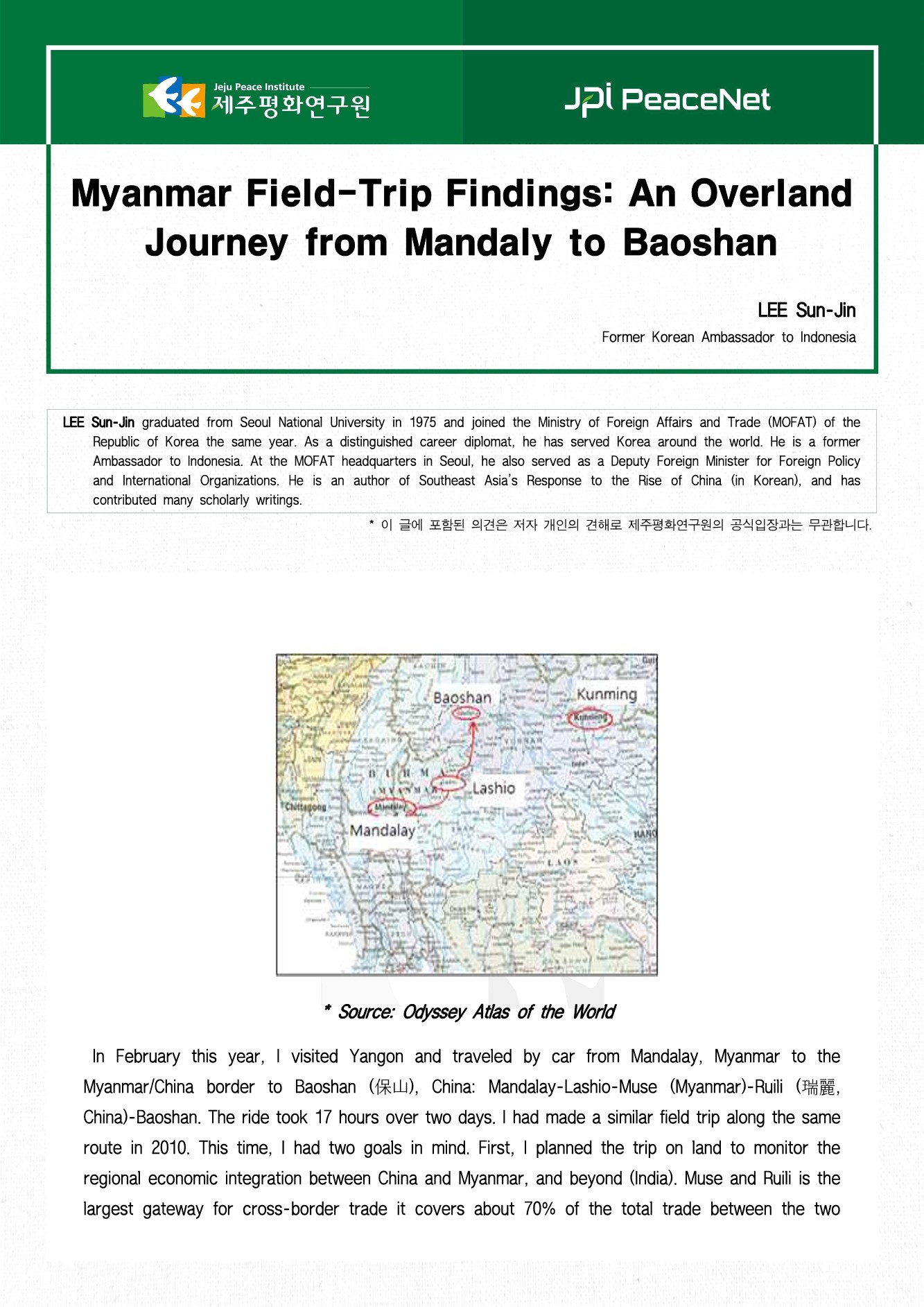
* Source: Odyssey Atlas of the World In February this year, I visited Yangon and traveled by car from Mandalay, Myanmar to the Myanmar/China border to Baoshan (保山), China: Mandalay-Lashio-Muse (Myanmar)-Ruili (瑞麗, China)-Baoshan. The ride took 17 hours over two days. I had made a similar field trip along the same route in 2010. This time, I had two goals in mind. First, I planned the trip on land to monitor the regional economic integration between China and Myanmar, and beyond (India). Muse and Ruili is the largest gateway for cross-border trade it covers about 70% of the total trade between the two countries. In addition, I wished to investigate hearsay reports on the large-scale projects that are currently being pursued by China in Myanmar. Findings (1) Myanmar-Kunming (昆明) Pipeline Construction in Progress. I witnessed many constructions sites, which were very close to the road: some within 100 meters or 1-2 kilometers away from the road I passed. Most of the sites were indeed visible from the road between “Pyin Oo Lin” (located about an hour-drive from Mandalay) to “Lashio” (located about an hour-drive before the border). I encountered repeated processions of trucks carrying construction materials such as large-sized pipes during my journey. In some sections, a pair of pipelines were completed with about 5-10 meters of space lying between them and about a half meter above the ground by my eye measurement. The pipelines have two usages: one for the crude oil imported by China from the Middle East or Africa and one for the gas explored by Korean Daewoo International in the Myanmar waters. According to informed sources, the project will be completed sometime next year, though not within the target date of May, 2013. A Chinese scholar told me that construction on the China side has already been completed. (2) Mandalay Kunming Railway Construction on Hold. Early last year, there was a news report that the government of Myanmar and China signed an agreement to build a railway connecting Myanmar and China along the pipeline route. They also agreed to improve and upgrade the existing road networks between Mandalay and Kunming. However, the new Myanmar government has not yet given a go-ahead signal. According to a rumor circulating in Yangon, China is planning to construct a railway in a space between the two pipelines, but the new Myanmar government is objecting to the idea. (3) Surge in Cross-border Trade. On the way to the border, I was amazed to witness the sharp increase in the cargo-carrying traffic on the road. In my previous trip, I had counted the number of lorry trucks (load capacity of 25 tons) coming from the opposite direction, from the border to Mandalay. The trucks carried heavy loads of international cargo (international cargo is easily recognized since it is fully covered and carried by lorry trucks). The number had been 40 lorry trucks per hour in 2010, but this time it had increased to 92. Surprised to see the surge in cargo traffic, I counted again in the afternoon. The number reached 110, which implies a two to threefold increase in 18 months since July, 2010. Trucks carrying construction materials for the pipeline project are not included in my estimates. I was told that 20-30% of shipments from China are diverted to India through Mandalay (of course, officially non-registered). Once the road connection between Mandalay-India is completed in the near future, the China-India trade via Myanmar (trilateral trade) will further expand. If the bilateral/trilateral border trade with China and India continuously grows, the Myanmar government will feel compelled to positively reexamine the aforementioned Mandalay-Kunming railway connection. (4) “Myitsone Dam” Project in Suspension In 2006, China and Myanmar signed an MOU on the hydroelectric power development project constructing seven dams along the Irawaddy River in Kachin State. The project is one of the largest dam construction projects in the world with the estimated total construction cost over USD 16 billion. However, the new Myanmar government announced the suspension of the dam construction in September, 2011 with an excuse that the local residents in the area were opposing the project. The announcement was in stark contrast with the position of the previous military junta, which had been resolute in implementing the project as scheduled. The junta had even sent a military unit to protect the construction sites where militia of the Kachin state used to enjoy self-governing power. The Kachin militia had tried to sabotage the construction and attacked military posts in defiance of the military presence in their area. Some Myanmar watchers interpret the government’s decision to suspend the project in two ways: first, the new government wishes to address the public concerns about growing economic dependency on China, and secondly, the position of the new government has become secure enough to be able to rebuff any possible counter-blow by the retired junta. (5) Democratization Process in Myanmar, “so far so good” The democratization process has been successful until now under the leadership of the highly popular President Thein Sein. A wide range of reform and open-door policies have been introduced and received favorably by the public, the opposition parties including Aung San Suu Kyi, and even the military. However, the new government is aware that such a democratization process will not be sustainable without matching economic performance. Moreover, peace accords with local militias are still volatile and many more challenges lie ahead. Myanmar Overview Myanmar is a strategic location for China China needs to cross Myanmar to reach Southwest Asia, the Middle East, and beyond. As such, the US and India will enhance their efforts to check China’s advancement in Myanmar. Under the circumstances, Myanmar will try to make use of these rivalries to promote democracy and economic development. In addition, ASEAN will also utilize the attention and assistance from the powers to promote ASEAN integration programs. Such play-making in this region could be the opening of a Pandora’s box. 이 글에 포함된 의견은 저자 개인의 견해로 제주평화연구원의 공식입장과는 무관합니다. * LEE Sun-Jin graduated from Seoul National University in 1975 and joined the Ministry of Foreign Affairs and Trade (MOFAT) of the Republic of Korea the same year. As a distinguished career diplomat, he has served Korea around the world. He is a former Ambassador to Indonesia. At the MOFAT headquarters in Seoul, he also served as a Deputy Foreign Minister for Foreign Policy and International Organizations. He is an author of Southeast Asia’s Response to the Rise of China (in Korean), and has contributed many scholarly writings. -
- 저자
- Artyom LUKIN(Far Eastern Federal University)
- 발간호
- 2011-25
러시아는 태평양 해안을 16,700마일이나 접하고 있으면서도 아시아-태평양 지역주의에 뒤늦게 동참했다. 특히, 소련(Soviet Union)은 냉전 때문에 지역적 공조에서 소외당했고, 양자 관계만 간신히 맺는 정도였다. 그러던 중 1990년대 초, 적대적 대립에 종지부를 찍으면서 러시아는 아시아-태평양 국가들의 다자간 공조 체제에 필사적으로 뛰어들었다. 그러나 아시아태평양경제협력체(APEC) 및 아세안지역안보포럼(ARF)에 가입하고 나서도 혼란한 러시아의 정국으로 인해 아시아-태평양 공조 체제의 주요 일원이 되지 못했다. 하지만 푸틴(Putin) 총리와 메드베데프(Medvedev) 대통령이 집권하면서 러시아의 국내 상황이 호전되었고 2000년대에는 선제적으로 외교 정책을 펼칠 수 있었다. 러시아가 해당 지역의 주요 안보 포럼에 참여한다는 것은 아시아-태평양 공조 체제에 회귀하였다는 방증이다. 2003년 러시아는 6자 회담의 공동 후원국이 되었다. 그리고 2010년 마침내 미국과 함께 동아시아 정상회담에 초대받았으며, 아세안 국방장관회담(ASEAN Defense Ministers Meeting)에 동참했다(ADMM+8). 이로써 러시아는 현재 모든 아시아-태평양 지역의 다자간 안보 및 정치 주체, 즉 SPT와 ARF, ADMM+8, EAS의 일원이 되었다. 러시아는 아시아-태평양 안보 포럼에 참여하는 것 자체가 확실히 자국의 의견을 천명하고 다른 나라들의 관심을 끌 수 있는 계기가 될 것이라고 보고 있다. 아시아-태평양 지역의 정치적 질서에 대해 러시아가 제시한 이상적인 모델은 이른바 다극적 협력 체제(multi-polar concert system)로, 이 협력을 이끄는 리더는 러시아이며 중국과 미국, 일본, 인도, 그리고 아마도 한국과 인도네시아가 함께 할 것으로 보인다. 러시아 정부는 6자 회담이 북한의 비핵화를 위한 외교적 측면에서 가교 역할을 해야 함은 물론 “동북아시아 지역의 안보를 정치적, 법적 측면에서 보장할 수 있도록 해야 한다”고 주장하고 있다. 동시에 러시아는 동아시아 정상회의를 통해 아시아-태평양 지역 국가들의 정치적인 공조를 옹호하고자 한다. 러시아는 아시아-태평양 지역에서 정치적으로는 상당한 영향력을 발휘하고 있지만 반면에 경제적인 면에서는 그 입지가 그다지 탄탄하다고 볼 수 없는 것이 사실이다. 러시아의 교역량은 이 지역의 총 교역량의 대략 1%에 지나지 않으며, 러시아가 유일하게 참여하고 있는 지역 경제 협의체는 APEC 뿐이다. 더욱이 러시아는 아시아-태평양 국가의 다자간 공조국이면서도 이 지역에서 자유무역협정(FTA)을 한 건도 체결하지 않았다. 이에 러시아는 아시아-태평양 지역에서 경제적으로 영향력이 점점 줄어들게 되는 것이 아닌지 위기를 느끼고 개혁을 결정한 것으로 보인다. 그리하여 2010년 러시아는 뉴질랜드와 FTA 협상에 돌입하였으며 베트남 및 싱가포르와도 FTA를 추진하기 위해 관련 조사를 실시하고 있다. 러시아가 추진하고 있는 지역 통합은 크게 세 갈래 공조 전략으로 되어 있는데 그 중 한 갈래가 바로 아시아-태평양 지역, 그리고 다른 두 갈래가 구소련연방 지역과 EU 지역이다. 러시아가 궁극적으로 지향하고 있는 목표는 구소련연방 지역을 경제적으로 재통합하는 것으로 그러기 위해서는 2011년 10월, 블라디미르 푸틴 총리가 제안한 바와 같이 유라시아 연합(Eurasian Union)의 형태를 완성해야 한다. 그러고 나서 EU와 경제적으로 통합하여 러시아의 해외 교역량을 상당한 수준으로 확보한다는 것이다. 실제로 푸틴 총리는 유라시아 연합이 “대유럽(Greater Europe)”의 일부가 되어야 한다고 주장한다. 동시에 러시아는 유라시아 연합이 유럽과 아시아-태평양 지역을 이어주는 역할을 하도록 하겠다는 큰 꿈을 품고 있다. 하지만 러시아가 경제적으로 비교 우위에 있는 틈새시장 지역이라는 것을 규명하고 이를 활용할 수 있어야만 경쟁력 있는 아시아-태평양 시장을 공략할 수 있을 것이다. 러시아가 아시아-태평양 지역과 경제적으로 통합을 이루고자 하면서, 캐나다와 호주의 경제적 통합 사례를 이상적인 모델로 보고 있다. 캐나다와 호주는 천연 자원을 대규모로 수출하면서도 이와 함께 최첨단 기술 및 과학, 고등 교육 체제 등의 혁신적인 부문을 교역 대상으로 하고 있다. 물론 러시아가 캐나다와 호주만큼 이러한 부문에서 성공을 거둘 수 있을 것이라는 것은 아직 알 수 없다. 이는 실제로 기존의 아시아-태평양 지역의 패권국들이 얼마나 러시아를 지원해 주느냐에 달려있다. 그런 면에서 중국은 이 지역에서 러시아의 주요 “전략적 파트너”라고 할 수 있다. 2010년, 중국은 독일을 제치고 러시아의 최대 교역 대상국이 되었을 정도다. 하지만 아시아-태평양 지역의 경제 공조 체제에 러시아가 참여 자격을 갖출 수 있도록 과연 중국이 지원할 것인지는 미지수다. 중국은 러시아가 원자재 공급 국가로서 상당한 가치가 있다고 보기 때문에 다른 아시아-태평양 시장과 러시아를 연계해 주기보다는 자국의 자원 조달 기지로 확보하고자 하는 데 더 관심이 있다. 아시아-태평양 지역의 주요 경제 대국인 일본도 러시아가 중국 의존도를 줄일 수 있도록 지원하면서도 정작 러시아가 이 지역에서 입지를 넓힐 수 있도록 지원하지는 않는 듯하다. 물론 이는 러시아와 일본이 쿠릴열도 주변 국경 지역에서 분쟁을 일으킨 것이 주요 원인이긴 하다. 또한 이러한 정세는 아시아-태평양 지역의 또 다른 패권국인 미국과도 관련이 있다. 여기서 주목할 점은 지정학적으로 러시아와 미국이 모두 아시아-태평양 지역에 관심을 둘 수밖에 없다는 것이다. 또한 이 지역은 양국의 이해관계에 대한 상충이 가장 적은 지역이면서 양국의 이해가 양립할 수 있는 지역이다. 이에 반해, 동부 유럽과 코카서스(Caucasus) 지역과 중앙아시아 지역에서 러시아와 미국은 파트너라기보다는 경쟁관계에 놓여 있다. 이처럼 러시아와 미국은 태평양 지역에서는 화해와 협력이 가능하다. 최근에 러시아가 동북아시아 지역에 미치는 영향력이 다소 커지고는 있지만 미국이 현재 러시아의 영향력이 상당하다고 인식하거나 향후 그럴 가능성이 있다거나 문제가 될 수 있다고 인식할 만큼은 아니다. 러시아는 이 지역에서 지정학적으로 태평양 영역을 효율적으로 통제하고자 하는 것이지 경제적 지배권을 확대하려는 것이 아니다. 미국도 이를 잘 알고 있다. 또한 중국이 성장함에 따라 이 지역의 지정학적 불확실성을 러시아와 미국이 모두 막으려한다는 점도 시사하는 바가 크다. 동북아시아와 동아시아 지역이 아시아 국가들끼리만 공조하고자 한다면, 문화적·역사적으로 아시아의 패권국이 될 수 없는 러시아와 미국으로서는 치명적인 약점을 안게 된다. 바로 이러한 이유로 러시아와 미국이 환태평양 차원에서 아시아-태평양 지역 공조를 추구하고 있는 것이다. 또한 이런 면에서 아시아-태평양 지역에 공동으로 이해관계가 있는 러시아와 미국으로서는 환태평양 권역을 이끌고 있는 APEC이 매우 적절한 명분이 되는 것이다. 더 나아가 러시아의 입장에서는 장기적으로 보았을 때 미국이 이끌고 있는 환태평양경제동반자협정(Trans-Pacific Partnership)에 참여하는 것이 아시아-태평양 지역 공조 체제에 가입하고 미국과의 관계도 돈독히 하는 데 유리할 것이라고 판단할 수 있다.이 글에 포함된 의견은 저자 개인의 견해로 제주평화연구원의 공식입장과는 무관합니다.* 現 Far Eastern Federal University 교수. 동 대학 내 Research at the School of Regional and International Studies 부소장. 주요 연구 분야는 아시아-태평양 지역과 동북아시아 지역의 안보 및 국제 정치 경제. 러시아어와 영어로 40여 편 이상의 학술 저술을 출간하였음. -
 2012 서울 핵안보정상회의: 인도의 시각 조회수 6
- 저자
- Rajaram PANDA
- 발간호
- 2012-04
2012년 3월 26~27일 이틀간 한국에서 핵안보정상회의가 개최되고 있다. 이번 정상회의에서는 테러리스트들이 핵무기를 획득하고 사용함으로써 발생하는 위험에 대해 중점적으로 논의할 것이다. 49개국의 교섭대표들이 지난 1월 16~17일 양일간 뉴델리에서 차기 정상회의 의제를 논의하기 위해 모였었다. 이 자리에서 인도 외무부 란잔 마타이(Ranjan Mathai) 장관은 “핵안보정상회의는 핵테러 위협에 대한 전 세계적인 경각심을 높이는데 그 목적이 있다”고 밝혔고 “핵안보라는 것은 근본적으로 개별 국가의 책임이지만, 핵안보의 목표 및 기준강화를 위한 국제협력이 필요하다”고 덧붙였다. 핵안보는 근본적으로 개별 국가의 책임이지만, 핵안보 강화나 불법거래 근절을 위해서는 국제협력이 필요하다. 한미 공동 주재로 핵안보정상회의 준비를 위해 뉴델리에서 개최된 사전 회의에선 서울 정상회의 참가국이 승인 할 사항에 대해 초점을 두고 논의를 이어갔다. 2010년 4월 워싱턴에서 열린 제1차 핵안보정상회의에서 47개국 정상 및 3개 국제기구(국제연합UN, 국제원자력기구IAEA, 유럽연합EU)의 대표가 국제안보의 가장 도전적인 과제인 ‘핵테러 위협’에 대해 논의했으며, 인류, 사회, 환경을 보호하기 위한 강력한 핵안보 조치를 취하기로 약속했다. 오바마 미국 대통령은 2009년 4월 프라하 연설에서 핵테러 방지를 위한 세계 정상의 단합을 촉구하고 “향후 4년 내에 전세계 모든 핵물질 사용에 대한 위험 가능성을 제거하고 핵물질을 안전하게 방호하기 위해서는 새로운 국제 공조가 필요하다”고 선언하였다. 핵안보정상회의는 국가의 수반이 참가하는 최고위급 안보회의로서, 21세기 국제안보에 가장 큰 위협인 핵테러를 방지하는데 공동의 목표를 두고 있다. 서울 핵안보정상회의 의제를 확정 짓기 위해 1월 뉴델리에서 소위 “교섭대표회의”라고 불리는 국제회의가 열렸다. 46개국 및 4개 국제기구(국제원자력기구IAEA, 국제연합UN, 유럽연합EU, 국제경찰INTERPOL)의 교섭대표가 당시 회의에 참석했다. 이 회의는 세간의 이목을 끄는 2012년 3월 ‘서울 핵안보정상회의’를 준비하는 일련의 회의 중 4번째 회의였으며, 부에노스아이레스, 서울, 헬싱키에서 열린 바 있다. 인도는 개발도상국 중 최초로 교섭대표 회의의 개최국이 되었다. 뉴델리 회의의 목표는, 테러단체의 핵무기 획득 가능성을 차단하고 세계 모든 핵물질 사용에 대한 위험 가능성을 제거하기 위해 이번 서울 핵안보정상회의에서 채택될 사안을 마무리 짓는 것이었다. 인도는 파키스탄에 있는 테러단체가 핵무기를 획득하는 것에 대해 우려하고 있으며, 특히 국가 무기고를 지키는 경비대원의 역할에 대해 염려하고 있다. 회의에 참석한 많은 참가국 대표들은 고농축 우라늄HEU은 핵무기 연료로 사용될 수 있기 때문에, 군사적 목적 이외로 전용될 가능성을 “원칙적으로” 최소화하는데 동의했다. 고농축 우라늄HEU에 대한 이번 합의는 서울 핵안보정상회의 정상합의문인 “서울 코뮈니케(Seoul Communique)”에 포함될 것이다. 서울 핵안보정상회의에서 논의될 중요 안건은 개량 핵무기를 생산하려는 과격분자로부터 방사성 물질을 안전하게 보호하는 방안이 될 것이다. 그 밖의 의제로 핵 테러 공격의 위험을 최소화하고 일본 후쿠시마 다이이치 원자력 발전소 사태와 같은 위기를 방지할 “타당하고 구체적인” 방안도 포함될 것이다. 한편 2012년 1월 발표된 텍사스 오스틴 대학의 ‘핵확산 방지 프로젝트’에 따르면, 핵확산 방지·의료·보건 관련 미국 전문가 단체에서 미의회로 보낸 서한을 통해, 무기로 전용 가능한 러시아산 우라늄으로 만든 의료용 방사성동위원소 사용 제한을 촉구했다. 또한, 늦어도 2017년까지 전면 사용 금지를 요구했다. 이 단체가 보낸 서한에서는, 러시아가 폭발물로 전용할 수 있는 우라늄을 지속적으로 활용하고 있으며 이를 통해 의료용 방사성동위원소(몰리브덴99)를 생산해 미국 의료계 동위원소 판매시장을 장악하려 한다고 폭로했다. 이 단체는 러시아의 이러한 조치가 미국의 정책 고농축우라늄을 사용하지 않는 원자로를 통해 의료용 방사성동위원소를 생산과 상반된다고 주장한다. 따라서 러시아의 의도가 핵 테러 위협을 증가시킬 수 있다는 것을 분명히 보여주고 있다. 이 단체의 전문가들은 2011년 11월 상원에서 승인한 법안(미국 의료용 방사성동위원소 보호법) 수정을 요구했다. 핵무기로 전용 가능한 우라늄으로 생산되지 않는 방사성동위원소를 정부가 우선적으로 구매할 수 있도록 법제화하려는 취지였다. 이명박 대통령은 정치적 결단력과 국제협력을 통해 핵 테러 및 기타 위협과 같은 어려운 도전 과제에 중대한 진전을 이끌어 낼 수 있다고 언급했다. 의장국으로서 한국은 더 나은 국제 핵안보를 위한 비전을 설정하고 그 비전을 실천할 수 있는 구체적인 수행계획을 만드는 데 총력을 기울일 것으로 보인다. 서울 핵안보정상회의는 보다 안전하고 평화로운 세상을 구축하기 위한 구체적인 성과를 거두어 낼 수 있을 것이다. 또 녹색성장과 인류 번영을 촉진할 수 있는 핵에너지의 평화적 이용에도 중점을 둘 것으로 보인다. 테러리스트의 핵물질 획득 및 사용을 저지하는 것이 이번 정상회의의 주된 목표지만, 한국이 이란과 북한 문제를 공식적으로 논의할 계획은 없는 것으로 보인다. 하지만 사실 서울 핵안보정상회의 개최만으로도 북한에 분명한 메세지를 전달할 수 있을 것이다. 북한은 미사일 및 기타 무기 관련, 가장 유력한 핵확산국가로 여겨지고 있고 시리아 같은 국가들과 핵 관련 협력을 구축하고 있다고 의심받고 있다. 한국은 북한의 새 지도자 김정은이 기존 김정일의 핵무기 정책을 변경 없이 그대로 고수할 것이라고 보고 있다. 2011년 12월 사망한 김정일은 핵무기를 한국과 미국의 침략 가능성에 대응하기 위한 북한 정부의 보험정책이자 국제사회에 경제적 원조와 안보적 양보를 얻어낼 수 있는 중요한 수단으로 여겼다. 이러한 정책은 새 정권이 들어서도 변동이 없을 것으로 보인다. 3월 정상회의 의장국으로서 한국은 차기 핵안보정상회의 의장국을 선정해야 할 것이다. 네덜란드가 2014년 3번째 핵안보정상회의 개최에 동의했다. 유럽의 중심부에 자리한 네덜란드의 위치를 고려했을 때, 적절한 선택이 될 것이다. 2014년 네덜란드에서 열릴 핵안보정상회의의 공식 명칭은 이번 서울 핵안보정상회의에서 결정될 것이다. 보다 안전하고 살기 좋은 세상을 위한 범세계적인 노력에 찬사를 보낸다. 이 글에 포함된 의견은 저자 개인의 견해로 제주평화연구원의 공식입장과는 무관합니다. * 前 Institute for Defence Studies and Analyses 연구위원. 현재 뉴델리에 기반을 두고 독자적으로 연구 활동 중. 동아시아 지역의 안보 및 전략적 사안에 연구 초점을 두고 있음. Jawaharlal Nehru University에서 박사학위를 받았으며, 총 7권의 단행본과 100여 개의 연구기사를 출간했음. -
- 저자
- Vannarith CHHEANG(Cambodian Institute for Cooperation and Peace)
- 발간호
- 2012-12
At the 20th ASEAN Summit held in Phnom Penh in early April 2012, ASEAN member states extensively discussed on the South China Sea with incremental progress in moving toward common understanding and approaches to the issue. China and ASEAN seem to share common views that Code of Conduct (COC) should not aim to solve the sovereignty dispute but it is an important instrument to promote cooperation, deepen trust, and ensure peace and stability in the region. COC is part of the implementation of the Declaration on the Conduct of Parties in the South China Sea (DOC). It needs to be progressive and incremental. The ASEAN leaders, at the 20th ASEAN Summit, reaffirmed the importance of DOC, the universally recognized principles of international law, including the 1982 United Nations Convention on the Law of the Sea (UNCLOS), and the willingness to move forward for the eventual realization of COC. The ASEAN leaders supported the convening of the ASEAN-China Joint Workshop to commemorate the 10th Anniversary of the DOC, in Cambodia, in the fourth quarter of 2012. They also looked forward to the holding of the 5th ASEAN-China Senior Officials’ Meeting on DOC and the 8th Meeting of the ASEAN-China Joint Working Group. Moreover, ASEAN Maritime Forum (AMF) and other existing ASEAN mechanisms are encouraged and believed to contribute to regional maritime security cooperation. The ASEAN Leaders shared the common views that the existing ASEAN-China Mechanisms on the DOC should be the way forward to ensure peace and stability with regard to the South China issue, and the interference from the outsiders would complication for ASEAN to address the issue on South China Sea. However, there is no consensus within ASEAN regarding whether China should be included in the process of discussion on the key elements of COC. With regards to the process of discussion the key elements of COC, there are several pending issues need to be addressed including how to define and clarify the disputed and non-disputed areas, and joint cooperation areas in the South China Sea, and whether to include dispute settlement mechanism in the COC. South China Sea issue is also discussed at different forums in ASEAN and between ASEAN with dialogue partners. In the joint declaration of the ASEAN Defence Ministers’ Meeting which is adopted on 29 May 2012, it reaffirms ASEAN Member States’ commitment to fully and effectively implement the Declaration on the Conduct of the Parties in the South China Sea, and to work toward the adoption of a regional Code of Conduct in the South China Sea that will further promote peace and stability in the region underscores the importance of freedom of navigation in, and over-flight above, the South China Sea as provided for by universally recognized principles of international law, including the 1982 United Nations Convention on the Law of the Sea (UNCLOS) and welcomes the ASEAN Maritime Forum (AMF) as a venue for enhancing regional maritime cooperation, including the proposal to convene an expanded AMF as noted by the 19th ASEAN Summit and the 6th East Asia Summit, and reinforce the ADMM’s efforts to actively participate in the Forum. For the upcoming ASEAN Regional Forum in July 2012, 21th ASEAN Summit in November 2012, and 7th East Asia Summit, South China Sea will be one of the topics for discussion and elaboration. Cambodian Prime Minister Hun Sean stated at the press conference after the 20th ASEAN Summit in Phnom Penh that South China Sea was regarded as an important wheel or instrument of building an ASEAN Community. It had become a norm for ASEAN to discuss the issue in order to promote peace and stability in the region. But he emphasized that South China Sea needed to be addressed and solved under ASEAN-China framework only. Reflecting on the past experiences, we can approach the South China Sea based on several instruments such as confidence building measures, resolving the conflict through dialogues and cooperation, promoting information sharing and transparency, implementing preventive diplomacy, linking security with economic interests, enhancing the roles of military in promoting cooperation to address non-traditional security issues, strengthening regional institution especially ASEAN, respecting international laws and regional legal instruments, and working towards the realization of the Code of Conduct. South China Sea needs to be examined in the complex connection between economic and security dimensions. Stronger economic interdependence and link between the claimant states can reduce tension. The claimant states and stakeholders of the South China Sea need to improve confidence and trust among themselves. Specific issues should be identified and discussed to find common solution based on common understanding and interests. Frank exchange of views on the issues at all tracks including track 1 and track 2 should be further strengthened. We need to solve the disputes and differences through dialogue and cooperation. Things need to be changed from zero sum game to positive sum game or win-win for all parties from blame game to frank dialogue and negotiation from sticking to position to the understanding of motivations from strategic competition to strategic and economic cooperation and integration and from nationalism to regional citizenship and interests. Both bilateral and multilateral dialogues and cooperation need to be maintained and strengthened at both formal and informal mechanisms. Full coordination between and among concerned parties is necessary. Hot line communication and cooperation between Vietnam and China is a good example. The claimant states need to exercise utmost restraints in any action that may lead to tension and conflict. The engagement of the extra-regional powers should be restricted at a certain level in order to avoid strategic misunderstanding. In order to build trust and confidence, all parties need to be more transparent in their activities in the South China Sea. Information sharing mechanism needs to be strengthened. Regional preventive diplomacy mechanism and real implementation steps should be in place in order to make sure that regional peace and stability can be surely maintained and guaranteed. The claimant states need to sustainable bilateral mechanisms together with multilateral framework in order to build trust and confidence and identify as early as possible the potential risks and differences that can stir the tension and disrupt regional cooperation process. International Law is the foundation of the international cooperation, development, management and solution of the South China Sea. As far as regional legal framework is concerned, the Code of Conduct built upon the Declaration on the Conduct of Parties in the South China Sea (DOC), is necessary since it can provide more binding legal principles to shape the behavior of the state parties in the South China Sea. The new areas cooperation should focus more on the role of the militaries such as establishing and bringing into full play the existing cooperation mechanisms among ASEAN armed forces such as ASEAN Defence Ministers’ Meeting (ADMM), ADMM Plus, ASEAN Naval Chiefs’ Meeting (ANCM), ASEAN Heads of Asia Coast Guard Agencies Meeting strengthening the capabilities and close coordination among maritime forces which include naval forces, maritime police, border guards, customs, and other forces to combat crimes at sea, while providing assistance in mitigating consequences of natural disasters establishing hot lines among navies, maritime police forces, border guards, customs to share information launching sea patrols to cope with non-traditional security issues cooperating in training and scientific research aimed at enabling the capacity to cope with maritime security challenges providing assistance in logistics and technical equipment, improving the capabilities of armed forces to tackle maritime security challenges and conducting regular search and rescue exercises. 이 글에 포함된 의견은 저자 개인의 견해로 제주평화연구원의 공식입장과는 무관합니다. * Vannarith CHHEANG is Executive Director of the Cambodian Institute for Cooperation and Peace. A graduate of the Institute of International Relations in Vietnam, he received his MA in international relations from the International University of Japan and his Ph.D. in Asia Pacific studies from the Ritsumeikan Asia Pacific University. His research interests include international relations in East Asia and the Cambodian political economy. -
- 저자
- LEE Sang-Hwan(Hankuk University of Foreign Studies)
- 발간호
- 2011-26
Today, issues related to energy, the environment, and bio security are becoming a focus of attention in the international community. During the 20th century, national security for survival was a matter of urgent necessity. In the 21st century, human security related to the quality of people’s lives, such as the stable securing of energy, food, and water resources, development of alternate energy, environmental conservation, disease control and development of new medicines, is becoming the center of attention. Especially, energy resources of which reserve is limited have become a factor that has a decisive impact on the fate of countries in matters related to economic development and the expansion of military power needed to protect their sovereignty. An increase in supranational environmental threats caused by the consumption of energy resources is gradually giving rise to conflicts between countries and presenting threats to humankind. Under such circumstances, sustainability conflicts over countries’ competition to secure energy, environment, and bio resources have emerged as an important subject for international discussions in the 21st century. Thus, we should note the fact that disputes and conflicts are mounting over issues related to the environment and energy, food, and water resources of which impact on humankind is only increasing in the 21st century. In the post-Cold War period, disputes attributable to ideological conflicts have noticeably decreased. However, conflicts over energy, environmental and bio resources, particularly in Africa, Latin America, and Asia, continue to increase. Matters concerning limited resources and the increase in conflicts related to them are important problems that should be solved for a Sustainable Global Society. In regard to energy conflicts, domestic, regional, and international conflicts are occurring due to the need to secure and manage energy resources, such as petroleum and natural gas, and non-energy resources, including metals, and some of them are on the verge of a physical clash. International competition for securing energy is compounded by newly emerging economies, such as China, Russia, India, Brazil, and South Korea, in addition to advanced countries like the US, Japan, and those in Europe. Environmental conflicts are deepening between countries with a compulsory burden of reducing greenhouse gases and those without such a burden, as testified by the process of the UN Framework Convention on Climate Change. Even in the case of bio disputes, conflicts are worsening between countries, in which epidemics, such as a new strain of swine flu or SARS, have begun, and their neighboring countries. Instances of internal strife in African countries due to insufficient food and water supplies are also getting worse. Former US State Secretary Henry A. Kissinger said, “The conflict that is most likely to occur in the global village is one over fossil fuel.” Wars without weapons are being waged in global villages over production and distribution of resources as if to confirm what Mr. Kissinger said. In many countries rich in important sources, such as petroleum, natural gas, gold, or tungsten, bloody internal strife is going on between different political factions and tribes. Big resource-consuming countries put pressure on, or sometimes even invade, resource-holding countries to secure resources. Examples of big and powerful countries’ energy security policies intended to secure stable resources include the US waging wars in Iraq and Afghanistan, Russia taking measures to block the establishment of new countries near the Caspian Sea, and China cracking down on the movement of independence in the Uygur Autonomous Region of Xinjiang and Tibet in connection with a need to establish a presence in the Caspian Sea, a treasure trove of energy resources. The yellow dust from China that wreaks havoc with regions in Northeast Asia is likely to lead to environmental and bio disputes. More seriously, big and powerful countries’ energy, environment, and bio policies are clashing with each other in the course of reestablishing alliance relations aligned with their national interest. That is, sustainability conflicts are creating another Cold War. Energy, environment, and bio disputes pose a serious stumbling block to the establishment of a Sustainable Global Society and present a threat to world peace. As the 13th largest economy relying on imports for most (97%) of its energy needs, South Korea has also joined the competition for securing energy resources. More developed countries need a wider variety of mineral resources and South Korea is in a very disadvantageous position due to the lack of available mineral resources the country should rely on foreign countries for most of its strategic resources. Thus, the matter involves energy security, as energy (particularly oil) supply stability has a critical impact on the country’s economic development, operation of military power, and the peoples’ survival rights. As a country that has applied itself to industrialization over the past half-century, South Korea is faced with environmental problems due to its heavy energy-consuming industrial structure. The country may suffer a severe blow to its economy if it is subject to the compulsory burden of reducing greenhouse gases without proper measures. In Korea, as a country that signed the Kyoto Protocol in 1997, resolving problems of an increase in energy consumption and the environmental pollution associated with economic development has emerged as a core issue of new national projects. The inability to reorganize into an industrial structure centered on a knowledge-based industry with high added value will mean a free fall of the country’s economy. Without development in genetics, engineering needed to find a solution to the food shortage problem, and in pharmaceutical science and bio engineering, needed for solution of disease problems, it is likely that the country’s status will fall and the quality of Koreans’ everyday lives will worsen. Sustainability Conflicts and Importanceof Global Crisis Management If World War Ⅲ ever breaks out, it will mostly likely be caused by a sustainability conflict. Finding a solution to such a problem requires the understanding of the nature of disputes over energy, environment, and bio-related matters, which have the most conspicuous impact on the establishment of a sustainable international society. In other words, global crises that may be caused by energy, environment, and bio-related disputes should be managed well in conjunction with a need to maintain a sustainable international society and for efficient joint use of energy, environmental, and bio resources. That way, the world will continue to enjoy sustainable development and maintain peace by maintaining human security. 이 글에 포함된 의견은 저자 개인의 견해로 제주평화연구원의 공식입장과는 무관합니다. * Dr. LEE Sang-Hawn is Professor of Political Science & Diplomacy at Hankuk University of Foreign Studies and the Director of the Institute of Global politics of the same university. He received a Ph.D. in politics from Michigan State University. He currently serves as a policy adviser to the Ministry of Unification, a publication directors at the Korean Association of International Studies and a director at the Korean Political Science Association. He has also served as a Presidential advisor for diplomatic and security matters. -
- 저자
- BYUN Dae-Ho(Jeju Peace Institute)
- 발간호
- 2012-11
The 7th Jeju Forum for Peace and Prosperity will be held May 31 through June 2, 2012, in Jeju, designated as “Island of World Peace” by the Korean Government in 2005, where many summit meetings and important international conventions take place. The main theme of the 7th Jeju Forum is “New Trends and the Future of Asia” and there will be more than sixty sessions, with more than 2,000 participants, to discuss various issues related to peace and prosperity in Asia and Pacific. Based on the key concept of the Jeju Peace Declaration adopted at the First Jeju Forum in 2001, which recognized that “peace is a prerequisite for common prosperity, but also that sustained and stable peace can only be achieved on the basis of common prosperity,” the 7th Jeju Forum will analyze and evaluate the international political, economic, business, social and cultural trends in the region, try to find best practices and materialize international cooperation for the future of Asia. The 7th Jeju Forum will include various topics for peace and prosperity: nuclear non-proliferation and the peaceful use of nuclear power, Korean reunification, democracy and human rights in Asia, energy cooperation and peace in East Asia, international aid, transportation cooperation, international cooperation for environment and ecological conservation, fusion of Asian culture and community building, IT and business strategy, tourism, education, gender and disabled problems, etc. Five incumbent and former Heads of Governments in Asia and Pacific countries will be present and discuss, in depth, new Asian community building trends, future visions of Asia, and the role of Asian leaders at the World Leaders’ Session of the Jeju Forum. To celebrate the 20th anniversary of the establishment of diplomatic relations between Korea and China, a special session by the Korean and Chinese diplomats will be held to recollect the negotiation process for the opening of the diplomatic relations between the two countries in 1992 and to find ways to enhance mutual cooperation in Asia and the world. As in the previous Jeju Forums, more than 250 renowned international and Korean experts of various fields in peace, security, economy, environment, culture, gender, science and technology will participate in the sessions. In addition, to expand the geographical horizon of the Jeju Forum, a session on cooperation between ASEAN and the Northeastern Asian countries is planned for the Asia and Pacific countries’ ambassadors in Korea. In sum, the 7th Jeju Forum is a continuation of previous Jeju Forums which have achieved great success thanks to the active participation and contribution from regional and world political, governmental, social and business leaders. It aims to be truly a comprehensive international forum for regional cooperation without any issue limit this is a part of the Jeju Peace Institute’s effort to realize the Jeju Process proclaimed in 2007. The Jeju Forum for Peace and Prosperity, originally started as the Jeju Peace Forum in 2001 as a venue for Asian leaders to jointly promote common peace and prosperity in East Asia, has now established itself as one of the Korea’s most important international conferences. In order to develop the Jeju Peace Forum as one of the top comprehensive international forums in Asia, it was renamed as the Jeju Forum for Peace and Prosperity at the 6th Jeju Forum in 2011 and it was decided to be held as an annual event beginning with this year’s 7th Jeju Forum. The Jeju Process was initiated at the 4th Jeju Peace Forum in 2007, when the participants approved the Jeju Declaration with an urgent task: “To ensure a lasting, flexible, and evolving process of dialogue and negotiation between the states, peoples, and public and private institutions of the Northeast Asian region, we advocate a new Jeju Process, modeled on and drawing on the valuable lessons of the Helsinki Process.” While the Helsinki Process contributed much to the security cooperation in Europe during the Cold War, the Jeju Process is trying to become a model of multilateral security cooperation, enhancing transparency and building trust among countries through continued dialogue. Nevertheless, considering the vastly different security and historical international cooperation environment in Asia and the Pacific region, the Jeju Process requires a different path from the Helsinki Process. There is a need to emphasize non-security dialogue for international cooperation in the region until the international political and security environment matures. The Jeju Process was a brainchild of the Jeju Forum, but the Jeju Forum provides the main tools for materializing the Jeju Process. The Jeju Forum will continue to be a key dialogue process to strengthen and to consolidate the Jeju Process, and is determined to lay a firm foundation for multilateral cooperation in East Asia. The 7th Jeju Forum for Peace and Prosperity will prove that the Jeju Process is on the right track. 이 글에 포함된 의견은 저자 개인의 견해로 제주평화연구원의 공식입장과는 무관합니다. * Dr. BYUN Dae-ho is Director for Planning and Coordination at the Jeju Peace Institute (JPI). Before joining JPI, he served at the Ministry of Foreign Affairs and Trade since 1991. He worked at the Korean Embassies in Russia, Sweden, and Romania as foreign service officer. His last position was Ambassador to the Republic of Croatia. He earned Ph.D. in International Studies from the University of Miami in Florida in 1990. -

- 저자
- LEE Dong-Ryul(Dongduk Women's University)
- 발간호
- 2011-01
The US-China Summit, which was held at the beginning of the second decade of the 21st century, became the focus of worldwide attention. At the meeting, the leaders of the two countries presented a new vision of the bilateral relationship using such phrases as "mutual respect" and "collaboration" and "the construction of a mutually beneficial partnership." Indeed, such terms emerged as summit keywords and characterized the meeting in the press. Since the beginning of 2010, following President Barack Obama's visit to China in 2009, the US and China have conflicted with each other over a series of issues including the US sale of weapons to Taiwan, President Obama's personal meeting with Tibet's spiritual leader, the Dalai Lama, the US position on China's claim to islands in the South/East China Sea, the sinking of the South Korean navy ship ROKS Cheonan, North Korea's shelling of the South Korean island Yeonpyeongdo, and US demands for monetary appreciation of the Chinese Yuan and the release of Chinese political prisoners along with Nobel Peace Prize winner Liu Xiaobo. International observers even expressed concern over the possibility of a new cold war era due to the souring of the relationship between the two countries. The Summit went a long way toward mitigating such concern and showed that the relationship between the US and China was returning to one of mutual collaboration. It is noteworthy that in the joint statement released after the summit, the United States reiterated that it "welcomes a strong, prosperous, and successful China that plays a greater role in world affairs" and China said it "welcomes the United States as an Asia-Pacific nation that contributes to peace, stability and prosperity in the region," thus displaying a spirit of mutual respect. Following the sinking of the Cheonan in March 2010, the two countries became embroiled in conflict amid the competition for greater influence in East Asia, which saw China trying to expand its regional sphere of influence and the US fighting to recover its traditional influence in the region. The Summit showed that the two countries were willing to meet halfway, with each regarding the other as a necessary partner. To summarize, the summit showed that both countries believe the rivalry for influence in the region will go nowhere towards their respective national interests. China should continue to build up its strength as a superpower, a process which requires collaboration with the US both realistically and strategically. For China, regime stability has emerged as one of the most important issues in connection with the forthcoming wholesale switch of power to the fifth generation of leaders in 2012. The US also needs to maintain a collaborative relationship with China, as it has a mountain of problems to resolve including Afghanistan, Iran and the recovery of the domestic economy. It can also be said that the current reality of international politics was reflected at the summit. The possibility has weakened of maintaining the international order under the leadership of a single superpower following the global financial crisis that started in 2008, while a new sense of international multilateralism led by the G2 or G20 has emerged as an alternative global governance structure. The two countries appear to have accepted that it will be difficult, realistically, for any single country to monopolize the position of leader in the international system. In other words, they appear to have accepted that they should inevitably recognize each others' status and cooperate in a grander context, although they will inevitably compete and come into conflict over individual issues from time to time. A Collaborative Relationship Hardly Guarantees Stability Still, it remains debatable whether the two countries can continue to be optimistic about their bilateral relationship Chinese Foreign Minister Yang Jiechi appraised Hu Jintao's recent visit to the US as "a trip that explored a new phase in the relationship of collaborative partnership." One can read the painstaking effort made by the two countries to show that they have reached agreement on a considerable number of areas as stated in the joint statement comprising 41 items in 6 sections. Meantime, a closer look into the contents of the joint statement shows that the controversial points that caused conflict between the two countries in 2010 remain unresolved. The two countries failed to hide the fact that they hold different views on such issues as human rights in China, Taiwan, and Tibet. In his speech in Washington DC, Chinese President Hu Jintao referred to matters related to Taiwan and Tibet as matters of Chinese territorial integrity and a "core interest" and as having to do with the sentiment of China’s 1.3 billion people. Concerning the US's demand for the appreciation of the Chinese currency, it appears that China assuaged US complaints with an offer to import USD 45 billion worth of US goods. They also appear to have reached an agreement on North Korea's nuclear program in principle, but failed to present a new, workable solution. It is not clear whether the two countries succeeded in drawing up a blueprint for the future world order at the summit despite the visions presented in the form of diplomatic rhetoric. It is thought that the two leaders met halfway, seeking common ground despite their differences, due to their respective political needs to conclude the summit successfully. Mr. Hu Jintao needed to reinforce the legitimacy and stability of the leadership of his country in connection with his forthcoming step-down as Chinese President in 2012, by reminding the world that China is emerging as a power equal to the US. President Barack Obama also needed an appraisal to the effect that the economic concessions he won from China have helped the country to extricate itself from the economic recession in connection with his forthcoming reelection campaign. Following the Summit, the two countries will move on to the path of a collaborative relationship, leaving their conflicts behind. However, it is difficult to predict whether their relationship will remain stable despite collaboration. The bilateral relationship is developing as something both vital and complex, as stated in the joint statement. Unlike the bipolar system between the US and the USSR during the Cold War era, the current relationship between the US and China is developing in such a way that their interdependence is increasing, with more incentives for mutual collaboration, but at the same time the bilateral relationship contains issues that may lead to sentiments of competition, conflict or even confrontation. The recent Summit also revealed another aspect of the complex relationship between the two countries: It is highly likely that the bilateral relationship will go through phases of competition, conflict and collaboration in the future, with the complex factors interacting among each other. Something that causes concern among Koreans is that a potential inability to accurately grasp the complexity of the relationship between the US and China may deliver an unexpected, devastating jolt as they wake up to the fact that their country has a vulnerable security structure and an easy-to-split domestic political topography. The summit dealt extraordinarily with the Korean Peninsula issue as a core item of the agenda. In addition, the two countries reached a compromise in a greater context on the Korean Peninsula issue, unlike on other controversial issues. They expressed concern over the heightened tension on the peninsula triggered by recent developments, and agreed that the critical importance of maintaining peace and stability on the Korean peninsula called for necessary steps to be taken that would allow for resumption of the Six-Party Talks process and sincere and constructive inter-Korea dialogue. In that process China agreed to include the concern over North Korea's uranium enrichment program (UEP) in the joint statement. The US even added that the expression of such concern in the joint statement laid the basis for South Korea to return to the inter-Korea talks and that the two Korea's recent agreement on the high-level military talks was an important result of the US-China Summit. It is not difficult to find traces of a give-and-take type compromise they made in connection with the need to have the two Koreas return to the inter-Korea dialogue and the Six-Party Talks. Implications of the US-China Summit We Koreans need to draw some important diplomatic lessons from and understand the implications of this summit. First, there is a greater possibility that the destiny of the Korean Peninsula may be left to the conflicts and compromises made between the US and China, regardless of what Koreans themselves really want. And we can see that basically neither of the two big countries want to see an abrupt change in the situation or further instability concerning the Korean Peninsula. The joint statement shows that the two countries are aware of the possibility that their bilateral relationship could deteriorate due to the Korean Peninsula issue. It indicates that, ultimately, China's relative influence on the Korean Peninsula issue will increase, whereas Koreans' say in issues that will determine their destiny may well decrease. In the wake of the Cheonan incident, we Koreans could not help but watch the way in which the situation on the Korean Peninsula rapidly developed into a conflict between the US and China. We should learn a sharp lesson from the fact that we had no choice but to agree to dialogue with the North in accordance with the outcome of the compromise made between the US and China. We must realize that we need to secure our own position on the Korean Peninsula issue, keeping in mind that no issue is more important than this one with regard to our own future, with the aim of minimizing the impact of the relationship between the super powers on the peninsula and of realizing the ultimate task of unification of the homeland. Concerning the forthcoming resumption of dialogue with the North, we need to bear such a lesson in mind in making well-knit preparations for dialogue and play a leading role in formulating progressive agenda items that can be effective in finding a solution to the Korean Peninsula issue. Mr. Lee is a professor in the Department of Chinese Studies at Dongduk Women's University, South Korea. Mr. Lee's publication includes "China's policy and influence on the North Korea nuclear issue: Denuclearization and/or stabilization of the Korean peninsula?" The Korean Journal of Defense Analysis, Vol.22, No.2 (June 2010),『New Areas in the Study of Chinese Foreign Policy』(Nanam, 2008), and『China's Territorial Dispute』(Northeast Asian Foundation 2008). Mr. Lee received his Ph. D. in political science from Peking University, the PRC in 1996. -
자연재해와 국제협력 조회수 6
- 저자
- 하규만(인제대학원대학교 외래교수)
- 발간호
- 2011-04
[편집자 註] 대규모 자연재해에 대처하는 국제협력에서 한국의 역할과 전략은 무엇이 되어야 하나? 하규만 인제대학교 외래교수는 작년 9월 JPI PeaceNet 기고문을 통해 자연재해와 관련된 국제협력에서 발견되는 문제점들을 지적하고 그에 대한 해결책을 제시하였다. 일본 도호쿠 대지진을 계기로 하규만 교수의 기고문을 재발송한다. 자연재해 국제협력에서 바람직한 한국의 역할과 전략에 대하여 다시 생각해 보는 기회가 되기를 기대한다. 최근에 발생한 아이티 지진, 파키스탄 풍수해 등에서 알 수 있듯이 대규모 자연재해는 피해가 거대한 지역에 미치기 때문에 재해관리를 위해서 국제협력이 반드시 필요하다. 예를 들어서 태풍이 특정국을 강타하는 경우에 다수의 주변국에도 비슷한 피해가 발생하기 때문에 자연재해의 발생 이전, 발생 기간 중, 그리고 발생 이후에도 국제협력을 추진할 필요가 있다. 자연재해 관리는 민간단체에서 시도하는 경우도 있지만 그 성격상 공공재이기 때문에 국가기관에서 총괄적인 책임을 맡고 있다. 우리나라의 경우에는 행정안전부 산하의 소방방재청이 관련된 업무를 총괄하고 있다. 소방방재청이 2004년 6월에 설립될 즈음에는 국제협력 업무가 매우 미비하였다. 어느 조직이든 설립 초창기에는 국제협력 보다는 국내적 역량강화에 집중을 하기 때문이다. 그러나 6년이 지난 지금 우리나라는 소방방재청이 주축이 되어 외교통상부가 협조하는 가운데 자연재해와 관련한 국제적 교류를 활발히 하고 있다. 예를 들면 최근에 소방방재청은 중국 쓰촨성 지진복구에 원조팀을 파견하였고, ‘제4차 유엔 재해경감 아시아 각료회의’를 국내에 유치하는 등 활발한 활동을 보이고 있다. 자연재해와 관련하여 우리 정부가 국제사회에 기부하는 액수도, 우리의 경제위상에 비해 아직도 미비하다는 국제사회의 평가도 있지만 그래도 최근에는 많은 증가를 하고 있는 상황이다. 이와 같은 활동과 노력에도 불구하고 자연재해와 국제협력에 관련하여 우리 정부는, 특히 소방방재청은 다수의 문제점을 보이고 있다. 그 중에서 거시적 차원의 문제를 다섯 가지를 소개하고 해결책을 제시해 보겠다. 첫째, 자연재해와 관련하여 우리나라는 주로 아시아 국가들과 협력을 시도하고 있다. 예를 들어서 소방방재청은 중국, 몽고, 일본, 동남아시아에 위치한 국가들과 국제협력을 서두르고 있다. 최근에 자연재해의 피해가 직접 발생하였던 중국과 몽고의 경우에 소방방재청은 지원팀을 파견하였고 현장에서 재난복구를 시도하였다. 중국의 경우에는 지진 발생 후에 구조구급팀을 파견하였고, 몽고의 경우에는 황사현상을 감소시키는 노력을 공동으로 기울였다. 자연재해가 직접적으로 발생하지 않는 이웃국가들과도 평상시에 합동세미나, 공동회의, 재난관리자 훈련, 재난관리 관련자 초청 등을 통하여 국제협력을 시도하고 있다. 이러한 경우에 이웃한 국가들과는 국제협력상 큰 문제가 발생하지 않고 있다. 국제협력에 동참한 이웃한 국가들은 우리나라의 원조에 대하여 감사를 표시하고 있기 때문이다. 그러나 우리나라는 멀리 위치한 국가들과의 국제협력을 소홀히 여기는 경향을 보이고 있다. 예를 들어서 최근에 아이티와 칠레에서 치명적인 지진피해가 발생하였는데 기부액을 포함한 우리의 국제협력이 미비한 것으로 지적이 되고 있다. 우리나라와는 달리 중국의 경우에는 아이티 공항에 비행기가 착륙하기 어려웠음에도 불구하고 대규모의 원조팀을 파견하면서 국제협력을 시도하였다. 당연히 아이티와 특히 미국의 언론에서 중국의 원조를 칭송하기에 이르렀다. 이러한 관점에서 앞으로 멀리 위치한 국가들에게도 국제협력을 시도해야 할 것이다. 왜냐하면 그것이 장기적 관점에서 재난관리 측면뿐만 아니라 국가차원의 실익 확장에 기초가 되어서 긍정적 파급효과를 가져오기 때문이다. 둘째, 우리나라는 자연재해와 관련한 국제협력을 시도하는 경우에 주로 정부기관 및 정부 인사들이 주축이 되어서 활동을 전개하고 있다. 예를 들어 소방방재청이 자연재해에 관련한 국제협력을 하는 경우를 분석해 보면 거의가 공무원 위주로 활동이 전개되고 있다. 간헐적으로 민간인이 동반되는 경우가 있지만 이러한 경우는 민간인이 개인적으로 그리고 자기조직의 재정지원으로 공무원들과 형식적으로만 동반하여 국제협력을 하는 경우이다.민간기관이나 민간인들은 업무수행능력에 한계가 있기 때문에 자연재해와 관련된 국제협력을 시도하는데 매우 큰 장애를 가지고 있다. 특히 국제협력은 경비가 비교적 많이 들기 때문에 작은 규모의 민간단체가 시도하기에는 어려움이 많은 것이 사실이다. 그러나 이들 중에서도 인류애에 기초하여 국제협력을 하고자 하는 열망을 가진 단체와 개인들이 많이 존재하고 있다. 특히 우리의 1인당 국민소득이 2만 불을 상회하는 요즘에는 이러한 국제협력 희망자들이 더욱 늘어나고 있다. 이러한 사실에 기초하여 우리 정부는 국제협력을 시도하는 경우에 정부기관뿐만 아니라 민간단체와 함께 국제협력을 시도해야 할 것이다. 특히 한국 적십자사나 기타 중요한 NGO의 경우에는 전 세계적으로 거대한 조직을 보유하고 있기 때문에 이러한 민간단체들과 함께 국제협력을 시도하는 것이 정부의 목적달성에 보다 용이할 것이다. 셋째, 우리나라는 국제협력을 시도하는 경우에 현직에 있는 인적자원만 활용하는 경향을 보이고 있다. 예를 들어서 주변국가 및 기타지역의 국가들과 국제협력을 시도하는 경우에 거의 모든 인원들이 현직에 종사하는 사람들로 구성이 되었다. 인적자원 활용의 폭이 매우 좁은 경우이다. 이러한 경우에 현직에서 물러났지만 국제적으로 중량감이 높은 인사를 동반하여 국제협력을 시도하는 것이 바람직하다. 왜냐하면 퇴직인사들도 국제사회에 공헌하고 싶어 하는 열망을 가지고 있으며, 특히 국제사회에서 여전히 영향력을 보유하고 있는 인사는 우리 나라의의 국제협력 효과를 배가시킬 수 있기 때문이다. 구체적으로 전임 대통령, 전임 국무총리, 전임 국회의장, 전임 대법원장 등을 활용하는 국제협력을 시도할 필요가 있다. 이들은 현직에서 물러났지만 전직 정치인 및 고위공무원으로서 국제사회에서 여전히 잠재적인 효과를 지니고 있다. 미국의 경우에 국제적으로 재난이 발생하였을 경우에 전임 대통령을 활용하는 경우가 매우 빈번하다. 이러한 점을 고려하여 소방방재청은 급박한 자연재해가 발생하는 경우에 특히 전임 대통령을 효과적으로 활용하는 방안을 마련해야 할 것이다. 넷째, 소방방재청의 경우 형식적으로나 실질적으로 이웃한 국가들과 국제협력은 서두르고 있으나 북한과의 국제협력은 거의 없는 것이 현실정이다. 북한과의 협력은 통일부가 총괄하고 있기 때문이다. 그러나 대부분의 자연재해는 남한에서 발생하는 경우에 북한에서도 발생하여 큰 피해를 야기시키고 있다. 하지만 북한과의 국제협력은 거의 없는 경우이다. 여러 가지 정치적 이유로 인하여 자연재해에 관하여 북한과의 국제협력이 불가능하다고 하더라도 정부는, 특히 소방방재청은 미래지향적인 차원에서 북한의 자연재해에 관하여 최소한 관련연구를 시도하는 것이 필요할 것이다. 이러한 연구결과는 통일이 되는 경우를 대비해서라도 필요한 지식자원이 될 것이다. 북한 자연재해 연구를 전담하는 팀을 새롭게 두기 보다는 기존인력과 조직으로 하여금 지금 하고 있는 연구에서 북한과의 연계성도 고려하는 연구를 하게끔 해야 할 것이다. 그것이 국제협력의 차원에서 미래지향적인 효과를 도출할 수 있을 것이다.다섯째, 우리나라가 외국에서 자연재해에 관련된 원조를 시도하는 경우에 언론매체가 이것을 보도하고 있지만 거의가 국내의 언론매체이다. 이는 국민의 세금으로 시도되는 국제협력이 안방잔치로만 끝나는 경우이다. 자연재해와 관련하여 국제협력을 시도하는 목적은 인류애에 기초하여 인명과 재산상의 손실을 감소시키려는 것이다. 하지만 다른 측면에서는 국제협력을 통하여 우리나라의 위상을 강화하려는 의도도 분명하게 존재하고 있다. 따라서 국내홍보용으로만 시도되는 국제협력은 재고할 필요가 한다. 우리 정부는 자연재해가 발생하는 지역에서 국제협력을 시도하면서 국가를 홍보하는 전략을 대폭적으로 강화해야만 할 것이다. 아이티에 지진이 발생하였던 경우에 중국은 원조팀이 아이티 공항에 도착하자마자 대형 오성기를 선두에서 들고 나가면서 아이티 원조의 구호를 외친 것으로 외신이 보도하고 있다. 또한 아이티 원조의 가장 큰 축을 담당한 미국의 경우에는 모든 주요방송사들이 아이티로 옮겨와 뉴스 프로그램을 진행하면서 미국 정부의 원조노력을 전하기도 하였다. 현재에도 파키스탄에 대규모 홍수복구를 시도하면서 미국홍보를 노리고 있다. 우리 정부도 중국과 미국의 이러한 전략을 분석하여 외국에서 자연재해가 발생하는 경우에 보다 적극적으로 우리의 노력을 국제적으로 알리려는 전략을 강화해야만 할 것이다. 이러한 전략은 소방방재청의 노력은 물론이고 외교통상부, 외국 언론사와의 사전협의에 기초해야만 가능할 것이다.이 글에 포함된 의견은 저자 개인의 견해로 제주평화연구원의 공식입장과는 무관합니다.* 하규만인제대학원대학교 외래교수 -
대북 심리전이 북한 체제에 미치는 영향 조회수 6
- 저자
- 강철환(조선일보 동북아연구소 연구위원)
- 발간호
- 2011-03
1985년경 필자가 요덕 정치범수용소에서 수감생활을 할 때 남한에서 보내는 풍선을 처음 접했던 기억은 지금도 잊을 수 없다. 갑자기 요덕 수용소 상공에 기구 모양의 대형풍선과 거기에 달린 네모난 형태의 지함이 터지면서 전단(‘삐라’)과 함께 여러 가지 물건들이 쏟아져 내렸다. 요덕 수용소 일대는 전단으로 덮였고 각종 내의류와 영양제, 육포, 라면 등 먹을 것들은 정치범들의 눈을 놀라게 했다. 이들 전단은 비도 젖지 않고 불도 붙지 않으며, 찢어지지도 않는 특수 비닐로 제작된 컬러 형태의 전단지였다.북한 체제 자체가 워낙 폐쇄된 상황인데다 수용소는 그야말로 외부와의 모든 것이 단절된 곳으로 정치범들에게는 외부의 정보는 고사하고 북한 내에서 벌어지고 있는 일조차 알 수 없었다. 그들에게 전단은 전율을 느끼게 하는 하나의 무기였고 외부와의 소식이 전달되는 유일한 수단이기도 했다. 정치범들은 남한에서 수용소가 있다는 사실을 알고 있다는 그 자체가 위안이 됐고 힘이 됐지만 국가보위부 요원들에게는 외부에서 날아오는 전단은 심각한 위협이 됐다.1987년 요덕 수용소를 출소한 이후에도 남한에서 보내오는 전단을 지속적으로 보게 됐다. 1990년 초 요덕군 읍광장에서 수천 명의 주민들이 집회를 하고 있었는데 그 위로 전단이 살포됐다. 당시 광장은 아수라장이 됐고 그 속에서 많은 젊은이들이 전단의 내용을 보느라 정신이 없었다. 국가보위부는 전단을 모두 수거하기 위해 주민들을 모두 철수시켰다. 당시 동구권 유학생들이 대거 남한으로 탈출한 사실이 전단으로 알려져 북한사회는 큰 충격을 받고 있었다.전단지의 효과북한은 극단적인 정보통제 국가로 라디오를 비롯한 일체 외부 소식을 접하는 행위 자체가 국가반역 행위로 규정돼 있다. 특히 김일성이나 김정일 등 김씨 왕조를 비판하거나 거론하는 것 자체가 죽을죄이기 때문에 북한 내에서는 김씨 왕조에 대한 그 어떤 비판적인 것을 본다는 것 자체가 충격이다. 동네 반정부 인사들이 개별적으로 낙서하거나 자그마한 전단 한 장이 붙어도 국가보위부는 총 비상 상태에 직면하게 된다.북한주민들이 전단을 보면서 가장 크게 충격을 받는 것은 첫째, 일체 거론할 수 없는 김씨 왕조에 대한 전면적 비판을 전단을 통해 한다는 것 자체가 엄청난 충격이다. 특히 김정일에 대한 사생활은 젊은 군인들에게는 충격 그 자체다. 그 많은 부인들과 화려한 음식들, 온갖 악행들이 적나라하게 알려지는 것은 김정일을 떠받들고 있는 군대가 김정일을 불신하게 하는 결정적 역할을 하게 된다. 둘째, 철저한 주민감시와 통제로 집단행동이 불가능한 북한 내부에서 주민들이 김씨 왕조를 반대해 들고 일어날 수 있는 분위기를 만들어주고 있기 때문에 정권에는 큰 위협이 될 수밖에 없다.1997년 출범한 김대중 정부는 북한의 김정일로부터 대북 심리전을 중단해야만 모든 남북관계를 개선할 수 있다는 제안을 받고 전단 살포를 중단하게 되는데 이는 무너져가던 북한체제를 살려주는데 결정적 역할을 했다고 볼 수 있다. 당시 전단 살포는 내륙의 수용소들에 집중되다가 평양으로 옮겨갔고, 1994년경 이후부터는 휴전선 일대에 집중적으로 살포됐다. 당시 북한은 식량난으로 휴전선 일대의 정규군단에도 식량공급이 제대로 안 돼 사실상 군대는 와해상태에 직면했었다. 그 어려운 상황 속에서 뿌려진 전단지와 식품은 북한이 자랑하는 사상적 무기를 와해시키는 결정적 역할을 하게 됐다.외부 정보와 단절돼 있던 휴전선 군단의 인민군 병사들은 남쪽에서 날아오는 전단지를 보며 체제에 분노할 수밖에 없었다. 경제적 위기 속에서 체제 붕괴에 직면했던 김정일 정권은 김대중 정부의 대북 심리전 중단으로 기사회생할 기회를 얻게 됐다.이명박 정부 이후 북한의 대남전략 변화북한은 이명박 정권 등장을 막기 위해 대남공작부서를 총동원해 한국 좌파가 집권하도록 도왔지만 결국 실패하자 한동안 충격에 빠졌고 그 이후 북한의 대남전략은 이명박 정권을 흔들고 5년 후 다시 친북적인 정권을 세우는 목표를 세우게 된다.북한은 핵실험과 미사일 발사 등을 통해 강성대국 완성을 위해 전력하면서 대남협박을 강화하게 되는데 결국 대북지원이 중단되고 국제적 고립을 자처하는 결과를 가져오게 된다. 북한당국은 지난 10년간 한국 정부의 대북지원에 도취돼 과거 10년 대아사 시절을 망각했고, 체제를 개혁하지 않고 버틸 수 있는 모든 시간과 에너지를 낭비함으로서 결국 똑같은 위기에 직면하고 있다. 북한의 이런 위기는 천안함 폭침과 연평도 도발 이후 한국 정부까지 가세한 대북 심리전이 시작되면서 걷잡을 수없는 사태에 이르고 있다.탈북자들이 한국 정부가 중단한 전단지 살포를 시작하게 된 것은 2003년부터다. 당시 노무현 정부는 2003년 유엔인권위가 상정한 북한 인권결의안에 기권하면서 탈북자들은 분노하게 됐고, 당시 탈북자들은 북한인권 단체를 결성하면서 전단지 살포와 같은 행동으로 넘어가게 됐다. 탈북 과학자 이민복씨와 박상학씨가 주축이된 전단지 살포는 원시적인 풍선에 의한 적은 규모의 전단 살포였지만 국민들의 지속적 관심이 높아지면서 상당한 규모로 발전하면서 북한 정권을 위협하기 시작했다. 북한당국은 군부를 동원해 탈북자들을 원색적으로 비난하며 전단지 살포에 극단적인 반응을 보이고 있다.이명박 정부 들어서 남북관계를 고려해 탈북자들의 전단지 살포에 대해 자제시키는 방향에서 넘어가려고 했지만 결국 북한은 천안함을 폭침시키고 연평도 도발까지 자행하면서 그에 대한 보복수단으로 대북 심리전 무기를 사용하지 않을 수 없게 만들었다. 1997년 김대중 정부 이전처럼 정부가 직접 나서서 대북 심리전을 재개할 경우 민간에서 하는 것보다 상상할 수 없는 위력이 나타날 수 있다. 일단 기구가 정교해지고 전단지 내용이나 물품 살포 등도 막대한 예산이 소요되는 것만큼 민간이 하기에는 사실 벅찬 사업이다.3대 세습 단행 이후 체제 급변사태 가능성2009년 11월 단행한 화폐개혁은 체제를 혼란 속에 몰아넣었고 시장이 무너지면서 시장상인들은 물론 국영기업소와 국가기관 외화벌이 회사들까지 모두 무너지는 결과로 이어졌다. 여기에 대외적인 압력이 가시화되면서 이중 삼중의 압력에 직면한 북한은 작년 태풍 콘파스에 의해 황해도 곡창지역의 농사까지 망치면서 식량난은 극에 달하고 있다.이런 와중에 단행한 2010년 9월 당(黨)대표자회는 체제 혼란을 가중시키고 있다. 무리하게 28세의 김정은과 김정일의 여동생 김경희 등이 인민군대 대장 칭호를 받자 군인들의 웃음거리가 되고 있다. 3대 세습은 명백한 봉건주의로의 회귀이기 때문에 인민군 병사들조차도 3대 세습을 경멸할 수밖에 없는 상황이다. 인민군대의 구호가 ‘인민을 위해 복무함’에서 ‘수령결사옹위 총폭탄이 되자’로 바뀌었고 인민의 군대에서 김정일의 군대로 공식화됐다.이 모든 것은 군대에 배급이라도 제대로 주면서 떠들면 괜찮겠지만 식량난에 군인들이 굶주림에 노출되면서 당국의 선전은 전혀 먹혀들지 않고 있다. 탈영병이 급증하고 10년 전처럼 영양실조 군인들이 창궐하면서 대북 심리전은 그 효과가 엄청나게 커지고 있다. 탈북자들이 보내는 전단지에 이어 정부차원에서 전단지 살포가 시작되자 북한은 군부의 이름을 빌어 전단 살포 근거지에 대한 조준사격 위협까지 가하고 있다.이집트에 이어 북한과 가장 유사한 독재국가인 리비아의 카다피 정권이 붕괴위기에 내몰리며 김정일 정권은 극도의 위기감에 내몰리고 있다. 특히 리비아 군부가 카다피가 아닌 인민의 편에 돌아서면서 카다피의 친위대가 인민들을 향해 무차별 살상을 벌이는 소식이 북한 내부에 전해질 경우 그 파장 역시 만만치 않을 것이다. 앞으로 벌어질 북한의 변화 중심에 인민군이 서게 되고 그들은 절대다수가 인민을 지지하지만 결국 김정일 정권에서 최대 호의호식했던 김정일 친위대와 호위부대가 끝까지 저항할 가능성이 높기 때문이다. 대북 심리전 수단은 김정일 정권에 대해 무력을 사용하지 않고 무너뜨릴 수 있는 강력한 무기이기 때문에 북한의 협박에 굴하지 말고 북한 군인들을 우리 편으로 돌리기 위해 전단지 살포는 더 강화해야 한다고 본다.이 글에 포함된 의견은 저자 개인의 견해로 제주평화연구원의 공식입장과는 무관합니다.* 북한 정치범수용소(요덕 수용소) 10년 수감. 1992년 대한민국 입국. 한양대학교 경영학부를 졸업하고 한국전력공사 3년 근무 후 2000년 조선일보 입사(정치부 기자). 현재 조선일보 동북아연구소 연구위원과 탈북자들의 싱크탱크인 북한전략센터 대표로 활동함. 저서로 『수용소의 노래』가 있음. -
한일 안보협력이 필요한 이유 조회수 6
- 저자
- 료 사하시(카나가와대학교)
- 발간호
- 2011-02
아마도 우리는 2010년을 동아시아 안보에 매우 중요한 한 해로 기억하게 될 것이다. 동해와 남중국해에서 일어나는 해상 영토 분쟁으로 인해 분쟁확대를 억지하는 메커니즘의 필요성을 진지하게 재고해야 하는 상황이다. 또한 군비 증강과 비전통적 안보에 대한 우려가 날로 높아짐에 따라 보다 강력한 역내 다자간 메커니즘에 대해 열띤 논의를 낳았다.하지만 천안함 침몰사건과 연평도 포격사태는 한반도가 뿌리 깊고 가장 위험한 불안정한 상황에 속해있다는 사실을 다시금 우리에게 상기시켜 주었다. 외견상 한국 및 일본 그리고 미국 사이에 양자간 혹은 3자간 공조를 위한 계기를 마련한 것으로 보였다. 2010년 7월, 일본 자위대 장교들은 한미 군사 훈련을 참관했고, 지난 12월 한국군 장교들은 미일 군사훈련을 참관했다. 한미일 3국의 외무장관들은 지난 12월 뉴욕에 모여 북한 도발을 반대하는 공통 입장을 보여주었고, 한국과 일본 국방부 장관들은 올해 1월에 양국의 안보 공조를 격상하겠다는 의지를 확인했다. 일본 총리도 일본의회 첫 연설에서 일본이 3자 공조 강화에 관심을 두고 있음을 표명했고, 지난 1월말 미국 태평양사령부(USPACOM: United States Pacific Command) 사령관 또한 향후 3자간 합동 군사 훈련에 관심을 표명했다.이런 일련의 움직임이 냉전 때부터 존재해온 허브 앤 스포크(hub-and-spoke) 체제를 넘는 새로운 안보체제를 동북아에 탄생시킬 수 있을까? 그리고 이렇게 새로이 강화된 파트너십을 통해 제공할 수 있는 기능은 무엇일까? 이와 동시에 일각에서는 이런 파트너십으로 인해 자칫 중국이 한층 더 북한을 지원하도록 자극하여 결국 이 지역이 양진영으로 갈라지는 상황에 처할 수 있다고 우려한다. 과연 이 주장이 정말 설득력이 있는가? 동맹국간 공조를 강화하면서도 중국과 공동으로 북한에 대응할 수 있기 위해서는 어떻게 해야 할까?지난 20년 간 미국, 일본, 한국은 명백하게 북한의 핵과 미사일 개발로 인한 안보 위협을 함께 우려했다. 하지만 3자간 메커니즘을 유지하는 데는 실패했다. 1994년 북미핵동결협약으로 1차 북한 핵위기 사태를 진정시키는데 성공한 후, 해당 3개국은 북한 문제와 관련해 협력하기 위하여 임시방편적 성격의 고위급 회담을 갖기 시작했다. 그러나 3개국 회담은 초반부터 국가별 우선순위와 대북(對北) 정책의 상충으로 난관에 봉착했다. 하지만 대포동 미사일발사와 페리 프로세스에 의해 한미일 3자조정감독그룹(TCOG: Trilateral Coordination and Oversight Group)을 결성하는데 성공했다. 공식적으로 TCOG는 1999년에 설립되었는데 조지 W. 부시 행정부가 출범할 때쯤 기능을 멈추었다. 그 결과, 2차 핵위기 때 TCOG는 북한의 행동에 대한 3자간 대응을 효과적으로 조율할 수 없었다. 일부 관료들이 예상하고 두려워한 대로, 6자회담 동안 다자간 협의로 인해 미국, 일본 및 한국 3자간 관계가 약화되었다.하지만, 오늘날 한국-일본 양국 관계 및 미국을 포함한 3자간 체제를 공고히 하는 것이 적어도 4가지 정당한 이유가 있다고 많은 이들이 주장하고 있다.첫째, 현상 유지를 추구하는 국가들간의 결속이 약해서 대북한 억지력이 약화되었고, 북한이 쐐기전략을 펼 수 있는 여지를 마련해 주었다. 연평도포격사건을 보더라도 북한의 저강도 군사작전을 억제할 정도로 대북한 억지력이 작동하지 못했다. 이는 상당히 새로운 상황이다. 더 강력한 억제 체제가 없다면 악몽으로 끝날 또 다른 북한의 도발을 저지할 수 없을지도 모른다. 옵저버의 참관 하에 이루어지는 한미 및 미일 합동 훈련은 어느 정도 상징적이고 억지적인 효과가 있지만 여전히 우리는 보다 확실한 방안을 구축해야 한다.둘째, 특히 북한의 전면적인 도발과 국내 혼란(domestic turmoil)이라는 두 개의 시나리오에 대처하려면 정책적 공조가 필요하다. 아직 가능성이 높지는 않지만 3국간 대응 메커니즘이 부재하다면 비판받아 마땅하다. 전(前) 일본외무성 차관이었던 히토시 다나카(Hitoshi Tanaka)는 3국 협력에는 북한 도발 발생 시 한국을 방어하기 위한 총체적인 긴급사태대책을 마련하는 것이 포함되어야 한다고 주장한다. 그는 또한 “탈북난민 문제를 처리하는 것과 같은 비군사적 측면”도 대비해야 한다고 지적했다. 주한미군과 한국 간의 군사 계획에 일본도 당사자로 포함시킬 수 있을 것이다.셋째로, 한미일 3개국은 미국과 맺은 동맹관계의 신뢰성을 유지하기 위해 믿을 수 있는 첩보 메커니즘을 수립해야 한다. 2006년 7월 5일 북한의 미사일 발사 직후 3자간 공조체제의 균열이 드러났는데, 한국 측 대응은 일본이나 미국보다 확실히 늦었다. 만약 북한에 의한 사건이 일어난 직후 미국 혹은 한국이 일본과의 정보공유를 결정하지 않는다면 이런 유사한 문제들이 다시 일어날 수 있다. 또한 한국과 일본의 우방국이자 동반자인 미국이 극히 중대한 안보 사건에 대해 즉시 통고하지 않을 수도 있기 때문에 한국과 일본은 신뢰성 문제에 직면하게 될지도 모른다.넷째로, 지금 현재의 모멘텀으로 인해 이번 기회가 적기이다. 2010년 사건들은 일본과 한국의 국민들에게 지역적 불안정성을 인식시키기에 충분했다. 또한 이명박 대통령은 정상회담을 위해 도쿄를 방문하고, 한국과 일본 양국은 새로운 한-일 시대에 대하여 합의할 것이다. 또한 보도에 의하면 일본 총리도 6월에 미국을 방문하여 전략적 동맹의 목적과 방식에 대한 새로운 지침을 공표할 것이라고 한다. 억지력이 발휘되려면 군사력과 준비태세에 덧붙여 상징적인 단합이 필요하기 때문에 최고위급 결정은 중요하다.2009년 9월 이후 일본의 새로운 여당인 민주당은 미국과 거리를 유지하는 것처럼 보였다. 그러나 실제로는 천안함 사태와 연평도 포격 사건이 터지자 일본 정부는 이에 신속하게 대응했고, 한국을 강하게 지지했다. 비록 언론보도에서는 마에하라(Maehara) 외무상이 북한과의 대화를 모색하고 있는 듯 보였지만 북한과의 양자간 협상에 대한 일본내 지지를 얻어 내지 못했다. 만약 북한과의 협상이 가능하다면 미국이 먼저 나서야 하고, 그래야만 한다.이번 기회에 세계 안보차원에서 양국공조를 가능케 하는 물자, 용역의 상호제공협정(ACSA: Acquisition and Cross Service Agreement)과 같은 소규모(low key) 항목을 필두로 한국과 일본 양자 간 안보파트너십이 공고해질 것이다. 첩보 공유 메커니즘도 가능성이 있다. 이와 같은 초기조치들을 넘어서 젊은 세대를 포함한 한일 간 실무급 정규회담을 시행해야 한다. 일본과 미국도 또한 “일본 주변지역의 상황에서 일본의 평화와 안보를 보장하는 조치에 관한 법(SIASJ: Security of Japan in Situations in Areas Surrounding Japan)”에 대해 추가 조치를 논의할 수 있을 것이다. 또한 3자간 긴급사태 대책수립과 합동 해상훈련을 위해 회담을 조직하는 등을 통해 미국이 참여하는 것이 핵심적이지만, 한국과 일본도 3자간 협력이 미국의 안보 약속과 이해관계를 확보하는 목적이라는 관점을 가질 필요가 있다. 이런 관점에서 지난 12월 3개국 외무장관회동에서 언급했던 동남아시아 정책에 대한 3자간 대화도 책임분담 방식으로 소중한 가치가 있다.하지만 많은 이들이 더욱 강력한 공조 체제를 수립하는 데 있어 역사문제와 중국의 우려가 장애물이라고 또한 지적한다.물론, 역사적 화해를 위한 일본 정부의 노력을 한국 국민들은 여전히 미흡하다고 생각하여 일본 자위대와 협력하는 데 거부감이 있음을 알아야 한다. 하지만 북한발 위기와 벼랑끝 행동(brinkmanship behaviors)은 긴박하며 현행 안보 체제를 강화하지 않는 한 처리하기가 어렵다. 또한 한국과 일본은 미국을 설득하여 이 사태에 공동으로 진지하게 대처하고 미국이 우방국과 공조하도록 해야 한다. 나아가서 만약 도서관 협정과 역사적 성명 등과 같은 다른 양자 협정과 이러한 안보 공조를 연계시킨다면 양국 정부는 자국 내에서 강한 압력을 받을 것이다.또한 우리는 동맹 공조와 중국의 차후 행보 간 관계에 대해 신중하게 생각해봐야만 한다. 우리는 중국의 영향력이 어느 정도일까 의아해하지만, 말할 필요도 없이 중국은 북한에 여전히 영향력을 미치는 관계를 맺고 있다. 이런 의미에서 중국이 3개국 및 유엔 안보리 결의안에 공조하도록 유도하는 것이 중요하다. 한미일 3자간 결속은 중국에 압력으로 작용할 수 있다. 왜냐하면 중국은 절대로 미국 동맹 네트워크가 이 지역 내에서 미국의 영향력을 보존하도록 공식적으로 강화되는 것을 원하지 않기 때문이다.물론, 중국을 몰아 부치는 것은 바람직하지 않다. 이런 결과를 피하기 위해 우리는 먼저 중국의 부상을 견제하려는 것이 아니라, 현재의 상황을 대처하는데 미흡한 공조 수준을 강화해서 오로지 북한의 도발을 억제하는 3자간 공조체제를 설계해야 한다. 인권문제와 민주주의를 홍보하는 것이 3자간 공조체제의 의제가 될 수 없다는 것이다.둘째로, 아시아재단(Asia Foundation)의 스콧 스나이더(Scott Snyder)는 3개국 간 파트너십은 “중국의 협력을 배제하거나 억지해서는 안 된다”고 지적한다. 중국-일본-한국의 3자간 회담과 중국과 일본 및 한국의 양자 간 회담 진척은 병행되어야 한다. 하지만 일각에서는 한국, 일본과 미국 간의 동맹 공조를 격상하면 결국 중국-북한 관계를 강화하게 될 것이라고 우려하는데 이는 너무 지나친 비관주의이다. 중국으로서는 북한과의 관계를 상징적으로 그리고 실질적으로 강화하는 것이 중국에게도 더 이상 이로울 게 없기 때문이다. 목표는 여러 채널을 통해 모든 당사국들이 합의를 도출하는 방식으로 한반도 비핵화를 향해 전진할 수 있도록 하는 것이다.후진타오 주석이 미국을 방문하고 나서 미국과 중국은 공동으로 북한과의 대화 재개 가능성을 모색하고 있다. 외교는 항상 수정주의자들을 평화적인 방법으로 설득하는 매우 중요한 도구이다. 동시에, 우리는 동맹 공조를 더 확고히 할 수 있는 모멘텀을 놓쳐서는 안 된다. 이는 우리가 오랫동안 가지지 못했던 것이기 때문이다. 또 위기가 고조되는 상황에서 우리는 우선 우리가 갖고 있는 것이 무엇인지 따져보아야 한다. 현재의 억지상황에는 해결책이 절실히 필요하기 때문이다._____*이 논문의 원제는 “Momentum for Alliance Coordinations is as Important as Negotiations: Why is Seoul and Tokyo Cooperation Necessary?” 이며 요약본이 “North Korea: Why Seoul-Tokyo cooperation is necessary”라는 제목으로 동아시아 포럼(East Asia Forum) 웹사이트에 게재되어있다. http://www.eastasiaforum.org/2011/02/09/north-korea-why-seoul-tokyo-cooperation-is-necessary/이 글에 포함된 의견은 저자 개인의 견해로 제주평화연구원의 공식입장과는 무관합니다.* 료 사하시(Ryo SAHASHI)는 일본 카나가와 대학교(Kanagawa University) 법학부 국제정치학 부교수이며 일본 국제 교류 센터(Japan Center for International Exchange)의 겸임 연구위원이다.


